
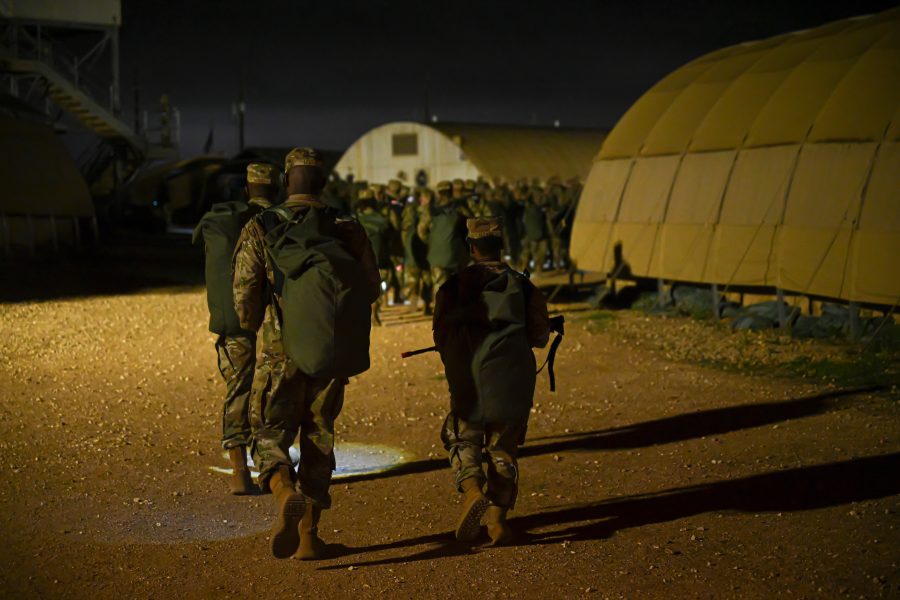
JOINT BASE SAN ANTONIO-LACKLAND, Texas—The Air Force has started challenging new trainees with less sleep and will soon ramp up the stress level in Basic Military Training to better prepare the future Airmen for the increased strain of combat operations such as Epic Fury.
The service’s 7.5 weeks of BMT already forced Airmen to endure the high stress of constant corrections, long hours of training, and sleep periods interrupted by guard duty.
But in late August, BMT officials here began an effort that will force trainees to handle additional sleep deprivation by increasing the frequency of nocturnal training. In the coming weeks, officials hope to add “stress inoculation” to the effort that’s designed to increase training stress but also teach trainees techniques to function more effectively under it, Col. Kellie Courtland, commander of the 37th Training Wing that oversees BMT, told Air & Space Forces Magazine.
Chief of Staff of the Air Force Gen. Kenneth S. Wilsbach directed BMT officials to make the new training changes after combat operations—such as the recent air campaign against Iran—showed that some young Airmen struggled under the strain of the increased operational pace, Courtland added.
The Air Force is “realizing that there are people that are not responding to being able to perform well when they’re sleep deprived, or there’s a lot of stress, … or hard events happen; they’re having a hard time recovering from that,” Courtland said. “The idea is to practice that a little bit more and get used to that level of stress and sleep deprivation because it’s going to happen at different points throughout your career but definitely when you’re out in those wartime environments.”
This is the latest change in a larger effort to overhaul BMT to instill a mindset of “airmindedness” in all Airmen to ensure they know how to work in small teams to defend, operate, generate, and sustain airpower.
Less Sleep
The first week of BMT will remain unchanged since new trainees are already “sleep deprived” from the complete culture shock of the new environment, Courtland said. Beginning in week two, military training instructors, or MTIs, will increase the amount of nighttime entry-control procedures, or guard duty, that each 60-member flight must share. In the past, shifts were two hours long. Now they are one hour each, which requires more trainees to be up on any given night.
Before “you would only have four to eight people basically getting woken up during the night that would do their entry control procedures,” Courtland said. “Now you’ve got 21 trainees that have to get up, spend an hour doing entry control procedures.”
On top of guard shifts, more nighttime training activities are added in the fourth and fifth week in the lead up to PACER FORGE, the final field training exercise that stresses trainees’ agile combat employment skills.
In the fourth week, “we will do different exercises, like maybe an accountability exercise,” said 37th Training Wing Command Chief Master Sgt. Caleb Vaden, describing how all trainees fall out of the dorm, so leaders can ensure everyone is present.
“That usually takes about an hour, and they’ll fall back into their sleeping area,” Vaden said. “Everything we do here is tied to a training objective.”
During the fifth week, trainees will see more nocturnal training events as they begin to prepare for PACER FORGE, where trainees traditionally get little sleep during the 57-hour training event, Vaden said.
“We are working on an exercise where they would fall out, work on that F-16, fall under attack, have to go to a bunker, and then they’re going to go forward to their forward site,” Vaden said. “So essentially, they’re getting additional sleep deprivation before they even get to the PACER FORGE site. We’re getting them up early, keeping them up, not letting them sleep very much. … it just keeps amping up as you get closer and closer to PACER FORGE.
More Stress
The plan to prepare trainees to endure more stress effectively is still under review, Courtland said, but the idea is to not only introduce more stress into training activities but also teach trainees techniques for recognizing and coping with extreme pressure.
“It’s more understanding how you work through stress when you are stressed out,” Courtland said. “The idea is they get stressed out more here. It’s intense. They get that stress, but then we are walking them through it— ‘hey, you probably felt really stressed in that moment, here’s something you could have done, or here’s something that may have helped.’”
For example, trainees may be taught to use box breathing, a technique that uses equal counts of inhaling, holding, exhaling, and pausing to calm the nervous system, said Courtland, who would not discuss the list of techniques that is currently under review. If all goes well, the new stress portion of training could be approved by the end of September, she added.
“At the same time that we’re teaching them how to deal with stress, we are going to be turning up the stress and turning up the intensity,” she said.
MTIs will use regular after-action reviews of training events to ensure trainees understand how the increased stress affected their performance, Vaden said.
“I will more than likely see degradation in teamwork. I’ll see degradation in leadership. I’ll see degradation in situational awareness; I’ll see degradation in a lot of things,” Vaden said. “We’re just going to use those performance measures when we’re assessing.”
Courtland added that the success of the effort will involve seeing if trainees use the new stress techniques under increased pressure. “The goal is to teach them the tools, stress the hell out of them, and see if they know how to use the tools correctly.”
In other changes to BMT, training officials have partially completed a portion of the new air base training range that includes a non-flying F-16 Fighting Falcon. Trainees have begun learning and practicing how to re-arm the fighter with mock AIM-9 Sidewinder missiles and other training munitions that mock Advanced Precision Kill Weapon System rockets. The new air base training range will soon include two retired C-130 Hercules aircraft which arrived here in August.