
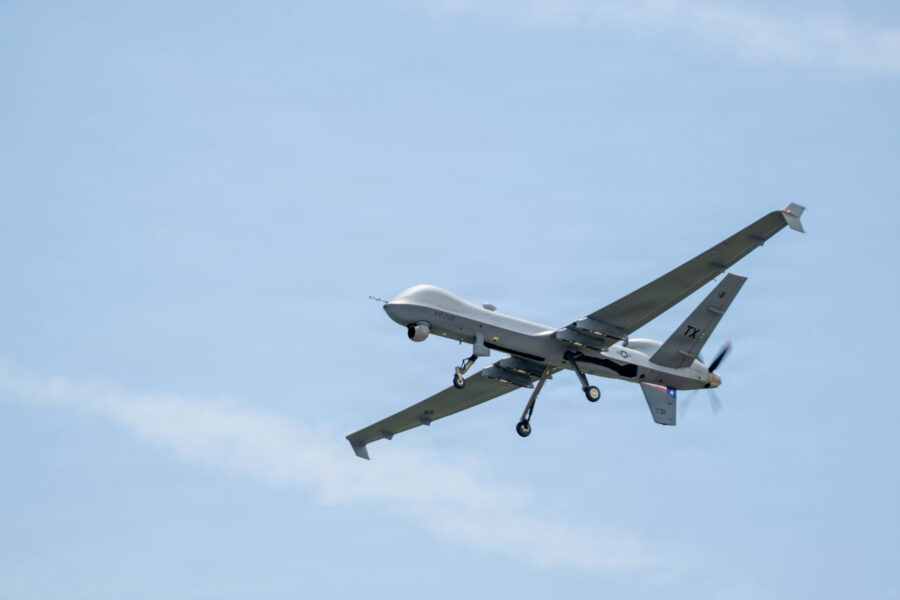
The Air Force is accelerating its plans to field an MQ-9A replacement in the wake of heavy Reaper losses in operations against Iran, top officials said Sept. 3, and they’re targeting a price point of just $10 million per aircraft.
Back in July, the Air Force and the Defense Innovation Unit announced plans to develop a low-cost drone to do all the missions that an MQ-9 can do today, and when necessary fly in groups to overwhelm an enemy’s anti-drone capabilities and force them to expend large numbers of munitions. They called the effort Massed Modular Aircraft, or MMA.
At the time, officials said they wanted to have a prototype to test fly within 21 months of a contract, and then 20 mission-ready aircraft by fiscal 2031 to achieve initial operating capability.
Now, though, officials are targeting a more ambitious timeline. During a media roundtable at the Pentagon, DIU military deputy Maj. Gen. Joseph Kunkel said the MMA program will try to follow DIU’s typical timeframe of prototyping a system within a year of a contract, and then fielding it at scale within three years—as soon as 2029.
Lt. Gen. Christopher Niemi, the Air Force’s new chief modernization officer, said those goals changed “fairly recently,” when Air Force Secretary Troy Meink “called us in and said ‘You need to move faster.’”
That urgency, Niemi acknowledged, came at least partly in response to the significant losses the MQ-9 fleet has taken in the past year or so during operations against Iran and Iranian-backed militias. Since the start of the Iran war, the Air Force has lost at least 45 MQ-9s, roughly a quarter of its fleet. The service was already thinking about what it needed to succeed the MQ-9 as a medium-altitude intelligence, surveillance, and reconnaissance platform, but Niemi said the combat losses pushed it to move faster.
“Although we have plenty of MQ-9As today, we are going through them at a rate that is concerning to us,” Niemi said.
Replacing, Not Reinventing, the MQ-9
The MQ-9 has long been a workhorse of the Air Force fleet, valued by combatant commanders for its long endurance, loitering ability, and ability to combine strike and intelligence, surveillance and reconnaissance capabilities. Air Force Chief of Staff Gen. Kenneth S. Wilsbach called the Reaper the “most valuable player” of Operation Epic Fury in a May congressional hearing.
Unsurprisingly, then, officials said they were eager to replace the ones lost in combat. Niemi said the Air Force has “spent a lot of time and energy” in recent months trying to figure out how to do so and found “there’s not a lot of good options to immediately replace those aircraft.”
The Air Force considered General Atomics’ MQ-9B, a larger and more complex—and more expensive—version of the MQ-9A, Niemi said. Ultimately, officials concluded the MQ-9B was not the right choice because the Air Force needed something more “attritable,” or inexpensive enough to be fielded in large numbers and easily replaced if lost in combat.
“If you don’t like losing an MQ-9A that cost on the order of $50 million, with the sensors, you’re probably not going to like losing an MQ-9B at a higher price point,” Niemi said.
For that reason, the Air Force decided to go all-in on the MMA concept. The Air Force plans to field at least 180 of the drones, Niemi said, but probably more than that.
In order to move fast and keep costs down, Niemi said the Air Force plans to “accept prudent risk” on the MMA program. Kunkel also said the Air Force wants “significantly increased levels of competition” to keep costs down.
As the Air Force wrote out what attributes MMA drones would need, Niemi added, it tried to allow as much flexibility as possible and not include hyper-specific requirements that “push technology to the very edge.”
“When that happens, you’re going to pay a lot for it, because it’s hard to do,” Niemi said. “It takes a lot of engineering, cutting-edge science, emergent technologies, things like that. So we’re trying to be more aligned with sort of an ‘80 percent is good enough,’ [using] mature technologies” approach.
That means MMA won’t have the latest and greatest flight control systems, engines, or manufacturing processes, he said—and they’ll actually resemble the MQ-9 in some key ways: they’ll likely have long-aspect wings and will likely be powered by turboprop engines.
One way officials are looking to differ from the MQ-9, though, are higher levels of autonomy and automation than the MQ-9A has today, Niemi said—“more mouse clicks and keyboard strokes instead of a stick and throttle.” That will reduce the number of Airmen needed to operate MMA drones and allow a single Airman to operate multiple drones simultaneously.
At the same time, Niemi said MMAs won’t have the same level of autonomy as the Air Force’s flagship autonomous drone program, Collaborative Combat Aircraft.
“It’s not going out and autonomously finding targets and employing weapons,” Niemi said of the MMA drone. “It’s more like a truck that’s carrying packages, whether it’s a sensor package or whether it’s a weapon, to a point where it can be employed.”
CCAs and MMAs
While CCAs and MMAs will both be unmanned and have some kind of autonomy software, Niemi was quick to note there will be major differences between the two.
“They’re going to look very different,” Niemi said. The MMA is “going to look like an MQ-9, and [CCA is] going to look more like a fighter, like you’ve seen in the current too CCAs that we’re flying.”
The Air Force wants MMA drones to be able to fly about 4,000 miles—more than twice the expected range of autonomous Collaborative Combat Aircraft drones—and carry a heavy payload, although they will be slower than CCAs, Niemi said.
Those differences extend to price, too—while the Air Force is targeting $10 million for an MMA drone, it’s hoping for $20 million per CCA once they reach full production. Those costs are for just the base aircraft, excluding sensors, weapons or other equipment that might be loaded onto them.
From an acquisition perspective, the Air Force is hoping to use the same methods across the CCA and MMA programs to keep costs down and production simple.
That includes moving quickly to award contracts and keeping several vendors on contract to provide a variety of drones. Like CCAs, MMA drones will also use open architecture, Niemi said. That will ensure the drones have standardized interfaces and could be easily upgraded with newer sensor packages or weapons capabilities, even from different vendors, he said. This would also allow MMAs to be tailored with the gear needed for a particular mission.
“If you want to build a package that’s going to go on this new aircraft, as long as it conforms to this [standardized interface], we can do it very speedily and very readily,” Niemi said. “That’s something we struggle with at the opposite end of the spectrum, something like the F-35, where it’s very very hard to incorporate new things onto it, because of the construct and the architecture of that system.”
The Air Force also wants manufacturers to be able to produce MMA drones in large numbers, Niemi said, but also be able to ramp production up or down as needed, such as if the Air Force started losing large numbers in a heated conflict. Keeping MMAs simple is the best way to ensure that production flexibility, he said.
“If you wanted to suddenly ramp up production of something like an F-35, it’s not a limiting factor so much as money, as the ability to build out your production capacity and actually crank more of those things out,” Niemi said. “And the more complex the aircraft, the harder that problem is. … In major combat operations, depending on who you’re fighting, we could be losing dozens [of MMA drones] a day, and so you have to figure out how do you adjust the industrial capacity in order to make [necessary production levels] happen.”
General Atomics, which also makes the MQ-9, is planning to pitch a newly designed drone it calls Wildfire for the MMA program.
“Our new Wildfire aircraft addresses all of the concerns posed by the MMA solicitation,” General Atomics spokesman C. Mark Brinkley said in a statement to reporters. “We can deliver years earlier and maintain the same high quality. You can have everything that makes Reaper special, plus more, at a price that doesn’t break the bank.”