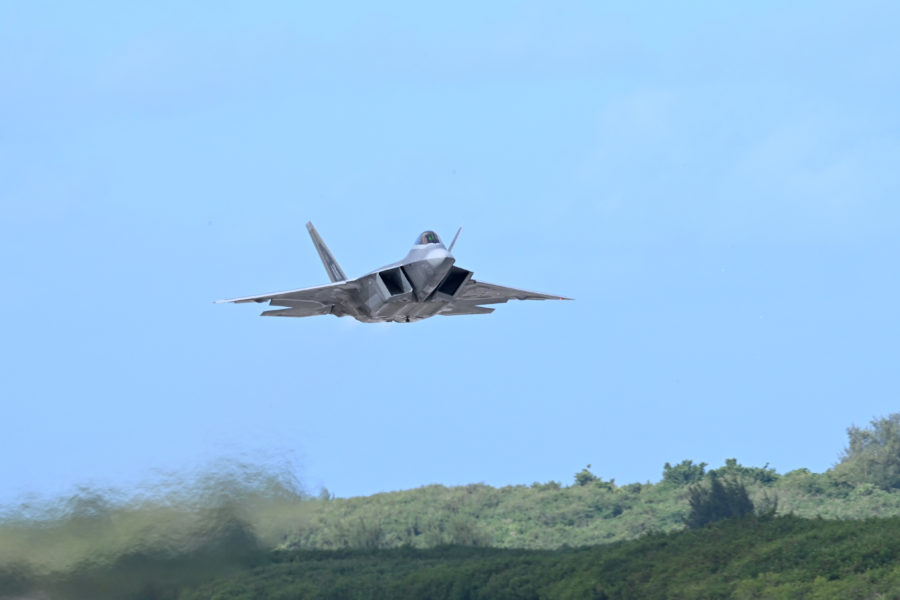
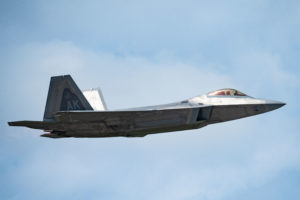
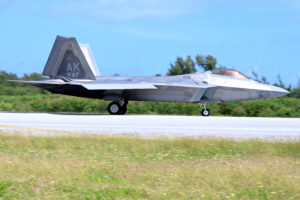
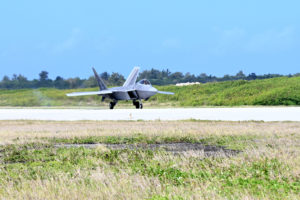
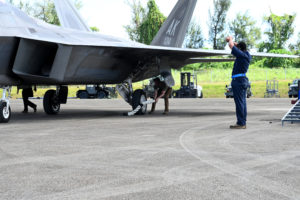
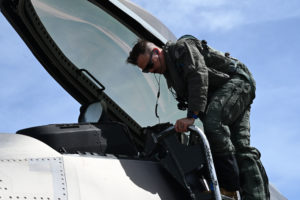
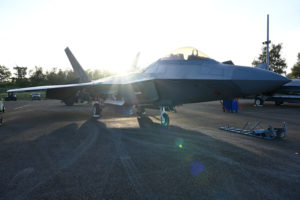
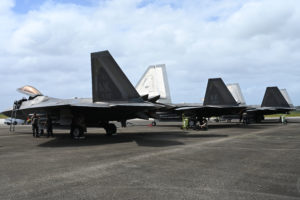
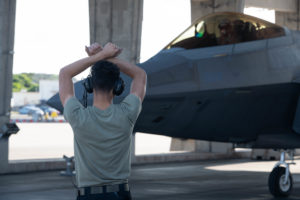
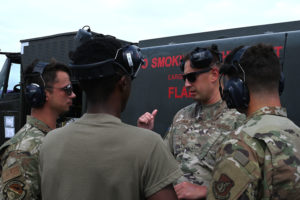
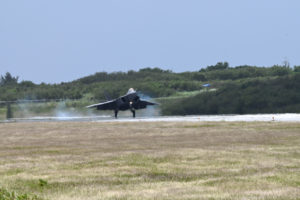
An F-22 Raptor assigned to the 525th Expeditionary Fighter Squadron, Kadena Air Base, Japan, launches from Tinian International Airport, Northern Mariana Islands, during Exercise Agile Reaper 23-1, March 2, 2023. U.S. Air Force photo by Tech. Sgt. Hailey Staker
Audio of this article is brought to you by the Air & Space Forces Association, honoring and supporting our Airmen, Guardians, and their families. Find out more at afa.org
For the first time, F-22s have deployed to the U.S. territory of Tinian, a small island around 100 miles north of the American military hub of Guam. The rotation of Raptors, which began March 1, is part of an exercise dubbed Agile Reaper 23-1.
Over the first week of March, the Air Force will conduct flight operations from Tinian with F-22s from Joint Base Elmendorf-Richardson (JBER)’s 525th Expeditionary Fighter Squadron of 3rd Air Expedtionary Wing. The unit deployed to Kadena Air Base, Japan, in late 2022 to replace aging F-15 Eagle fighters.
“For them to come support this exercise shows how agile we truly are,” Col. Kevin “Jinx” Jamieson, the commander of the 3rd Air Expeditionary Wing, told Air & Space Forces Magazine in an email.
Wargames have shown U.S. air bases in Japan and Guam would likely be targets should the U.S. be drawn into a conflict with China. Service officials believe the U.S. needs more airfields in the Indo-Pacific to counter the threat of Chinese cruise and ballistic missiles and have introduced the concept of Agile Combat Employment, known as ACE, to meet the threat.
“Guam and the Northern Mariana Islands are a strategic location that requires agility to defend if we find ourselves in a contested and degraded environment,” Jamieson said, adding that the excercise will give his team “a sense of reality and to rehearse in an environment that will likely challenge us real world.”
Having Tinian temporarily host American aircraft is not new—the U.S. first began using the island to launch warplanes after seizing it in World War II. It is, however, novel ground for the F-22, America’s premier air-to-air fighter.
In February, Tinian, one of the three main Northern Mariana Islands, hosted Air Force F-35 Lighting II fighters as part of exercise Cope North. The F-22’s operations at Tinian International Airport, which has just a single runway, mark the second time in less than a month that American fifth-generation stealth fighters have deployed there.
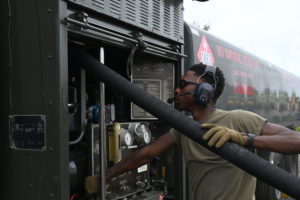
Crews on Tianan turning around F-22s so that they can flew sorties in the area’s training area, the Mariana Islands Range Complex (MIRC), which Jamieson called “an operationally relevant environment.”
F-22s will operate with maintenance personnel and other ground crew in the Northern Mariana Islands but receive support from additional aircraft flying out of Guam, including KC-135 Stratotanker refuelers, C-17 cargo planes, and a E-3 Sentry AWACS aircraft.
“We are operating as a hub-and-spoke which is a major element within the ACE operational framework,” Jamieson said. “The hub is located at Andersen AFB here at Guam and the spoke is operating out of Tinian International Airport.”
JBER’s aircraft are part of Pacific Air Forces, but its F-22s deploy around the world, from the Middle East to Europe, and have now set up operations at Kadena on a rotational basis. Nevertheless, its Airmen still call Alaska home.
“From 10 degrees and snowing, to 90 and raining, Airmen from the 3rd AEW will use [Agile Reaper] 23-1 to practice and validate new ways to deploy, maneuver and project power,” JBER said in a March 1 news release.
In addition to the F-22s, the C-17s in the excercise are also from JBER as well Joint Base Pearl Harbor-Hickham, Hawaii. Guam is roughly 4,000 miles west of Hawaii and more than 4,500 miles from Alaska, but long-distance missions are commonplace for C-17s.
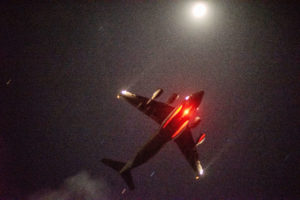
Though not part of the Agile Reaper exercise, operating from short and rough runways is one of the elements of the ACE and something the C-17 was designed to do. So to put the aircraft and Airmen out of their comfort zone, some C-17s participating in Agile Reaper have already conducted flight operations out of Anderson under minimal light with air traffic controllers wearing night vision goggles.
The Air Force says Agile Reaper is a prime test for “ACE’s hub and spoke frameworks by only employing bare-necessity, mission essential personnel and equipment to operate in a degraded environment.”
Audio of this article is brought to you by the Air & Space Forces Association, honoring and supporting our Airmen, Guardians, and their families. Find out more at afa.org
Air Force depots are not typically meant for quick repair jobs, but during Operation Epic Fury, the service moved some of its stateside heavy maintenance capability forward to fix battle-damaged aircraft closer to the fight.
The 55th Wing officially retired the EC-130H Compass Call aircraft in a ceremony Sept. 18 at Davis-Monthan Air Force Base, Ariz., while the 355th Wing there retired its final A-10 Warthog, another major transition for the base.
As the threat of Iranian-made drones grew, the Air Force rushed last year to equip F-15E Strike Eagles in the Middle East with a cheap, cost-effective way of defeating them. The service fielded the new capability in roughly a week.
An F-16 Fighting Falcon assigned to the Texas Air National Guard’s 149th Fighter Wing crashed during a training mission in Michigan on Sept. 17. The fighter's sole pilot ejected and is in stable condition at a local hospital.
The Air Force’s new Collaborative Combat Aircraft will take part in their first large-force engagement exercise in December, the head of the drones’ Experimental Operations Unit said Sept. 15.
The Pentagon announced a deal with Lockheed Martin on Sept. 17 to expand production of the AIM-260 Joint Advanced Tactical Missile, an advanced new Air Force and Navy air-to-air missile meant to equip fifth- and sixth-generation fighters.
Lockheed Martin has unveiled its concept for a modular version of one of the Air Force’s main air-to-ground cruise missiles, opening up a range of possible upgrades and uses for the weapon.
The Air Force will consider acquiring new F-16 Fighting Falcon jets to answer capacity shortfalls in its aging fighter fleet, according to multiple people familiar with the matter. These discussions are happening as the Air Force is building its proposed fiscal 2028 budget and the five-year spending plan that goes…
✓
Thank You!
Check your inbox to verify your email address and finish setting up your AFA account.
★
Welcome Back!
An account with this email already exists. Please log in to continue.
Subscribe to the Air & Space Forces Daily Report
The latest news from Air & Space Forces Magazine, as well as news from other leading publications, delivered right to your inbox every morning!
We’re sorry, there has been an error. Please review your input or try again later.