


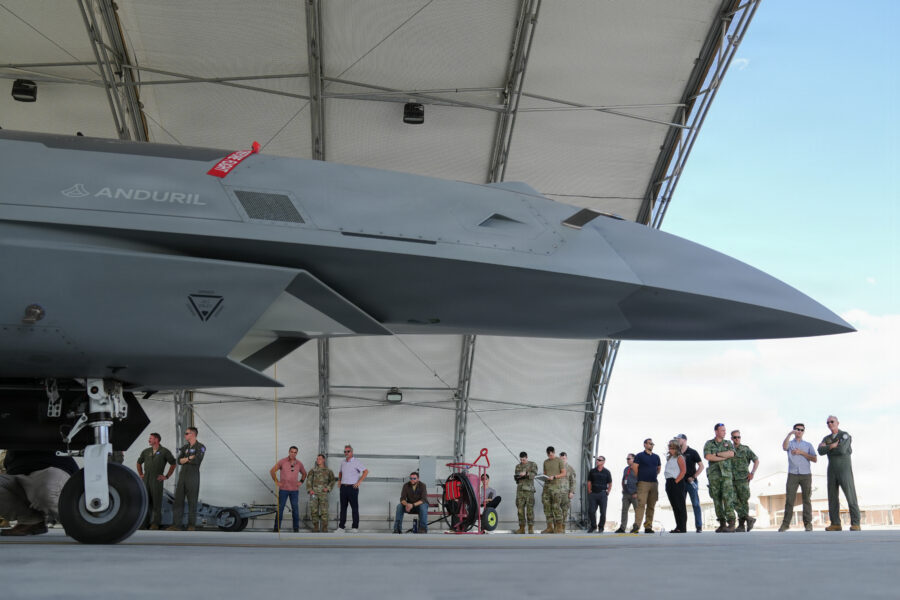
NATIONAL HARBOR, Md.—The Air Force’s new Collaborative Combat Aircraft will take part in their first large-force engagement exercise in December, the head of the drones’ Experimental Operations Unit said Sept. 15.
The Emerald Flag exercise, which will take place at Eglin Air Force Base in Florida, will be CCAs’ “first dip of the toe in an actual force integration,” Lt. Col. Lyndon Bartlett, commander of the unit, said in a panel at AFA’s Air, Space & Cyber conference.
Flying CCAs alongside manned fighters will help build the foundations necessary to one day use them in real-world operations, Bartlett said.
“That will, in [my] mind, be the first time that we will ever do some CCA end-to-end kill chain live,” Bartlett said. “That’s the first time we’ll ever be integrated in a fourth- and fifth-gen combined [offensive counter-air] push. It’ll be small, but those type of building blocks are where, I think, you get the intangibles like trust in the CCA.”
CCAs are semi-autonomous fighter drones that will, in some cases, fly alongside crewed fighters such as the F-35 or the upcoming F-47, and be directed by those fighters’ pilots using a tablet interface. The Air Force wants to have at least 500 CCAs by 2032, and plans a total fleet of 1,000 or more. So far, the service has committed to buying two CCAs—General Atomics’ FQ-42A Vengeance and Anduril Industries’ FQ-44A Fury—but more are planned.
Since the EOU was stood up at Creech Air Force Base, Nev., in June 2025, it has flown and experimented with CCAs to figure out how Airmen can best use them in combat.
During that time, Bartlett said, the EOU has been “pleasantly surprised” to learn how easy CCAs are to maintain and how small of a footprint they require to operate and sustain.
In a series of recent Agile Combat Employment exercises, he said, “we’re at a one-to-one maintainer-to-airplane ratio, which is crazy small.”
That simplicity will make it easier to have “cross-functional” Airmen take on work generating CCA sorties, even if those duties aren’t in their normal career fields, Bartlett said.
“Because [CCAs are] a little bit simpler, because their role is so focused, what we found … any [Air Force Specialty Code] can be trained to generate sorties, to load weapons,” Bartlett said. “We’ve done some of those things already, and we’re going to do a lot more experimentation over the next couple of years.”
Brig. Gen. Timothy Helfrich, the portfolio acquisition executive for fighters and advanced aircraft, also said at the panel that the EOU is flying CCA aircraft “multiple times a week.”
Jason Levin, Anduril’s senior vice president of engineering, said the company delivered its FQ-44 Fury drone to the EOU in August. And in recent months, the process for operating Fury has been streamlined to the point where “it’s down to a single operator flying a Fury from a laptop,” Levin said.
“They were doing disaggregated operations, flying from multiple locations,” Levin said. “They were doing hot reloads on Fury, so getting it down from hours down to single-digit minutes to turn the jet. They’re really pushing the envelope, flying with mission autonomy. It was the first time Air Force operators were flying with mission autonomy on Fury multiple times a day, in the airspace with crewed fifth-gen fighters, other CCAs, starting to build that trust.”
David Alexander, president of General Atomics Aeronautical Systems, said that once a foundation has been built for Airmen to autonomously use CCAs and they are comfortable, the program can focus more on Agile Combat Employment operations, where aircraft are flown from smaller, potentially austere and isolated bases, without the same level of support a larger base might have.
At that point, Alexander said, “it’s not an experiment anymore, it’s an everyday event.”
Levin said those ACE exercises are vital, because that’s where operators find the shortcomings of CCA’s software. And if those problems aren’t rapidly fixed, he said, Airmen in the field won’t become comfortable using CCAs.
“When we go out to those ACE exercises and they don’t like something, if we don’t fix it by the next ACE, they’re not going to trust the system,” Levin said. “They’re not going to trust that it does what it needs to do.”
Anduril’s Fury in July fired its first weapon—an AIM-120 Advanced Medium-Range Air-to-Air Missile—and General Atomics’ Vengeance will conduct its first live fire test later this year.
The biggest challenge that remains for the CCA concept, Bartlett said, is seeing whether their mission autonomy programming will deliver everything the Air Force needs and contractors have promised.
“Mission autonomy is going to be the secret sauce that lets these things become decisive or not, and we’ll know that over the next couple years, as that develops,” Bartlett said.
The Air Force has decades of established doctrine governing how it employs piloted fighters and other aircraft, Bartlett said, but the book for using CCAs is still being written. And as the Air Force figures out how it wants to use them, it needs to make sure this doctrine is tailor-made for CCAs and doesn’t just rehash existing guidelines.
“Working the nuances of CCA and fielding policies that are not just copy-pastes from old regulations, that are actually something that enables us to move quickly with these things … is, I think, our big challenge right now,” Bartlett said.
But it’s not just the Air Force that needs to adjust for a world with CCAs in it, Bartlett said. The entire nation will also have to get used to the concept of uncrewed aircraft regularly flying in U.S. airspace, he said. That will have policy implications, he said, and the Federal Aviation Administration will have to figure out how to integrate pilotless aircraft into the airspace it manages.
“Our system is not set up for that,” Bartlett said. The U.S. government has “to set policies that make sure the enterprise, and the country, is ready to receive these, and internalize an autonomous fighter that does not have a pilot, that is running on a mission autonomy agent, that doesn’t listen to” air traffic control.