
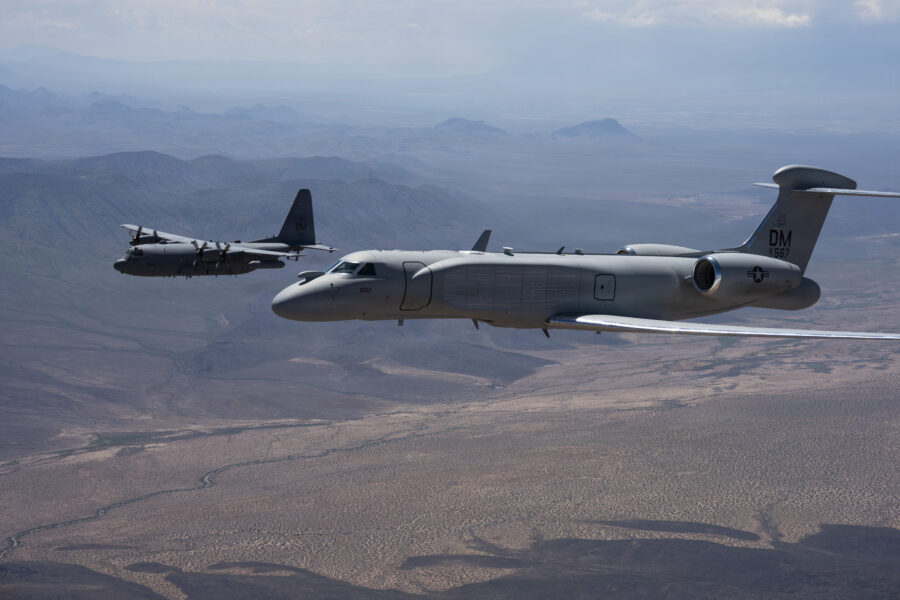
The 55th Wing officially retired the EC-130H Compass Call aircraft in a ceremony Sept. 18 at Davis-Monthan Air Force Base, Ariz., while the 355th Wing there inactivated its A-10 Warthog units, another major transition for the base.
The Compass Call mission is transitioning from the old propeller-driven EC-130s to the sleek EA-37B, which packs the electronic warfare mission into a modified Gulfstream 550 jet. The 55th Electronic Combat Group at Davis-Monthan has five of the new jets on hand, en route to a planned dozen by 2028 and 22 by 2031.
Meanwhile, the 355th is transitioning to a rescue mission as the base prepares to host a new special operations wing.
The new Compass Call jets compress the targeting, jamming, and other electronic warfare missions into a tighter space. About 70 percent of the equipment is unchanged, but instead of 13 Airmen performing Compass Call functions in the EC-130H, the E-37 B needs only nine.
“Its ‘plug-and-play’ architecture allows for rapid software updates and the integration of new capabilities to counter emerging threats and technologies without costly redesigns,” Maj. Claire Fitle, 355th Wing spokesperson, told Air & Space Forces Magazine by email.
The jet has “significantly increased speed, altitude, and range compared with the legacy EC-130H,” Fitle wrote. The equipment can also detect and jam a wider range of enemy systems from farther distances.
The new system is software-driven, allowing rapid updates via software rather than hardware modifications, “dramatically reducing response time … [to] evolving electromagnetic threats,” Fitle wrote.
Decade-long Road to Upgrade
The Air Force began seeking a replacement for the EC-130H in 2014, then awarded L3 Technologies a contract in 2017 to engineer the capability into a smaller airframe. Congress sped up the procurement program two years later, originally expecting to complete procurement in 2026.
The first five aircraft lack some low-band capability, which is anticipated in the remaining aircraft.
BAE Systems and L3Harris delivered the first EA-37B for developmental testing in 2023, and Air Combat Command received the first two airframes in 2024. Initial training sorties began in 2025 and operational testing wrapped up within the year. Contractors will be primarily responsible for maintaining the EA-37Bs at Davis-Monthan, Fitle wrote.
During Operation Epic Fury, they got their first combat exposure—even before the Air Force declared full operational capability.
The EC-130H saw combat action during Operation Just Cause in Panama, 1989, Operation Desert Storm in 1991, Operation Allied Force in Kosovo in 1999, and throughout the Global War on Terror in Afghanistan, Iraq, and Syria over the past 25 years. It was a workhorse to the end, making its final mission in the early stages of Operation Epic Fury.
The first legacy EC-130H retired in 2021, while the last aircraft conducted its final flight Sept. 2.
The 355th, 492nd, and the A-10
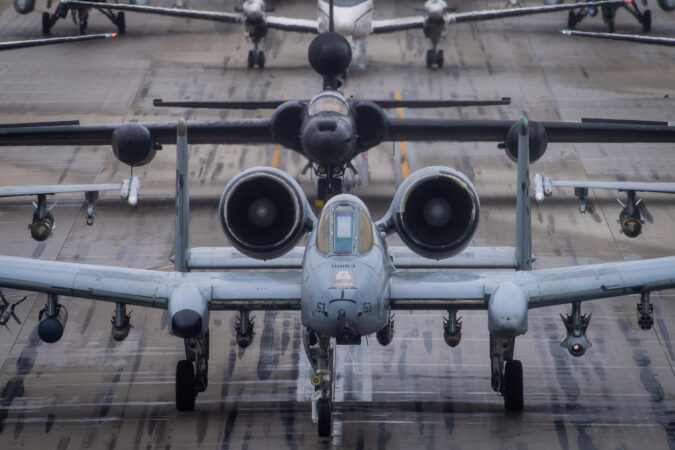
In a parallel event, the 355th inactivated its A-10 Warthog units as well Sept. 18. While the larger Air Force is keeping the popular close air support platform around until the 2030s, the 355th is becoming a “rescue hub,” Fitle wrote.
“Close air support is an enduring mission rather than a single airframe, and the Air Force will continue providing responsive CAS across the joint battlespace through a flexible mix of fifth- and fourth-generation multirole aircraft,” she wrote. “Experienced A-10 aircrew and maintainers are transitioning their close-support expertise directly into these platforms to ensure seamless coverage.”
The wing will continue its CSAR and personnel recovery mission through the 563rd Rescue Group using the HH-60W Jolly Green II helicopter and the HC-130J Combat King II aircraft.
Meanwhile, the 492nd Special Operations Wing is moving to Davis-Monthan, with full operational capability expected between 2028-29. The move comes as the USAF has restructured the former training wing.
The special ops wing will backfill the 355th’s A-10 capabilities by basing its OA-1K Skyraider II and CV-22 Ospreys at Davis-Monthan as well, expanding strike and specialized operational capabilities.
The former “high-end” strike missions will be absorbed by fifth-generation aircraft across USAF.
