


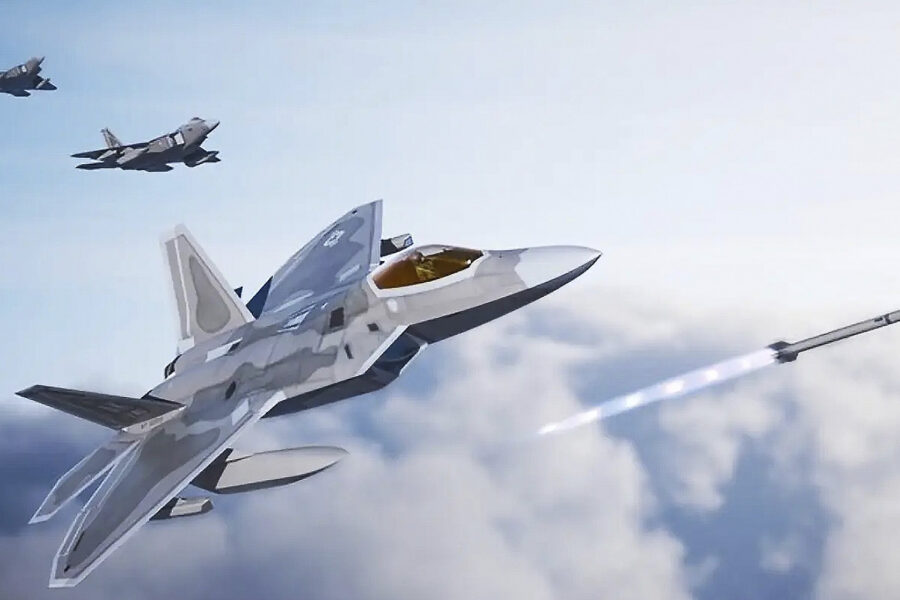
The Pentagon announced a deal with Lockheed Martin on Sept. 17 to expand production of the AIM-260 Joint Advanced Tactical Missile, an advanced new Air Force and Navy air-to-air missile meant to equip fifth- and sixth-generation fighters.
The “framework” agreement aims to give Lockheed a “long-term demand” signal, part of a push by President Donald Trump’s administration to build and sustain a more robust munitions manufacturing industrial base.
The announcement “establishes the framework for future multiyear procurement of JATM,” according to the Pentagon release.
“We will deliver JATM at the speed our nation and allies demand while providing value for taxpayers and our shareholders,” Tim Cahill, president of Lockheed Missiles and Fire Control, said in a company release.
A Lockheed spokesperson declined to answer further questions from Air & Space Forces Magazine, deferring to the Department of Defense. A Pentagon press officer also declined any further comment about the announcement.
The announcement should signal to Lockheed and other munitions-makers that a stable market is taking shape, said Mark Gunzinger, director of future concepts and capability assessments at the Mitchell Institute for Aerospace Studies.
“It is difficult for industry to justify expenditures needed to accelerate and scale up production,” the retired Air Force colonel said. “This is a key reason why this is an important framework.”
Next-Gen Option
The JATM is the successor to the AIM-120 Advanced Medium-Range Air-to-Air Missile, which has been in service since 1991.
The radar-guided, medium-range, supersonic AMRAAM has undergone major upgrades since its inception, most recently in 2020. The F-22 Raptor, F-35 Lightning II, F-15 Eagle variants, and the F-16 Fighting Falcon can all carry it, and the Air Force isn’t looking to stop buying the missile even as it looks to the JATM.
The service is seeking $953 million for 618 AMRAAMs in its fiscal 2027 budget request, while the Navy is asking for $673 million to buy 388 AMRAAMs.
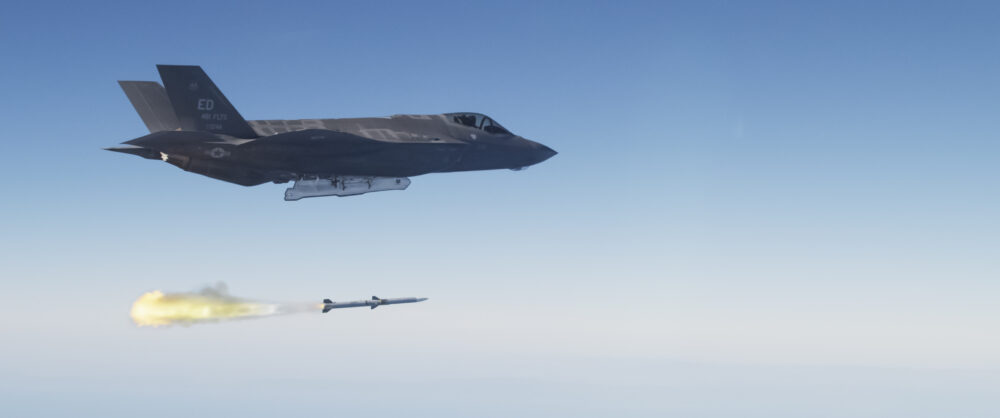
The JATM seeks to overmatch the Chinese military’s PL-15 and PL-17 missiles and will reportedly double the AMRAAM’s range and hit targets in excess of 120 miles away, though much of its capabilities have been shrouded in secrecy for years.
In its fiscal 2026 budget request, the Air Force revealed it had bought 144 JATMs in 2024-2025 and planned to buy at least another 112 missiles. The fiscal 2027 request, still pending before Congress, has $1.5 billion in procurement to scale up production, but budget documents don’t list any quantities.
While upgraded AMRAAMs provide an improved strike option for fighter aircraft, the JATM is necessary for advanced aircraft already fielded and those in the pipeline, such as the F-47 and Collaborative Combat Aircraft variants, the FQ-42 Vengeance and FQ-44 Fury.
“It doesn’t make sense to invest in highly survivable and incredibly capable fifth- and sixth-gen fighters and bombers just to saddle them with payloads of weapons that will not survive to reach their targets in a fight with a peer adversary,” Gunzinger said.
Mix for the Future Fight
Though reports on the current conflict with Iran don’t indicate the U.S. is using large numbers of air-to-air missiles, a future conflict with a peer adversary such as the Chinese military is likely to look much different.
“Multiple Mitchell Institute wargames have spotlighted the need to rapidly grow the U.S. Air Force’s inventory of advanced air-to-air weapons, which could be nearly depleted within a couple of weeks of high-intensity combat with a peer adversary,” Gunzinger said.
This isn’t the first time the Pentagon has announced plans for multiyear procurement of key missiles.
In July, the Pentagon announced a similar framework for a USAF program known as the Family of Affordable Mass Munitions, which will produce lower-cost cruise missiles that experts believe will be needed in future conflicts for higher strike volumes.
That deal anticipates 8,000 missiles annually once production is at full strength. Work is expected to ramp up by 2028 with 5,300 missiles produced, increasing to the 8,000-missile mark by 2031.
While the FAMM deal will bulk up low-cost options for the Air Force, work on more expensive but more capable munitions are an important part of the equation.
“Our air forces will have a future high-low mix of counter-air weapons, but it’s far more important to focus on the cost to achieve an effect in the battlespace like countering an enemy air threat than the unit cost of a weapon,” Gunzinger said. “The key is to determine the right high-low mix based on optimizing cost per effect instead of simply chasing lower unit costs.”
Allies and Partner Purchases
The U.S. isn’t the only country interested in JATM—Australia announced $736 million in spending to equip its Royal Australian Air Force with the weapon.
That move, along with potential deals with other allies and partners, could also help reduce missile costs for the U.S.
“I believe sharing production with key allies as soon as possible is critical to improving their interoperability with U.S. air forces and lead to cost-sharing agreements that can accelerate weapon development and acquisition,” Gunzinger said.
Beyond cost savings, having allies buy the next-generation missile for their fleets also gives the U.S. ways to standardize weapons loaders across a coalition and share munitions when needed, he said.