
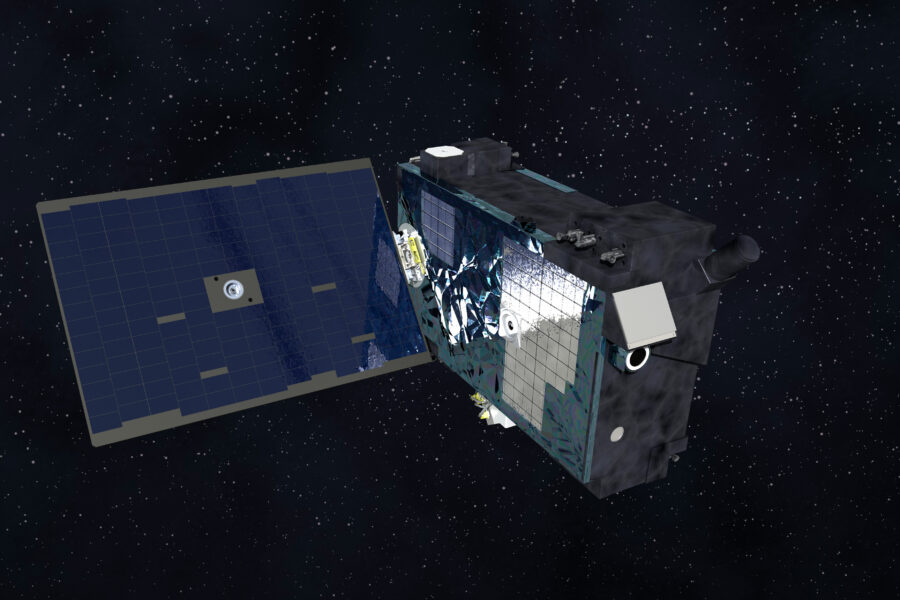
The Space Force and the Defense Innovation Unit have chosen two firms to demonstrate the ability of small satellites built with low-cost, commercial technology to track both friendly and adversary satellites in geosynchronous orbit.
Northrop Grumman and True Anomaly will build prototype satellites for DIU’s GEO High-Resolution Optical Space-Based Tactical Reconnaissance, or GHOST-R, program, the Pentagon technology accelerator announced Sept. 18 in a LinkedIn post. The work will feed into a broader, multibillion dollar Space Force initiative called RG-XX, with the goal to begin fielding a fleet of reconnaissance satellites by the end of the decade.
Col. Bryon McClain, acting portfolio acquisition executive for space combat power, said the Space Force is trying to “push the envelope” when it comes to both speed and affordability.
“This approach burns down technical risk, drives down lifecycle costs, and gets vital capability to the warfighter faster to ensure a more resilient architecture,” McClain said. “Successful prototypes will have a direct transition into the program of record.”
The Space Force in 2024 started talking about a lower-cost, commercial-based capability to augment its current fleet of Geosynchronous Space Situational Awareness Program, or GSSAP, satellites. At the time, then-acting space acquisition executive Maj. Gen. Stephen Purdy said the approach was partly motivated by a push from U.S. Space Command for more unclassified opportunities to partner with allies and industry.
It also aims to address two other SPACECOM needs: more maneuverable satellites and better space domain awareness to close gaps in its ability to characterize and track objects of concern in space. As recently as Sept. 16, Space Command Commander Gen. Stephen Whiting called for improved on-orbit targeting and tracking capabilities—and highlighted the fundamental role space domain awareness plays in the counterspace mission.
“To be able to negate threats in space, we must be able to find, fix, track, and target those threats,” Whiting said at the AMOS Conference in Maui, Hawaii. “Targeting in the space domain is maturing, but it still has a long way to go.”
In April, the Space Force chose 14 companies to be part of an industry consortium called Andromeda, where they’ll compete for task orders worth up to $6.2 billion. That contract will include work for both the maneuverable RG-XX reconnaissance satellites and a separate fleet of surveillance satellites called SG-XX.
As part of GHOST-R, Northrop and True Anomaly’s satellites are expected to launch in 2028 and then perform a series of demonstrations to prove they can collect high-resolution imagery and conduct weekly observations of target satellites. If successful, those spacecraft would become operational RG-XX platforms by 2029.
In parallel, the firms must provide a plan for scaling their satellites to a full constellation that can track all publicly catalogued objects in GEO.
Northrop, the incumbent prime contractor for GSSAP, said in a press release that its design will incorporate its ESPASat-L platform—a high-rate production bus—as well as optical payloads built by a company called TRL 11 based in Irvine, Calif.
“This award expands the company’s role in commercial, low-cost, proliferated space systems and builds on the success of the Northrop Grumman-built Geosynchronous Space Situational Awareness Program,” the company said.
In its own statement, True Anomaly said it will leverage is Jackal spacecraft as well as its Mosaic ground system for GHOST-R.
“Jackal and Mosaic were purpose-built for this mission, delivering superior maneuverability, sensing, and autonomy at a price point that enables scale without compromising performance,” CEO Even Rogers said.
True Anomaly recently showcased its maneuverable Jackal spacecraft as part of the Space Force’s Victus Haze responsive space mission. During the mission, Jackal has demonstrated the ability to approach a target—in this case a satellite built by Rocket Lab—capture an image of it, characterize it, and “engage in a space-to-space pursuit” of the vehicle, the company said in a July statement.
Meanwhile, DIU recently posted another space-related solicitation, this time focused on fostering AI tools that can help distinguish between friendly objects and threats. The project, perhaps complementary to GHOST-R, seeks software that can “ingest and fuse massive streams of multi-source data,” like satellite imagery, geospatial data, and live video.
“By automating advanced cross-data correlation, the architecture aims to uncover hidden patterns, complex operational relationships, and predictive threat behaviors far beyond the capabilities of human analysis alone,” the solicitation states.
