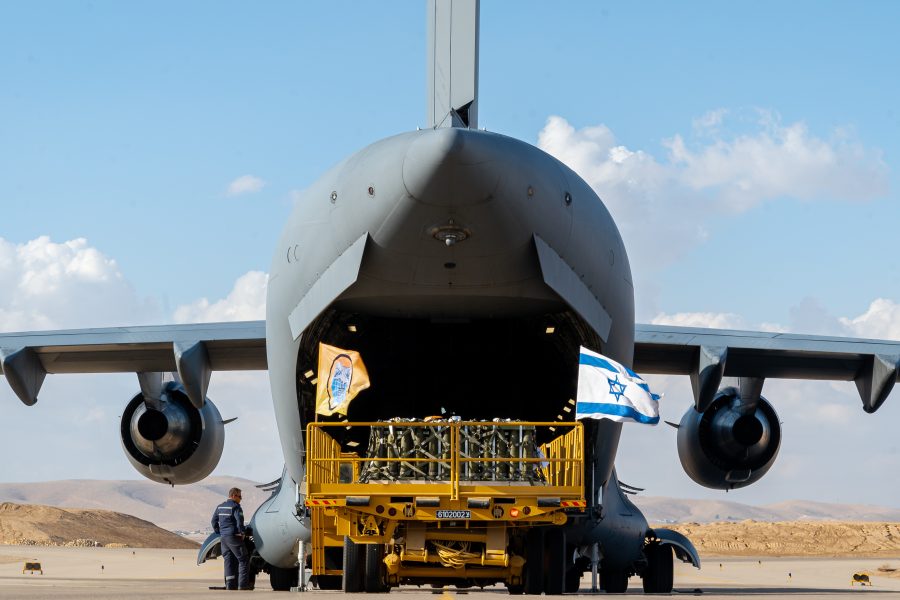
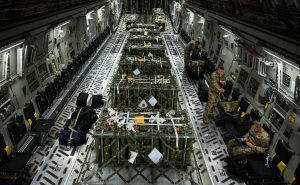
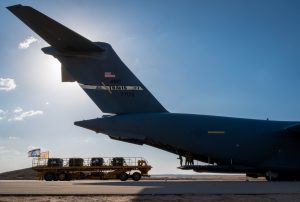
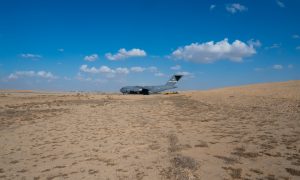
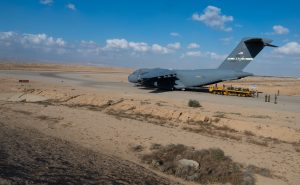
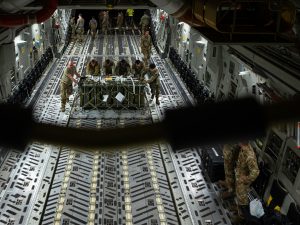
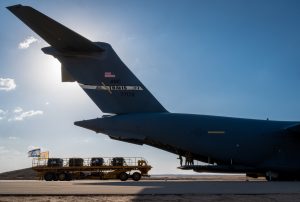
U.S. Air Force Airmen and Israeli military members unload cargo from a U.S. Air Force C-17 Globemaster III on a ramp at Nevatim Base, Israel, Oct. 15, 2023. U.S. Air Force Photo by Senior Airmen Edgar Grimaldo
Audio of this article is brought to you by the Air & Space Forces Association, honoring and supporting our Airmen, Guardians, and their families. Find out more at afa.org
While the Pentagon surges U.S. forces to the Middle East to deter further conflict in the region, the Air Force’s airlift fleet has been steadily working to deliver essential munitions, armored vehicles, and aid to Israel for its war against Hamas using C-17 Globemaster III aircraft.
Images published Oct. 24 show that aid in action, with Airmen from Ramstein Air Base, Germany, loading cargo onto a C-17 from Travis Air Force Base, Calif., and delivering it to Nevatim Base in Israel.
According to the Pentagon, five C-17s transported a variety of security assistance to Israel between Oct. 12 and Oct. 16. U.S. Transportation Command declined to release additional information on the volume and the specifics of the munitions C-17s are carrying to Israel.
During a briefing last week, Deputy Pentagon Press Secretary Sabrina Singh said she anticipates “nearly daily deliveries” of aid to Israel.
The U.S. has already supplied Israel with munitions such as small diameter bombs and Joint Direct Attack Munition (JDAM) tail kits, through Direct Commercial Sales Contracts, a senior defense official said Oct 23.
The JDAM is a guidance kit that transforms existing unguided free-fall bombs into precise, all-weather ‘smart’ weapons.
The senior official added that before the Oct. 7 Hamas terrorist attack, some 155mm ammunition had been taken from Israel’s war reserve stockpile to replenish U.S. stocks in Europe. However, a significant portion of that ammunition has been redirected and provided to the Israel Defense Forces for their use.
The Pentagon is expediting existing weapons orders for Israel from defense companies as well.
The C-17 is a heavy-lift, strategic transport capable of direct tactical delivery of all classes of military cargo. The aircraft previously conducted missions to bring back individuals from Israel following the Hamas attack.
After deploying F-15Es and A-10 Thunderbolts to the Middle East, the Air Force is bolstering its presence in the Middle East by sending additional F-16 Fighting Falcons that landed Oct. 24.
Meanwhile, President Joe Biden briefed Israel’s Prime Minister Benjamin Netanyahu on U.S. support and regional deterrence, including new military deployments on Oct. 23.
Biden also welcomed the release of two more hostages from Gaza and reaffirmed his commitment to securing the release of all remaining hostages including Americans, and maintaining humanitarian assistance in the region.
Audio of this article is brought to you by the Air & Space Forces Association, honoring and supporting our Airmen, Guardians, and their families. Find out more at afa.org
The command center that has run America’s air campaigns in the Middle East for over two decades took a direct hit during the U.S. war with Iran and was severely damaged, a senior U.S. official and other people informed about the attack told Air & Space Forces Magazine.
The Air Force is seeking to buy around 108 new aircraft in fiscal 2027—though really, officials wish they could get more. The issue isn’t just more money, according to the service’s No. 2 officer; contractors just aren't able to produce enough aircraft at the present moment, Gen. John Lamontagne said…
The Air Force would keep all of its 184 F-22 Raptors until at least the end of fiscal 2032 under an amendment added to the House Armed Services Committee’s version of the National Defense Authorization bill.
Boeing has completed initial flight testing on its redesigned Remote Vision System for the KC-46 tanker, the defense giant announced June 4. The new system, dubbed RVS 2.0, is meant to replace the original camera and video system boom operators use to refuel other aircraft, which has faced issues for…
The Air Force wants about $1 billion to move Collaborative Combat Aircraft into production in fiscal 2027 and accelerate the introduction of this game-changing technology. Congress should support that objective.
The Air Force has awarded contracts to General Electric Aerospace and Rolls-Royce to further hone their designs for engines that would power medium-thrust autonomous drones.
The Air Force plans to spend $213 million on its CV-22 fleet in fiscal 2027, about one-fifth of a $1.12 billion investment in the tiltrotor aircraft across the Pentagon.
The Air Force’s primary fighter fleet dipped below the minimum allowable size under law earlier this year—and that fact should rally a “call to action” for the nation to reinvest in its airpower, a key lawmaker said June 2.
✓
Thank You!
Check your inbox to verify your email address and finish setting up your AFA account.
★
Welcome Back!
An account with this email already exists. Please log in to continue.
Subscribe to the Air & Space Forces Daily Report
The latest news from Air & Space Forces Magazine, as well as news from other leading publications, delivered right to your inbox every morning!
We’re sorry, there has been an error. Please review your input or try again later.