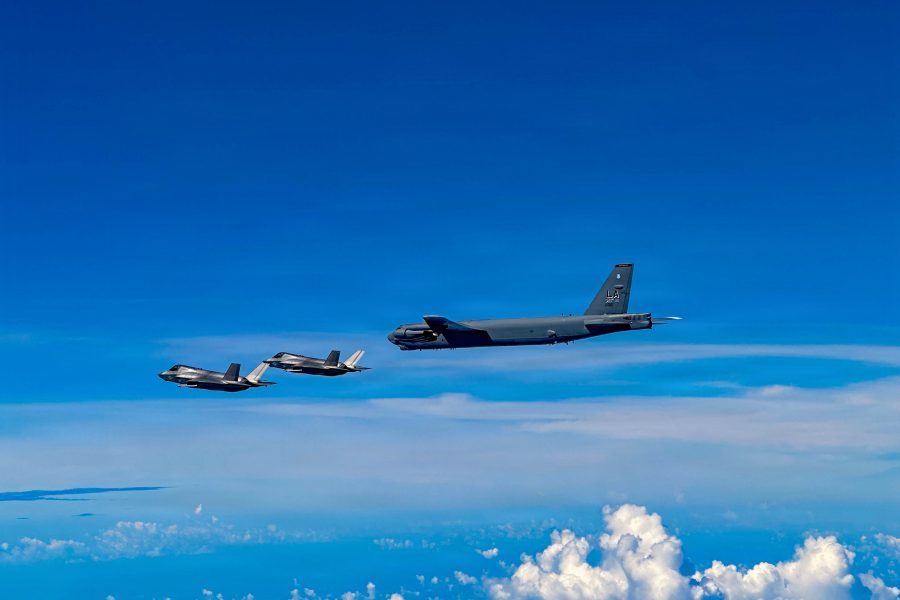
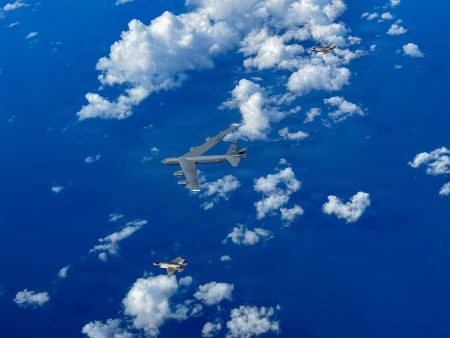
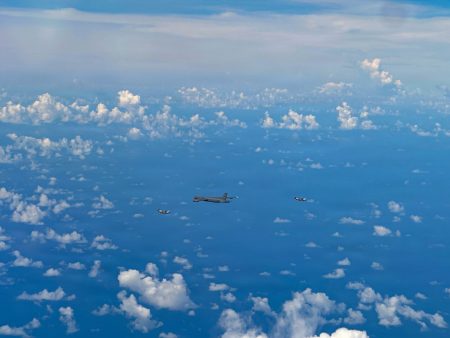
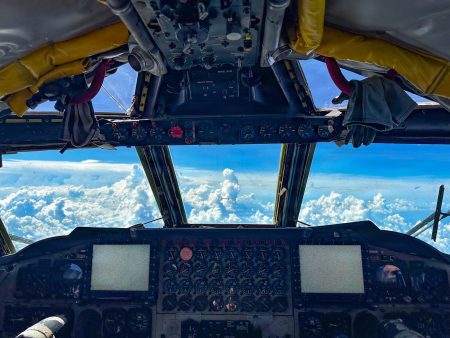
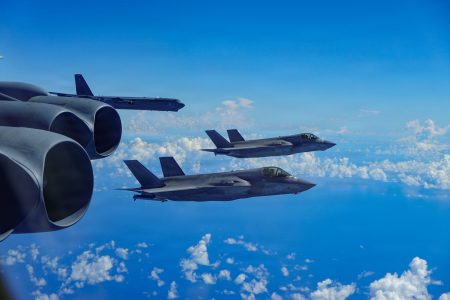
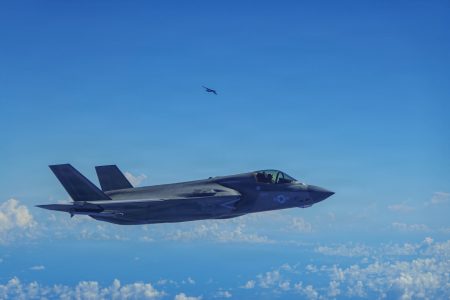
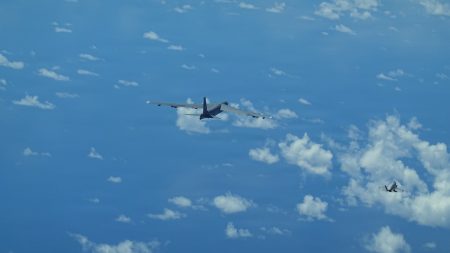
A U.S. Air Force B-52H Stratofortress bomber assigned to the 2nd Bomb Wing, integrates with two U.S. Marine Corps F-35B Lightning II aircraft, in the U.S. Southern Command area of responsibility, Oct. 15, 2025. U.S. Air Force courtesy photo
Audio of this article is brought to you by the Air & Space Forces Association, honoring and supporting our Airmen, Guardians, and their families. Find out more at afa.org
The B-52 bombers that flew off the coast of Venezuela on Oct. 15 were accompanied by Marine Corps F-35s as part of a so-called “Bomber Attack Demonstration,” according to new images and information from the Pentagon.
The Stratofortresses flew from Barksdale Air Force Base, La., into U.S. Southern Command’s area of responsibility, Air Forces Southern announced on social media. There, they flew with F-35B fighters from Marine Fighter Attack Squadron 225, according to images released by the 2nd Bomb Wing. The Marine Corps jets have been based out of Puerto Rico since September.
Air Forces Southern also said tankers from MacDill Air Force Base, Fla., provided refueling support for the flight.
Aviation enthusiasts first noted the B-52 flight through open-source flight tracking data, and U.S. officials confirmed it to Air & Space Forces Magazine. While the Pentagon did not disclose any details on the flight path, tracking data showed the bombers off the coast of Venezuela.
In captions accompanying the new photos, the 2nd Bomb Wing stated that “Bomber Attack Demonstrations contribute to the collective defense of the Western Hemisphere and demonstrate the U.S. commitment to the safety and security of the region.”
Of note, the photos show the F-35s armed with AIM-9 Sidewinder weapons, but the B-52s appear to not have any weapons mounted externally.
The bomber attack demo—the first time the Air Force has used that term—marks the latest show of force by the U.S. in the region amid escalating tensions.
President Donald Trump has authorized a series of airstrikes on what his administration says are boats smuggling drugs in international waters, and the U.S. government has charged Venezuelan President Nicolas Maduro with being involved in a conspiracy to smuggle cocaine and guns into the U.S.
The Trump administration is offering $50 million for information that leads to his arrest, and Trump recently acknowledged that the CIA is conducting covert operations in Venezuela and the White House is considering attacks on Venezuelan territory.
As part of the military’s recent moves to combat drug trafficking out of South America, the U.S. military deployed the F-35Bs and at least six different Air Force MQ-9 Reaper drones to Puerto Rico. There are also AV-8 Harrier fighter jets embarked on the USS Iwo Jima, which has been operating in the region.
Images posted on social media on Oct. 14 show at least one Air Force AC-130J flying over Puerto Rico armed with eight Hellfire missiles.
Audio of this article is brought to you by the Air & Space Forces Association, honoring and supporting our Airmen, Guardians, and their families. Find out more at afa.org
The Air Force Life Cycle Management Center is moving forward with a program to upgrade a quarter-century-old computing system for some F-16 fighter jets.
The U.S. Navy on Oct. 15 accepted a C-130J-30 Super Hercules plane that it will modify to become the first of its new nuclear command, control, and communications aircraft—a route the Air Force is considering for a similar NC3 mission under congressional direction.
More than 40 years after the original YF-117 operational prototype flew test runs from a Lockheed Martin Skunk Works facility, an F-117 returned for a $1 million refurbishment to look its best when it assumes its place in history alongside other iconic aircraft on permanent exhibit at the National Air…
A U.S. Air Force F-22 pilot controlled a YFQ-44A Fury Collaborative Combat Aircraft this month while both aircraft were in flight, according to an Oct. 16 release, another milestone in the service’s ambitious CCA efforts.
The Marine Corps recently conducted its first-ever “ripple” release of eight Small Diameter Bomb IIs from an F-35B, a key early step in proving out the capability for all F-35 variants.
The Air Force will field operational prototypes for an autonomous drone to replace its MQ-9 Reaper in 2028, Secretary of the Air Force Troy Meink said Oct. 14.
One of the Air Force’s critical B-2 Spirit stealth bombers has returned to Whiteman Air Force Base, Mo., after an extensive course of maintenance to restore its stealth coating and preserve its structural integrity.
BAE Systems has received a contract from Lockheed Martin to install an upgraded Block 4 electronic warfare system into new F-35 Joint Strike Fighters, as well as to retrofit some older jets.
The Air Force has figured out a way for maintainers to inspect what had been a “blind spot” in F-16 engines, after problems in that area led to the catastrophic crashes of two jets in recent years.
✓
Thank You!
Check your inbox to verify your email address and finish setting up your AFA account.
★
Welcome Back!
An account with this email already exists. Please log in to continue.
Subscribe to the Air & Space Forces Daily Report
The latest news from Air & Space Forces Magazine, as well as news from other leading publications, delivered right to your inbox every morning!
We’re sorry, there has been an error. Please review your input or try again later.