
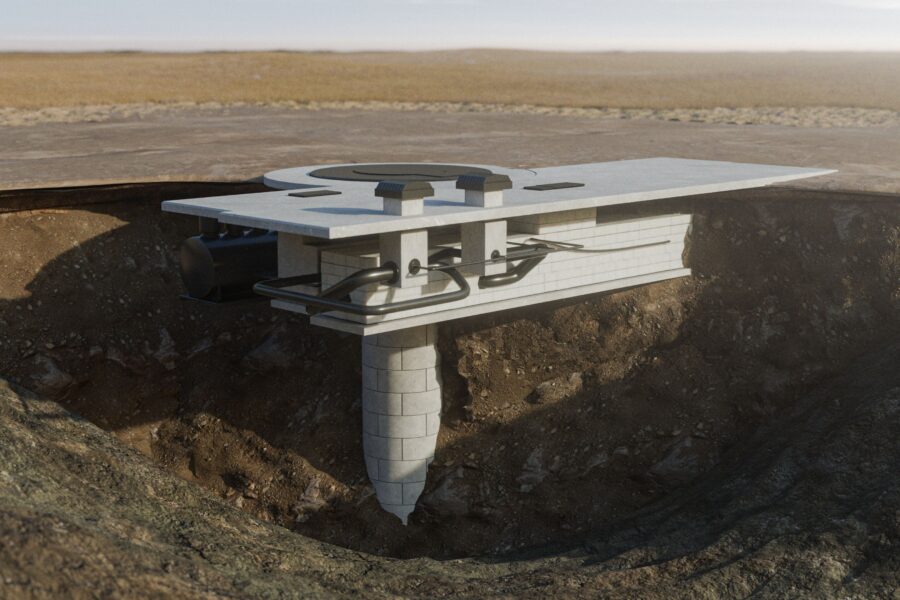
The Air Force may wind up buying land to build 120 new intercontinental ballistic missile silos as part of its revamped infrastructure approach for the new Sentinel ICBM.
The service revealed that and other new details about its Sentinel plans as it announced the start of an environmental impact analysis meant to supplement the program’s original review, which was completed in 2023.
The environmental impact statement released in March 2023 cleared a key procedural hurdle in the Air Force’s effort to replace the aging Minuteman III with the Sentinel across three bases in the western U.S.: F.E. Warren Air Force Base, Wyo.; Malmstrom Air Force Base, Mont.; and Minot Air Force Base, N.D. But much has changed since that EIS—in early 2024, critical cost and schedule overruns for Sentinel triggered a notice to Congress and a Pentagon review under the Nunn-McCurdy Act.
The program’s issues are not caused by the missile, but rather by the massive infrastructure and civil engineering work needed to build the systems it requires, officials say. The Air Force had hoped to reuse much of the infrastructure that supported Minuteman, but analysis showed much of it was too old or too expensive to upgrade.
Eventually, Pentagon leaders certified the Sentinel program to continue. But in an effort to control costs, Air Force officials decided in spring 2025 it would be more effective to build entirely new silos instead of reusing the old ones. There are 450 active Minuteman silos, which the Air Force plans to replace on a one-for-one basis.
At the time, a spokesperson told Air & Space Forces Magazine that the new silos would be “predominantly Air Force-owned real estate, which means reusing the existing missile sites but not the 55-year-old silos.”
A new website associated with the supplemental environmental impact analysis, launched Oct. 9, states that just over a quarter of the sites could be on land not currently owned by the Air Force, with the service considering:
- Acquisition of land and construction of up to 30 new launch silo sites around F.E. Warren
- Acquisition of land and construction of up to 30 new launch silo sites around Malmstrom
- Acquisition of land and construction of up to 60 new launch silo sites around Minot
Additionally, the service said it is evaluating old sites at Malmstrom formerly operated by the 564th Missile Squadron, now inactive, to reuse for up to 60 new launch silo sites.
The Air Force is planning to buy up to 12 acres per silo, according to the supplemental EIS website.
Launch Centers
Silos aren’t the only ICBM infrastructure getting a refresh in the Air Force’s latest plan for Sentinel.
Currently there are 45 missile alert facilities across the three bases where Airmen stay on watch 24/7. The original plan for Sentinel called for building new “launch centers” to command and control the ICBMs at 24 of those facilities and razing the rest.
The new EIS website states that the Air Force will reutilize Missile Alert Facility sites for Launch Centers “where feasible,” but at Minot specifically, officials are considering “construction of new launch center sites in previously undeveloped areas,” the website states. Each Launch Center would have a footprint of up to 16 acres.
Another new consideration is the construction of a “purpose-built Operations Group Facility” at Malmstrom.
Timeline
Now that the Air Force has announced its plans to craft a supplemental EIS, there is a 30-day public “scoping” period where federal, state, and local agencies, interested organizations, and members of the public can all provide comments on the proposed actions.
After that, the service will release a draft of its supplemental EIS, and there will be another window for public comments. The Air Force plans to release its draft by fall 2027.
A final supplemental EIS is scheduled for release in spring 2028, after which the Secretary of the Air Force can sign a Record of Decision, clearing the way for the acquisition of land and construction.
After that, it will be several more years before Sentinel is in the ground—the current Air Force estimate is for the new missile to reach initial operational capability by the early 2030s.
For now, though, the Air Force and contractor Northrop Grumman are already building a prototype silo for Sentinel at Northrop’s Promontory, Utah, facilities.