


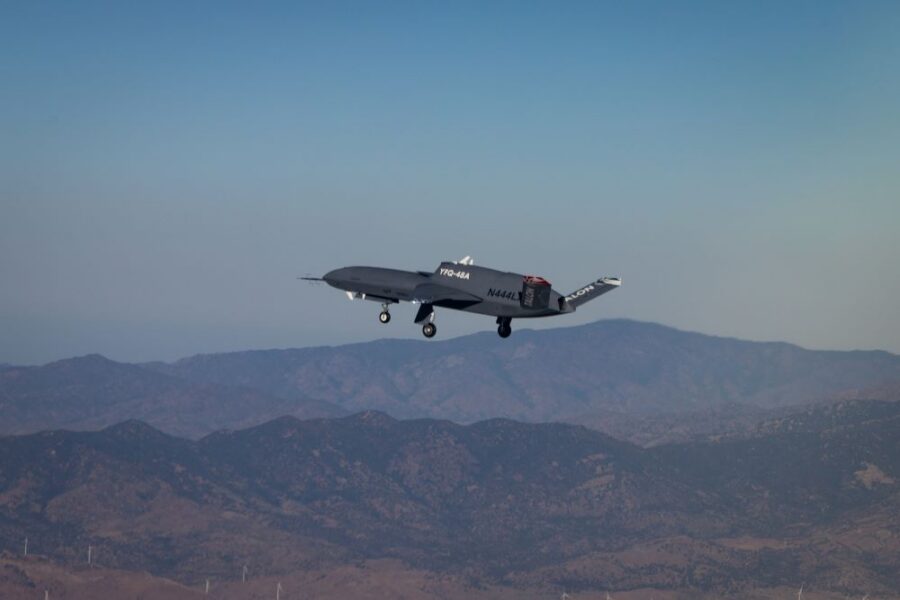
Northrop Grumman’s Talon Blue YFQ-48A Collaborative Combat Aircraft took its first flight Oct. 3, heightening the competition for the Air Force’s future combat fleet.
Talon Blue is Northrop’s so-called “loyal wingman” drone, an autonomous aircraft designed to pair with crewed fighters. The Oct. 3 flight was an important milestone for the firm as it looks to break into the Air Force’s CCA program—thus far, the service has awarded production contracts to General Atomics and Anduril Industries, but more “increments” are expected in the coming years.
Northrop said the drone completed a fully autonomous flight, including taxi, takeoff, “in-flight maneuvers,” and landing from its Mojave, Calif., facilities.
Air Force leadership say they plans to field at least 500 CCAs by 2032. While the service has not selected Talon Blue for production yet, the company has been bullish that the service could be a customer in the future. The Air Force also gave Talon Blue an official Department of Defense Mission Design Series designation, YFQ-48A, last December, signaling that it sees the aircraft as a competitor for future CCAs.
“Our customers made it clear they need autonomous systems that can be fielded faster and more affordably without sacrificing mission effectiveness,” Craig Woolston, Northrop Grumman’s vice president and general manager for research and advanced design, said in a statement. “We listened. Talon Blue’s first flight is one step toward a new generation of autonomous capabilities. Every flight and lesson strengthens our broader autonomy work and sharpens what comes next.”
The company’s CCA is a unique offering. It was first unveiled last December to a small group of reporters, including Air & Space Forces Magazine, as a self-funded effort. The company’s Scaled Composites subsidiary, known for its history of innovative aircraft, built it, and the company has touted how quickly it developed the aircraft. The time between when the aircraft was conceived and when it had “weight on wheels” was roughly 15 months, company officials said. When Northrop announced the aircraft, it said it expected the aircraft to fly around fall 2026, a milestone the company has now met.
Talon Blue falls under the company’s broader Project Talon. The project also includes the Talon IQ, an autonomous testbed for using Scaled Composites Model 437 aircraft. Talon IQ uses Northrop’s Prism mission autonomy software. So far, the Air Force has pursued a “software sold separately” approach to CCAs, running separate competitions for the mission autonomy software and the aircraft themselves.
While General Atomics’ FQ-42 Vengeance and Anduril Industries’ Fury FQ-44 have been awarded production contracts from the Air Force and are undergoing ongoing testing with the service as part of the Increment 1 of the service’s first autonomous wingman, Northrop Grumman is hoping to market Talon Blue for future Air Force purchases and to U.S. allies.
Northrop’s original CCA offering lost out on the Increment 1 contracts due to its cost, president of the company’s aeronautics division Tom Jones said, leading to what became Talon Blue.
“The idea was to see if we could build an aircraft that had all the same capability of our original offering, and do it faster,” Jones said at the unveiling last year. “So the outcome was an aircraft, but the outcome we’re shooting for was the process: How do we design and build things that perform at a high level, but that we can build quickly now and can do affordably?”
The Air Force has yet to spell out the requirements for Increment 2 of the CCA program.
“It’s getting defined as every day goes by,” Gen. Dale White, the Pentagon’s director of critical major weapon systems, told reporters at AFA’s Air, Space & Cyber conference when asked by Air & Space Forces Magazine about the status of Increment 2.
“The challenges I may have in the Indo-Pacific theater could be very different [from those] in the [U.S. Central Command] theater and different again in the [European Command] theater,” White said. “So how do we take all of those different requirements and make sure we have a [CCA] capability that can address many different mission sets across many different requirement centers?”
Whether Northrop’s Talon Blue fits into that picture is still unknown. But the YFQ-48A could also be appealing to U.S. allies, some of which have started rolling out their own CCAs, such as the U.K. government-backed, British-designed Brontanax CCA from BAE Systems. U.S. Air Forces in Europe and NATO Allied Air Command boss Lt. Gen. Jason T. Hinds said other European nations were watching the U.S.’s work on CCAs.
“You’re going to see a lot more interest from other nations inside Europe,” Hinds said at Air, Space & Cyber when asked about CCAs.
When the Talon Blue aircraft was unveiled last December, Jones said multiple U.S. military services and international partners are interested in the drone, and some had visited Mojave to see it.
“We’re still extremely good at making something very complex,” Jones said at the time. “This was really about broadening that paradigm to what it means to be a high-performing engineering, aviation, development, and manufacturing organization to encompass all aspects of it.
Talon Blue is important for Northrop’s future tactical aircraft efforts, as the company recently lost out to Boeing to build the Navy’s future F/A-XX sixth-generation fighter jet. The company is still building major weapons systems for the Air Force: the B-21 Raider stealth bomber, set to enter service next year and a project that will likely be expanded beyond the original program of record of 100 aircraft, and the LGM-35A Sentinel, the next-generation intercontinental ballistic missile.
The CCA market Talon Blue is competing for is crowded, not just by the FQ-42 and F-44, but also by Lockheed Martin’s new Vectis offering. Other possible competitors, such as Boeing’s MQ-28 Ghost Bat and Kratos’s XQ-58 Valkyrie, have been used by the U.S. military in tests and exercises alongside crewed aircraft.
The Air Force sees CCAs as a critical part of the future force.
“I can imagine a day in the future, 10 years [from now], maybe more, where a CCA autonomy algorithm does a better job flying a fighter airplane than I did as a captain,” Lt. Gen. Christopher Niemi, the Air Force’s Chief Modernization Officer, said last month. “That hurts my ego a little bit. But at the same time, I see that this trend is happening, and we’ve got to find a way to do that.”