
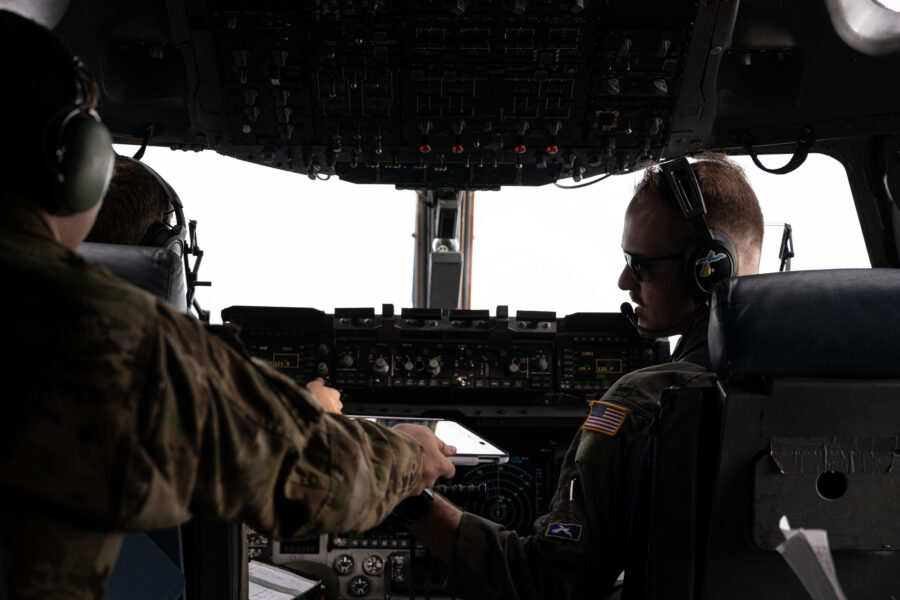
A recent $21 million contract award to three software companies could give the Air Force’s airlift and tanker units real-time software updates in degraded environments, including aircraft fuel, logistics, and other mobility fleet data.
The Defense Innovation Unit and Air Mobility Command announced Sept. 15 they have awarded deals to Defense Unicorns, Stator Integration Labs, and Air Space Intelligence, each providing different tools to move the prototype software to production and deployment across AMC platforms.
The effort is under the umbrella of AMC’s Open Mission Engine program. Dubbed OMEN, the program is aimed at giving aircrews and mobility commanders better real-time information in denied, degraded, intermittent, and limited environments.
An AMC spokesperson told Air & Space Forces Magazine that the program seeks to have “present, current, and usable” aircrew mission software without a reach back or needing to connect to ground networks or cloud infrastructure to obtain the necessary update.
The program is still in its prototype phase, the AMC spokesperson wrote in an email, so they could not share initial and full operational capability timelines.
Officials have described OMEN as creating a “common operating picture” for mobility forces that have long lacked sophisticated connectivity. Using edge computing, the system will be able to track fuel, deliver software, and fuse data to create that common operating picture across the fleet, which will then load into aircraft cockpits and tablets.
Defense Unicorns CEO and cofounder Robert Slaughter told Air & Space Forces Magazine that’s “what makes OMEN special.”
“There’s a lot of different AMC assets, and they all need a common operating picture,” Slaughter said.
A former Air Force major, Slaughter explained that OMEN will fuse data across multiple inputs to give each user a clear understanding of what’s happening where and when.
“I think the biggest thing is: how do you do that on your worst day, and I think that’s key. How do you get software delivery done?” Slaughter said. “Accelerate the speed of software delivery on the nation’s worst day, and that’s what OMEN’s ultimately all about.”
The goal, Slaughter said, is to get on-demand software updates in the users’ hands.
“That’s measured in hours, not months or weeks,” he said. “That is a gnarly problem.”
Mark Lepczyk, Air Space Intelligence’s vice president of defense, says that as things stand, mobility crews wind up “pulling numbers from separate systems and reconciling them while the situation keeps evolving,”
“Under DIU’s OMEN program we’re reading crucial data like fuel state directly from the aircraft, fusing it on the same screen with the threats, the weather, and mission details, and offering optimal course of action recommendations, so the crew can now make accurate decisions at machine speed,” Lepczyk wrote in an email.
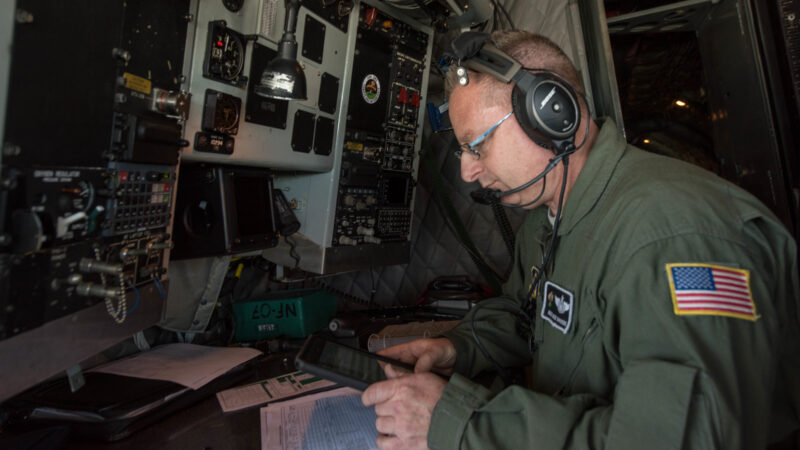
ASI’s application, which creates the common operating picture via data fusion tech provided by Stator Integration Labs, runs on a tablet that aircrews currently carry, Lepczyk said.
“The aircraft and the command center are working from identical information. It connects to existing Air Force systems, shared data services, and beyond-line-of-sight connectivity. A traditional operating picture tells you what is happening right now,” Lepczyk wrote. “Ours projects forward, so if weather suddenly shifts 300 miles ahead, the crew immediately understands all impacts and options to mitigate.”
The OMEN software assesses the “ripple effect” of any disruption to fuel, timing, or mission objectives and then gives the user “executable options” to replan quickly, Lepczyk wrote.
“We configured our solution assuming that any network can fail. Data can be cached locally, and the applications intuitively cue the crew if any information is degraded or stale,” he wrote.
Finding the Tools
DIU sought a software solution with both open-source protocols and a purpose-built capability stack tailored to OMEN’s needs, , unit spokesperson Caroline Thompson told Air & Space Forces Magazine in an email.
The unit works with military organizations such as Air Mobility Command and industry vendors as a kind of middleman, finding the right prototype solutions to military problems.
OMEN fleet software is part of a larger DIU effort to get quickly updatable and upgradable software in action across all Pentagon entities, Thompson wrote.
“The OMEN project exemplifies DIU’s strategy to bridge this gap,” she wrote. “By establishing an air-gapped-native fleet management layer, OMEN is building a repeatable framework to push software updates and AI capabilities directly onto operational aircraft. This project provides Air Mobility Command with a scalable blueprint to keep tactical edge software current and mission-ready.”
Delayed software impacts are felt across the fleet.
“This agility is key because software is only useful if it can be accessed and updated in the environments where it is required, in this case, on aircraft in austere locations or at 35,000 feet in the air,” Thompson wrote.
Defense Unicorns’ Unified Defense Stack-Fleet software is what Airmen will be using through the OMEN program. Components of UDS software have been used to upgrade F-22s, F-16s, and C-17s.
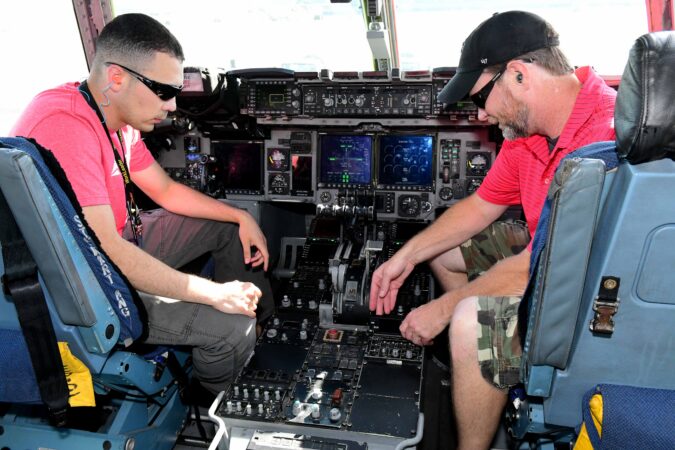
Slaughter, who deployed as an Airman with AMC assets, is keenly aware of what delayed software updates can do to a fleet. Often, software updates on legacy platforms can be a depot-maintenance level task.
“The jet not only goes through a maintenance period on the flight line, but the jet has to fly somewhere and be grounded completely out of the fight,” Slaughter said. “That is huge. I mean, I have vulnerabilities in the system, and I need to patch these. Imagine the entire fleet saying, ‘Hey, all of you have to go to depot-level maintenance, and it’s going to take several days or a week per plane’…You literally couldn’t fight and win wars with that posture.”
While Defense Unicorns’ UDS software will run on large platforms such as airlift assets and tankers, the software can be trimmed down for fighters and even drones, Slaughter said.
And while contractors are running the software updates in the prototype phase for OMEN, Airmen will be taking the reins once it reaches the production phase, Slaughter said.