
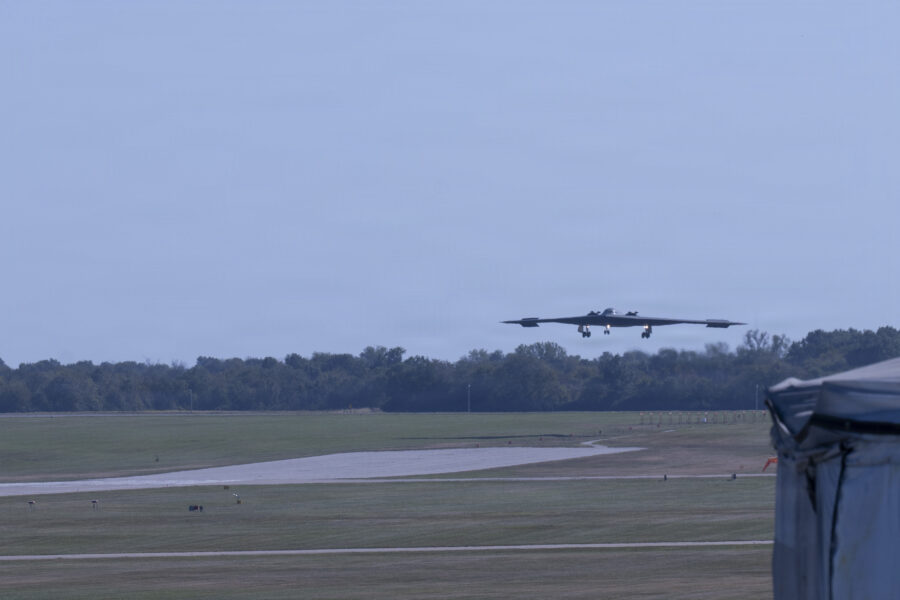
One of the Air Force’s critical B-2 Spirit stealth bombers has returned to Whiteman Air Force Base, Mo., after an extensive course of maintenance to restore its stealth coating and preserve its structural integrity.
The B-2, which bears the tail number 93-1086 and is nicknamed the Spirit of Kitty Hawk, underwent programmed depot maintenance at Air Force Plant 42, a highly secure facility in Palmdale, Calif., the Air Force said in an Oct. 10 statement. Northrop Grumman, which originally built the B-2 when it was called the Northrop Corp. and today builds B-21 Raiders at Plant 42, managed the Spirit’s depot maintenance.
Programmed depot maintenance is a regularly scheduled, labor-intensive process for thoroughly inspecting, overhauling and repairing Air Force aircraft. It becomes increasingly important as aircraft age and more maintenance troubles emerge.
The Spirit of Kitty Hawk touched down Oct. 7 at Whiteman, which is home of the 509th Bomb Wing. But it’s not returning to service just yet—it will now move to the 509th’s modification line to receive advanced stealth and communications upgrades.
The Air Force officially records 20 of the stealthy long-range B-2s in its inventory. But another B-2, called the Spirit of Hawaii, had a fiery crash in 2022 after its landing gear collapsed, which sparked a fire that ignited the bomber’s fuel tanks. The Air Force later said it planned to retire the Spirit of Hawaii, which would leave the service with 19 B-2s.
With so few B-2s in its fleet, the Air Force said, returning even one bomber responsible for some of the service’s core functions back to the field “represents a significant boost to readiness.”
“The B-2 is a small fleet,” Lt. Col. Jeffrey Lembrick, air vehicle and systems management materiel leader for the B-2 program office, said in the statement. “Every time we return a jet to the field, it represents an additional strategic option available for the President of the United States. When you talk about aircraft availability, one thing we know is that a jet can’t be used if it’s sitting at PDM. So, completing PDM and returning to the field is a big deal.”
Depot maintenance for the B-2 typically involves restoring its low-observable stealth coating, inspecting its fuel system for leaks, and maintaining its blade seals, which are strips of metal that seal gaps when doors for weapons bays, landing gear, or other compartments close. In recent years, B-2s have taken about 15 to 16 months to go through programmed depot maintenance, although in 2024, one B-2 finished the process a little more than a year after it began.
This time, the Air Force said, the Spirit of Kitty Hawk’s depot maintenance included replacement of its hot trailing edge, “a critical structural assembly designed to withstand the extreme thermal and acoustic fatigue generated by the bomber’s four engines.”
Maintainers also spotted and fixed several unexpected maintenance problems while the B-2 was going through the depot. This included carrying out “a strategic part swap” with another B-2 that was coming into the Palmdale depot, and manufacturing another replacement part on-site, a B-2 program office official said.
