
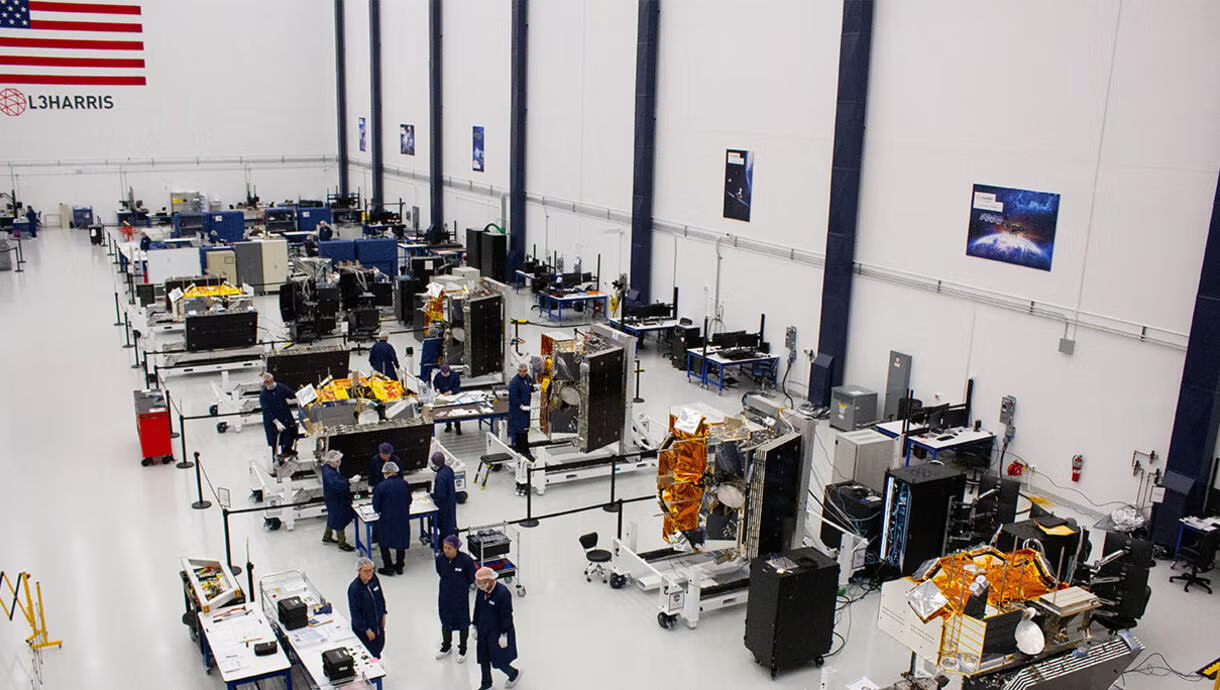
As the Space Force eyes a possible fivefold increase in the number of satellites it operates on orbit, defense officials are looking for ways to shore up the industrial base to support that growth, which is expected over the next three to five years.
USSF officials have been telling space companies in recent months to invest in new infrastructure and production capacity to prepare for an increase in demand for satellites and other space systems. In April, the head of Space Systems Command, Lt. Gen. Philip Garrant, said a significant portion of the Space Force’s historic $19 billion procurement budget for fiscal 2027 would go toward contracts for new satellite lines and an expansion of existing constellations.
“If a company is nominally making 10, we want you to be prepared to make 40,” he said at the time. “We want industry to make the investments in capitalization and facilitization, and in return you’re going to get these large production contracts.”
Garrant and others, including Air Force Secretary Troy Meink, have said the service is weighing multiyear procurement deals for satellites as well as production framework agreements, similar to the massive munitions deals the Pentagon has signed in the past year. The munitions agreements, which weren’t initially backed by funding, are meant to send a demand signal to industry so they can confidently spend their own capital to increase production capacity and be ready to deliver when the contract awards come.
Leadership’s push comes amid a broad increase in private investment in the space industry; according to a new report from British investment firm Seraphim and Relm Insurance, global investment has doubled in the last year, hitting $23 billion in June. However, that funding hasn’t necessarily been directed at manufacturing capacity. A March report from the Aerospace Industries Association and Price Waterhouse Coopers noted hesitance among manufacturers to fund new facilities, workforce, and tooling without guarantees of long-term demand.
“Space programs often lack the volume predictability and multiyear commitments required to support large capital investments, reinforcing a conservative approach among suppliers,” the report states. “While this strategy can accelerate asset degradation and limit productivity gains, federal budget volatility (accounting for more than 20 percent of total space economy), program delays, and shifting priorities all increase the perceived risk that capacity built today may be underutilized tomorrow.”
The Space Force’s new space acquisition executive, Erich Hernandez-Baquero, told reporters Sept. 16 the service is considering how it might be able to help, possibly using similar framework deals and multiyear procurement assurances as tools to drive more stability into the space industrial base—particularly for components and subsystems that have proven difficult to produce at scale.
“What we’re seeing is we need to scale our production capability around satellites in general,” Hernandez-Baquero told reporters at AFA’s Air, Space & Cyber conference. “There are lower, subtier elements of that supply chain that cross cut different mission areas that we may want to look at, because those are bottlenecks.”
For example, the Space Development Agency—founded in 2019 as a disruptor for military space with ambitions to launch the Pentagon’s first proliferated satellite constellation—has faced setbacks due in part to challenges producing the laser-based communication systems known as optical inter-satellite links that enable the rapid transmission of data.
SDA Director Gurpartap Sandhoo told reporters Sept. 15 that production of these optical terminals is still a bottleneck for the agency, as are some other components like focal plane arrays.
“I think it’s been very well reported that optical inter-satellite link components are bottlenecks for our systems, so that would be one that I would look to as an example,” Sandhoo said. “What do we need to do to help facilitate that? Anywhere where we have that bottleneck that keeps us from going at speed in support of the mission is something that would be subject to review.”
Hernandez-Baquero said that may be an area where multiyear procurement assurances could provide more support for suppliers.
While those chokepoints have plagued nearly every SDA prime, some, like L3Harris, have seen their early investment in facility expansion and supply chain pay off. The company, to date, has been tapped to deliver 70 satellites for SDA’s missile tracking layer, including an award in July to deliver 18 spacecraft in support of the Pentagon’s Golden Dome missile defense shield.
Rob Mitrevski, the firm’s president of Golden Dome strategy and integration, said the company links some of its success to early decisions to use internal research and development funds to expand production and shore up its supply chain before it had a single contract in hand. That decision, he said, required L3Harris to change the way it perceives demand signal from the government.
“The demand signal in the past, maybe, has been award of contracts. The demand signal today is prioritization of capabilities,” he told reporters Sept. 16 on the sidelines of the conference. “The defense industrial base has to adapt, I think, to how the demand signal is seen. And some of us have taken chances, risks, and are willing to invest.”
