
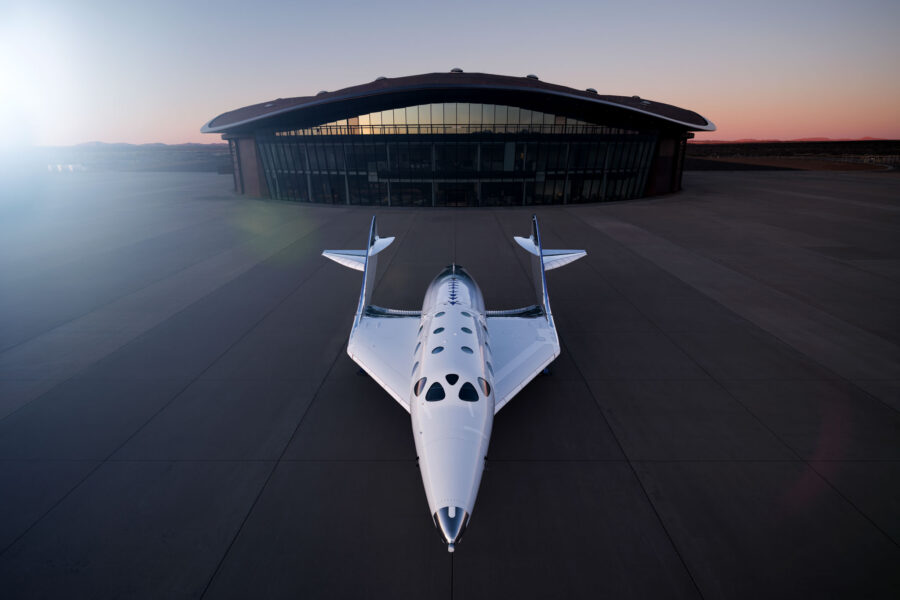
Space tourism company Virgin Galactic announced a new partnership with the Air Force Research Laboratory’s space warfare directorate to collect and share space weather data from the company’s suborbital spacecraft, due for its first commercial flight next year.
The two-year cooperative research and development agreement, which Virgin announced Oct. 14, will provide AFRL with key information about space weather to help researchers understand its impact on satellites and infrastructure that reside on orbit—all gleaned from planned flights of the company’s SpaceShip vehicle. Virgin noted that as part of the agreement, AFRL will “evaluate the integration of sensor systems with Virgin Galactic’s next-generation SpaceShip to collect space weather data during flight.”
“This cooperative research and development agreement will help expand and identify new and additional opportunities for our growing fleet,” the company said.
Understanding space environmental and weather conditions—like solar flares and winds, coronal mass ejections, and geomagnetic storms—is important for government organizations and commercial firms alike. SpaceShip’s suborbital flights offer a chance for AFRL to get more insight into a region where those conditions are perhaps less understood: the mesosphere and lower thermosphere, or MLT. Situated between 60 and 110 kilometers above the Earth, the MLT is too low for satellites to operate, but space weather there can disrupt GPS signals and communications.
Shaun Ard, a senior research chemist at AFRL, said high-quality data about MLT space weather dynamics is limited, and the collaboration with Virgin will help the lab’s researchers “protect and advance space-based systems essential to modern infrastructure and exploration.”
Like previous Virgin Galactic vehicles, SpaceShip is designed to be launched from an aircraft “mothership.” After it reaches altitude and is released from its launch platform, SpaceShip will ignite its own rocket motor to reach suborbital space. The company will launch and land the vehicles from Spaceport America in New Mexico. SpaceShip can carry six passengers.
SpaceShip has been moving through integrated ground testing in recent months, and company officials expect to start flight testing in New Mexico this month.
Virgin envisions SpaceShip as both a space tourism vehicle and a research platform and has aggressive plans to ramp up its cadence following its first commercial flight in February 2027. Once its second vehicle enters service next year, it expects to hit a rate of at least 10 flights per month by the summer, company officials said during an earnings call in August.
“This flight rate is an unprecedented achievement in human spaceflight, and this is made possible with our highly reusable spaceship design,” Chief Financial Officer Douglas Ahrens said at the time. “It’s a beautiful machine with vast potential and now we are approaching the moment when we bring it all together with the ramp of commercial spaceflight operations.”