


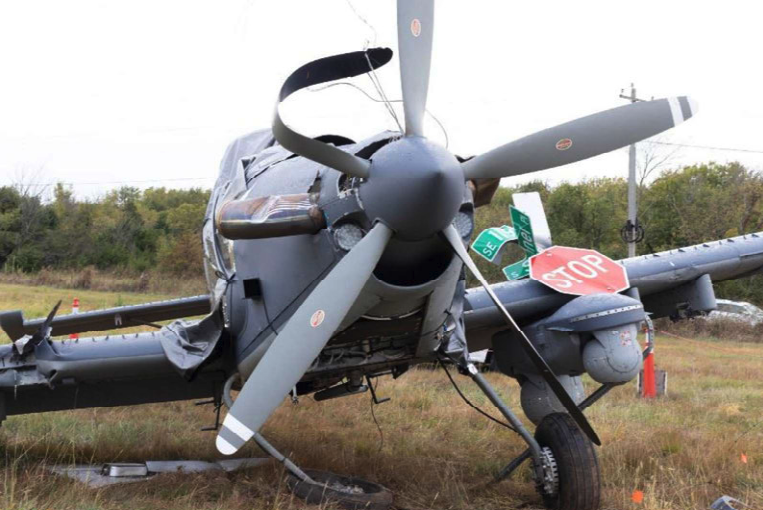
An Air Force pilot learning to fly the new OA-1K inadvertently shut off the plane’s fuel in the middle of a training sortie last October, leading to the Skyraider II crashing in an Oklahoma field, according to a new investigation report.
The aircraft, a special ops “light scout” adapted from a cropduster, was destroyed in the mishap at the cost of $17.9 million, per the accident investigation board report released June 26. Neither the pilot or instructor were injured.
Things could have been worse. The crash occurred on the outskirts of Oklahoma City near roads in the middle of the afternoon, and the report notes that the plane struck and damaged road signs and utility poles before coming to rest in a field. An unconfirmed video from the time showed the OA-1K flying extremely low over a road, forcing a driver to swerve to avoid it.
This is the first known mishap to involve an OA-1K, which U.S. Special Operations Command is buying as a lightweight, flexible, rugged platform to support counterinsurgency operations in relatively uncontested airspace.
While investigators determined the main cause of the mishap was the student pilot’s mistake in shutting off fuel to the engine, they also noted contributing factors like issues with the aircraft’s communications systems and poor prioritization by the instructor and student as the emergency unfolded.
Learning a New Plane
The pilot in the mishap was not new to flying—he was previously a U-28 pilot with more than 2,300 flight hours to his name. But in transitioning to the OA-1K, he was learning a very different platform. While the U-28 and OA-1K are both turboprops, the OA-1K can only carry two crew members and no passengers while the U-28 can have up to four crew and nine passengers. The OA-1K is also unique in the Air Force fleet in having a tailwheel.
At the time of the mishap, the pilot was participating in a tailwheel training course from Will Rogers Air National Guard Base in Oklahoma, which serves as the OA-1K’s schoolhouse. The pilot had just over 37 hours of flight time in the OA-1K to that point—and just three in the “Block 1” version of the aircraft.
While earlier “Block 0” aircraft were not fully modified and were meant to provide initial training for pilots, the Block 1 airframes have all the Skyraider’s systems. Crucially, a particular power lever in the cockpit was changed from Block 0 to Block 1, and the latter, larger version partially obstructs the pilot’s view of a panel. That panel has a silver lever that controls the fuselage fuel tank valve and a red crank that shuts off the fuel tank valve, separated by five inches “given space constraints within the cockpits,” the accident report notes.
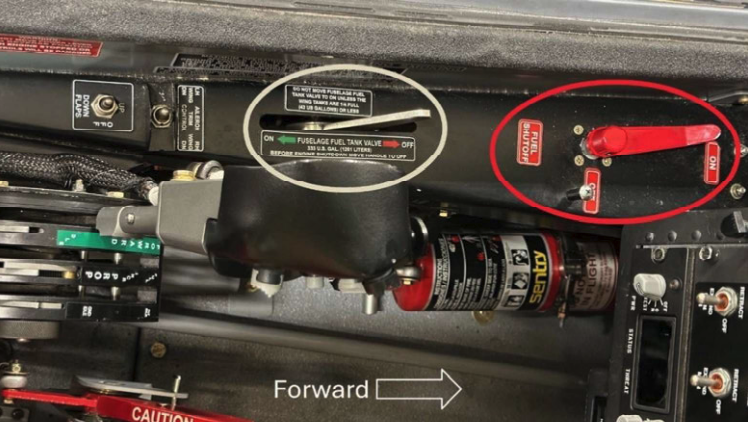
Those two actuators were at the heart of the mishap.
Upon takeoff, the pilot had trouble hearing his instructor and tried to adjust his helmet and comms settings without ever telling the instructor about the issue, which was “exacerbated by engine and wind noise in flight,” the report states.
The pilot was still trying to solve his comms issues four minutes into the flight when the instructor told him to “open the fuselage fuel tank valve to ensure functionality,” according to the report. Instead of pulling the silver lever, the pilot twisted the red crank, cutting off the flow of fuel to the engine.
Within seconds, error messages and warnings filled the cockpit. Engine torque dropped off completely, “consistent with total loss of fuel,” investigators noted. About 20 seconds after he closed the fuel tank valve, the pilot noticed his mistake and twisted the red handle back, reopening the valve—but he did not inform the instructor of the issue.
The instructor pilot disengaged the autopilot and told the student to override the plane’s fuel control unit before making a “mayday” call. At 2:21 p.m. local time, about two minutes after the emergency began, the plane crashed in an empty field.
The propeller hit a utility wire and barbed-wire fencing, bending one blade and wrapping around the gearbox, and both wings sustained serious damage, with one losing its aileron, a flight control surface on the end of the wing. One of the landing gear wheels was bent completely under the plane, and the fuselage had damage to its skin and bent frame tubes.
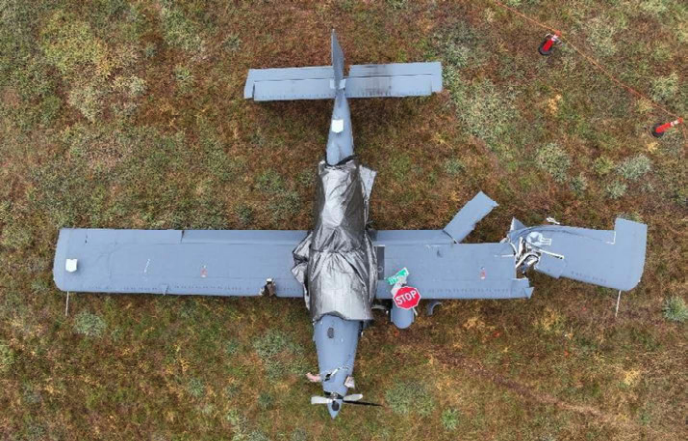
Images included in the report show a stop sign and street signs lodged on the left wing.
While investigators noted the positioning of the fuselage fuel tank valve lever and the fuel valve shutoff handle and the partial obstruction of the power level, they did not explicitly cite that as a factor in the crash.
Rather, officials cited the mistake in twisting the shutoff crank as the more immediate cause of the mishap, while also faulting other issues, like:
- “Task saturation” for the pilot
- Issues with the comms systems
- Poor communication between the pilot and instructor, especially the pilot not informing the instructor of his comms issues or the fact that he had inadvertently shut off the fuel
- Ineffective prioritization by the crew, especially the instructor pilot. Investigators said they “prioritized the emergency landing instead of attempting to execute [critical action procedures]” to manage the situation.