


The Space Force has partnered with the the National Reconnaissance Office to get started on key intelligence, surveillance, and reconnaissance programs but is starting to take more ownership of those efforts, an arrangement the nominee to serve as the next NRO director said is a “lesson in good government.”
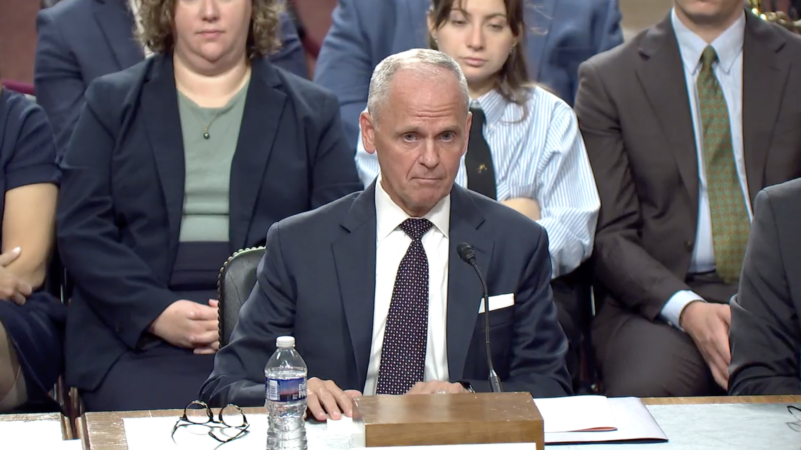
L. Roger Mason Jr., testifying before the Senate Armed Services Committee on July 14, made the case that the relationship between the the two organizations is strong—but was not asked and offered no indication that he supported merging them as another top Trump administration official previously suggested.
“The relationship, the coordination between the United States Space Force and the NRO is essential,” said Mason, a longtime space, intelligence, and defense industry executive and a former Assistant Director of National Intelligence. “It’s the cornerstone for space dominance for the nation. At the same time, the roles and responsibilities are quite clear. The Space Force’s are to organize, train, and equip; the NRO’s are to provide space based intelligence for the [intelligence community] as well as the warfighter.”
For years, the NRO focused on developing “national technical means”: highly secretive, strategic-level satellites and space sensors. With the advent of cheaper launches and proliferated satellite constellations, the Pentagon is increasingly eyeing the Space Force to take over more operational and tactical intelligence.
That’s led to two major NRO-Space Force collaboratives. Silent Barker, a group of three satellites for wide-area surveillance of other objects in orbit, launched in 2023. And the NRO has acquired and launched prototypes of “moving target indication” satellites to track targets on the ground, which the Space Force will operate alongside NRO personnel.
Mason made the case that in both instances, the Space Force needed the NRO to get going.
“In terms of the ground MTI, that was a case where the department took some existing technology that was being developed by the NRO, and then instead of starting a brand new program, adapted that technology, which has been far cheaper, and we certainly got it on a lot quicker,” Mason said.
Silent Barker “follows the same pattern as the moving target indicator,” Mason later added, “Starting with some strengths that the NRO had in terms of developing these type of spacecraft and instead of developing a whole new system, applying resources that were very clear, which were coming from the department versus which was coming from the national intelligence program, and then using those resources to great effect.”
Yet even as Mason touted the NRO-Space Force partnership, he noted that it is fundamentally changing with follow-on efforts.
“[Airborne moving target indication], as I understand it, takes us to the next step that’s actually being procured by the Space Force,” he said. “So to me, this is a good progression of good government decisions in terms of taking strengths and moving them into areas where they should be done by the military.”
In May, the Space Force announced it had awarded a $4.2 billion contract to SpaceX as part of its AMTI program.
Likewise, the Space Force is going its own way for a new batch of surveillance satellites meant to succeed Silent Barker called SG-XX.
“The partnership with the NRO today is great and strong. We are working to fully transition that to the Space Force for the future acquisition,” Col. Brendan Hochstein, commander of Delta 89, told reporters at the Spacepower Conference in December.
The Space Force taking more ownership over such programs could quell the concerns of some experts who previously worried the NRO and the intelligence community would not provide tactical-level data fast enough for commanders in the field. It could also reinforce the separate missions of the two organizations.
Shortly after the Space Force was established in 2019, there was some discussion about moving the NRO under the new service. That idea never got off the ground, but it came back up last year with the nomination of Marc Berkowitz to be assistant secretary of defense for space policy—Berkowitz has perviously argued that the two organizations should tighten their relationship and potentially even merge.
For now, though, there appears to be no appetite in Congress for the idea; no lawmakers asked Mason about it.
Also appearing before the committee July 14 was Erich D. Hernandez-Baquero, nominee to be assistant secretary of the Air Force for space acquisition and integration. Hernandez-Baquero, a former executive at Raytheon and Air Force veteran who spent time at the NRO, told Senators that, if confirmed, he will focus on fully implementing the Pentagon’s ongoing acquisition reforms.
Those reforms mainly focus on organizing acquisition by mission area and granting officials more authorities within those portfolios, but they also are meant to push the Pentagon workforce to embrace commercial technologies and digital tools for faster results.
Hernandez-Baquero said these reforms may be harder to see through for older Space Force programs that traditionally have taken many years and billions of dollars to complete.
“I’m mostly concerned about our legacy acquisitions that have been ongoing for a number of years, and if confirmed, one of the first things I’ll do is review the progress, what’s remaining to be done in those legacy acquisitions?” Hernandez-Baquero said. “Those are the ones that are going to be encumbered the most because they weren’t born with the new digital engineering techniques. They weren’t born with the intent to integrate into these hybrid architectures. And so that would be the the area that I would be most concerned about.”