
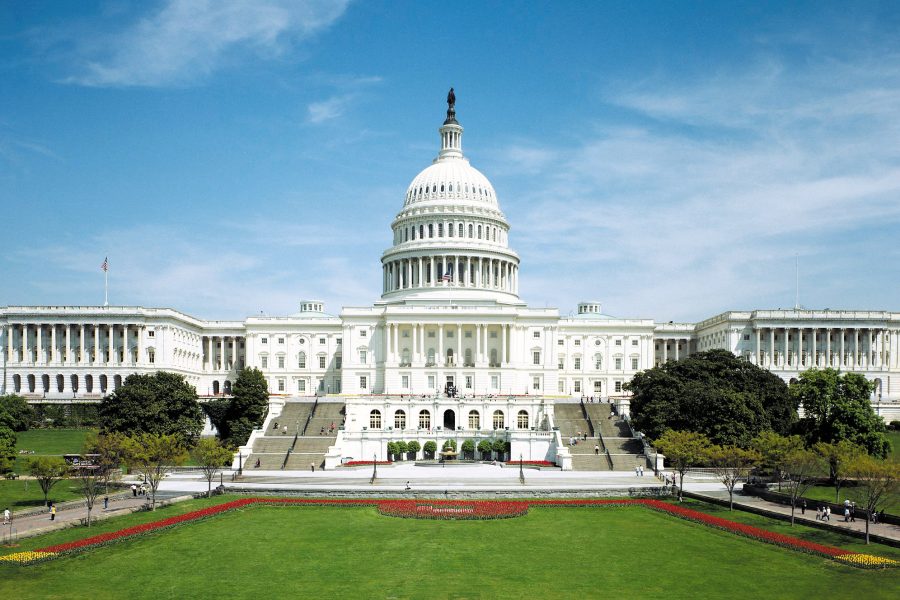
The House of Representatives passed its version of the 2027 National Defense Authorization bill and a new reconciliation package with $60 billion for the Pentagon on July 22, but both the policy and funding legislation face uncertain futures in the Senate.
Both pieces of legislation passed in largely party-line votes—the NDAA vote was 216-212 and the budget resolution vote was 216-214.
2027 NDAA
The NDAA, typically considered must-pass legislation, sets policy, directs reports, and recommends spending levels for the Pentagon each year, though the budget is set by a separate appropriations bill.
The House’s 2027 version includes hundreds of provisions, many of which are directed at the Air Force and Space Force, including:
- Authorization for multiyear procurement contracts for the F-35 and F-15EX fighter jets
- A requirement for the Pentagon to submit a plan to address Government Accountability Office recommendations from multiple reports on the F-35 dating back as far as 2014.
- Elimination of two Space Force acquisition organizations, the Space Development Agency and the Space Rapid Capabilities Office.
- Authorization for four new MH-139 helicopters and a requirement for the Air Force to brief lawmakers Air Force on why it abandoned plans to have the MH-139 fly VIP transport missions around Washington D.C.
- A report on the Air Force’s plan to arm its tanker aircraft with sensors, processors, and weapons for self-defense
- A prohibition on retiring any E-3 AWACS aircraft through 2027
- More authorities to to repair and maintain equipment, also known as ‘right to repair’
More amendments adopted on the House floor July 21 before the final vote touch on the Collaborative Combat Aircraft program. One would require the Air Force, with U.S. Transportation Command, to provide Congress with a strategy on the “storage, mobility, maintenance, cost, and deployment requirements” for the program. Another amendment would require a report on the Air Force’s future plans for advanced sensor and electronic warfare systems on CCAs; the first iterations the service has unveiled are weapons-carrying platforms.
With the House having now passed its version of the bill, the Senate must still pass its version. A procedural vote in that chamber failed to get the necessary 60 votes earlier this month, as Democrats have pushed back over the war with Iran and the scale of the defense budget increase compared to nondefense spending.
At a July 21 press conference, Senate Majority Leader John Thune (R-S.D.) offered no indication of when he may try to bring the NDAA up for another vote.
Reconciliation 3.0
The budget resolution the House passed by just two votes is the third reconciliation package Republicans have pursued this Congress—the first in July 2025 included $150 billion for defense, and the second, in June 2026, had $70 billion for immigration agencies.
This third version has $95 billion, the bulk of which is meant for the military. The exact details of what that $60 billion will go toward are still unclear, as the House Armed Services Committee must still craft a spending plan.
Republican lawmakers have portrayed the reconciliation effort as a way to help pay for the costs of the war with Iran and replenish munitions stockpiles used in the conflict. The White House submitted a supplemental funding request for those costs and other programs with $67.1 billion for the Pentagon, leaving a $7.1 billion gap.
At the same time, the Pentagon is still waiting to see if Congress will fulfill its 2027 budget request for $350 billion in reconciliation funding. House lawmakers have reportedly suggested they may pursue a fourth reconciliation package after the 2026 midterm elections, but the third package’s fate is still far from clear.
At the July 21 press conference, Thune noted that Senate Republicans do not all agree on the $60 billion in reconciliation—some want more money, while others are upset there are not offsetting cuts elsewhere. Instead, Thune said he preferred to negotiate with Democrats on the supplemental funding request.
