
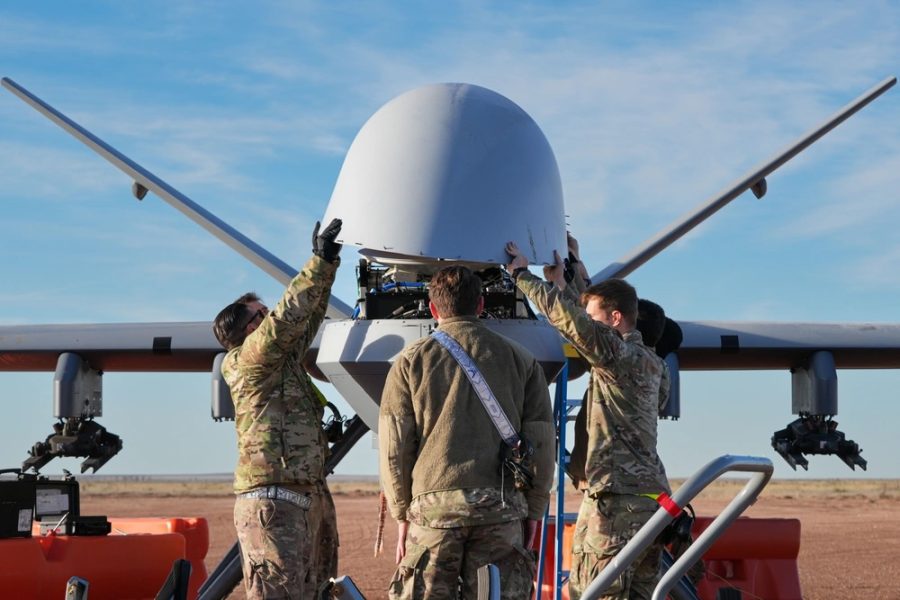
General Atomics plans to pitch a brand new design for a low-cost, attritable drone to take on missions now carried out by its MQ-9 Reaper.
In a July 21 statement to Air & Space Forces Magazine, General Atomics spokesman C. Mark Brinkley confirmed the company will propose a clean-sheet approach in response to a Pentagon call for a new type of drone it calls Massed Modular Aircraft, or MMA.
Breaking Defense first reported the news, based on an interview with Dave Alexander, CEO of General Atomics Aeronautical Systems, at the Farnborough International Airshow in England.
The Defense Innovation Unit on July 7 posted a solicitation asking companies for their proposals to make the MMA, which would fly in groups big enough to overwhelm the enemy even if some were shot down. The Air Force later said it was working with DIU on the effort.
The Air Force and DIU want MMA drones to have a fully loaded combat radius of at least 2,300 nautical miles and be able to launch weapons, collect intelligence, perform electronic warfare operations, or relay communications in flight to exhaust the enemy. They said MMAs should also be modular and able to carry payloads of at least 2,800 pounds, including full-motion video sensors, to fill the MQ-9’s current roles.
Brinkley told Air & Space Forces Magazine that the company plans to use experience learned from making hundreds of MQ-9s and other drones over more than two decades to hone its pitch.
“We don’t have to reinvent every wheel here,” Brinkley said. “We have a lot of qualified parts and processes in place, from a lot of programs, and it makes sense to use many of those in new ways.”
The Defense Innovation Unit said the MMA approach is needed because the military’s current approach of using “exquisite” aircraft costing more than $30 million per tail is not sustainable against enemies with low-cost antiaircraft capabilities and layered defenses. The proposal came after the loss of about 30 MQ-9s during operations against Iran, and as Ukraine has extensively used low-cost drones against Russia.
Alexander said in his interview with Breaking Defense he is confident General Atomics will be able to offer a drone in DIU’s price range, which has not been made public. But he questioned how realistic DIU’s lower-end cost requirements are, saying “anybody that bids that number is very suspicious.”
Brinkley said General Atomics understands that keeping costs down on MMA drones is a top priority for the government, alongside scaling, manufacturing and capability. That is “a lot to chew on,” he said, and General Atomics is in the process of working out its plan.
“We’re hearing the government on this and we understand what the ask is,” Brinkley said. “We’re going to submit an honest, scalable, buildable, flyable, reliable aircraft. No one wants the government to waste money here on junk.”
