


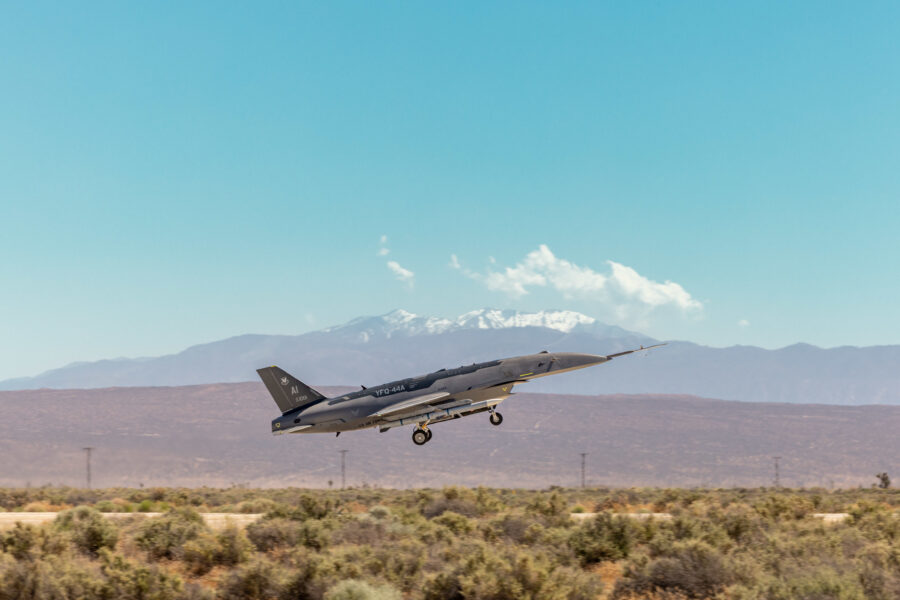
The Air Force’s “software sold separately” plan to buy critical autonomy software decoupled from the physical air vehicle for its nascent Collaborative Combat Aircraft fleet could help the drones evolve quickly, foster competition, and avoid vendor lock-in, experts and service officials told Air & Space Forces Magazine.
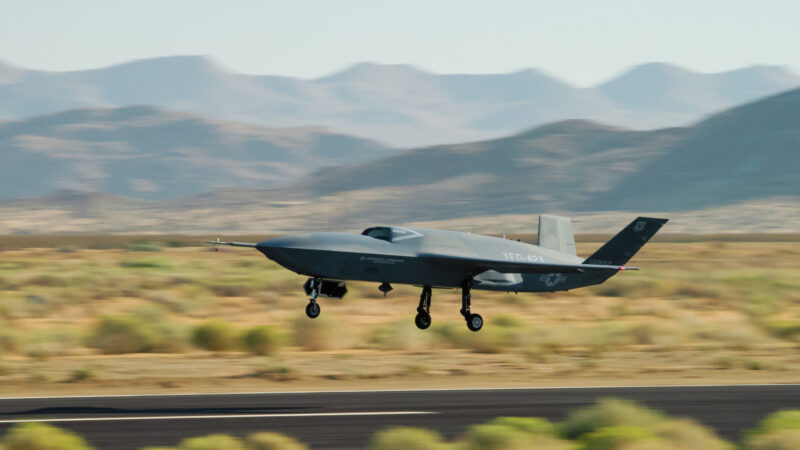
The service in June announced it had awarded production contracts to General Atomics Aeronautical Systems and Anduril Industries to build the Air Force’s first two CCA vehicles. General Atomics’ FQ-42A and Anduril’s FQ-44A will pair with manned platforms, taking high-level orders from the human pilot and executing missions semi-autonomously.
The key to that vision is in three other production option deals announced in June—with Anduril, Shield AI, and Collins Aerospace—to deliver mission autonomy software that would allow CCAs to carry out operations without direct human control.
The service hopes this approach could provide a path forward for better high-tech, software-heavy acquisition programs.
An Air Force spokesperson said in a statement to Air & Space Forces Magazine that this approach will allow the service “to buy the best software available independently from the air vehicle,” or the physical CCA itself.
To make this possible, the spokesperson said, the Air Force established a common digital standard called the Autonomy Government Reference Architecture, or A-GRA. This approach “decouples software from hardware, prevents vendor lock, and allows the Air Force to switch between autonomy solutions without having to redesign the entire system,” the spokesperson said.
Sold Separately
Bryan Clark, a senior fellow at the Hudson Institute who specializes in defense technologies and autonomous systems, agreed this strategy could make it easier for the Air Force to buy the best mission autonomy system and drive vendors to perform better. At this point, he said, the approach is largely untested.
“We haven’t really had any major acquisition programs where they’ve decoupled the software from the hardware to this degree,” Clark said.
Former Air Force Secretary Frank Kendall, who made CCAs a top priority of his tenure during the Biden administration, compared the “software sold separately” approach to how a smartphone’s programming works.
Similarly to how an iPhone or Android phone have an own operating system running the device, each CCA will come with its own native flight control software to manage things like its engine, fuel system, and other “inherent functions of an airplane to be an airplane, and fly successfully without a pilot,” Kendall said in an interview with Air & Space Forces Magazine.
But beyond that, he said, the CCA will require mission autonomy software to control tactical behaviors, such as how it fights and follows the human pilot’s instructions. This programming, under the “software sold separately” approach, will be akin to the apps an iPhone or Android runs—programs that provide additional capabilities but could be updated or replaced, like swapping Google Maps for Waze, Kendall said.
This has been the CCA program’s strategy virtually from the start, said Kendall, who released a book this month called “Lethal Autonomy: The Future of Warfare Whether We Like It or Not.” The idea, Kendall added, is to free the Air Force to choose which mission autonomy provider is the best, regardless of who makes the aircraft.
“It allowed [the Air Force] to pick from multiple software providers who are good at that, as well as from multiple airplane providers who were good at that,” Kendall said. “It’s a way to manage the risk, [to] have more than one person trying to do this so that increases your odds of success.”
This approach also encourages economic competition, Kendall said, which could help keep prices down as vendors compete to provide the best value to the Air Force. Kendall said he was glad the Air Force awarded production contracts for the air vehicle to both Anduril and General Atomics for that reason.
“I think we’ll learn more from that,” Kendall said. “It allows you to carry the competition forward further into the program. [It encourages] better performance, and keeping the cost under control.”
The Need for Speed
As military aircraft have become increasingly complex and high-tech over the decades, getting the software right has become increasingly important. At times, software problems have snarled critical upgrades and left fighters unable to perform vital missions, such as the F-35 after its Technology Refresh 3 modernization.
Taking a more modular approach to CCA mission autonomy will help keep the Air Force from being constrained, Kendall said.
“Having a lot of options is a good thing, and having continued competition as an incentive is also a really good thing,” Kendall said.
A software-sold-separately approach also avoids a prime contractor locking in multiple key aspects of a new system, which can limit the government’s choices for future improvements, he said.
“For any program that you’re going to have for quite a long period of time—and F-47 certainly should be one of those—you want the capability to upgrade it,” Kendall said. “We should have learned from the F-35 that you don’t want to just hand that over to the prime. You want to make sure that on the government side, the opportunities to modularly add new capability, switch out subsystems or software modules, is designed into the platform. You’re going to constantly be upgrading software.”
When asked whether a similar strategy could be used for the F-47, the Air Force spokesperson said that government reference architectures like the one being used for CCAs “give the USAF and industry the flexibility to pursue similar strategies if it is in the best interest of the warfighter.”
Clark said one potential drawback to the software-sold-separately approach is that vendors’ programming will need to be designed to work with multiple systems, and, as a result, could lose some of the performance that more tailor-made software might provide.
“When you’re writing the software for a radar, if you knew what the vehicle was going to be on every time, then you would write the software in a way that is tailored to the vehicle design, and also leverages what the vehicle’s other capabilities,” Clark said. “If it’s a highly modular system where you’re mixing and matching different sensors, or different electronic warfare jammers or different weapons payloads, that mixing and matching means you’ve got to genericize the software to a degree. That means you’re not going to be able to leverage all the functionality of the payloads every time.”
For that reason, Clark said, a software-sold-separately approach may not be right for the F-47, which is focused on delivering high performance. But other systems that wouldn’t require such high performance, such as next-generation mobility or refueling aircraft, may benefit from this strategy, Clark said.
A critical prerequisite for this kind of strategy, Kendall said, is that the government must have a strong technical team that can work with contractors to sort out the details.
“You get in a lot of trouble when you don’t have that kind of expertise and insight on the government side,” Kendall said.
Next Steps
Anduril, Shield AI, and Collins’ mission autonomy software offerings were selected from a broader pool of potential vendors that also includes Lockheed Martin, Northrop Grumman, and General Atomics.
The winning firms are now working to advance their mission autonomy software as much as possible within six months to meet the Air Force’s initial operating capability criteria. The Air Force will then choose one or two vendors to continue for six more months, and in summer 2027, it will choose a single vendor.
Shield AI is offering its Hivemind mission autonomy and artificial intelligence software for the CCA project. Anduril is pitching its Lattice for Mission Autonomy system, and RTX-Collins Aerospace is offering its Sidekick system.
Shield AI’s Todd Wesley, vice president for Hivemind, told Air & Space Forces Magazine in a phone interview that the software does more than simply keep the aircraft flying without a dedicated pilot.
The software is involved in planning a set of ground-based mission activities before takeoff, Wesley said. And when the aircraft is in the air and the mission is underway, he said, Hivemind’s mission autonomy software can react to various scenarios based on the limits and functions the operator has set.
“Mission autonomy isn’t like a remotely piloted aircraft, or just following scripted automation capabilities on a preplanned route or preplanned set of activities,” Wesley said.
Shield AI said that over the next six months, the company will continue to mature the technology and work on reducing software risk.
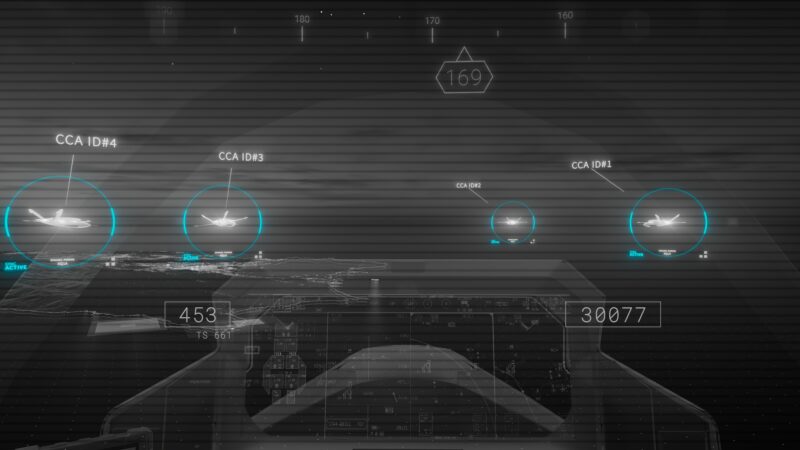
Shield AI will be shaping Hivemind based on many lessons learned from a variety of Pentagon autonomy programs, including the Alpha Dog flight trials with the F-16, a Defense Advanced Research Projects Agency effort that tested AI-driven aerial combat experiments.
“We’re not just going through the experimentation side of things now; we’re going through building trust, along every aspect of mission execution to ensure that we’ve got a deployable capability, something that [Air Combat Command] is willing to go to war with,” Wesley said.
An Anduril spokesman, responding via email, told Air & Space Forces Magazine that the company will continue “rapid development and testing of Lattice for Mission Autonomy” to expand its capabilities and prove its performance across more parts of the CCA mission profile.
Anduril’s YFQ-44 has not only run Shield AI’s Hivemind software, it was also able to switch from Hivemind to Anduril’s own Lattice software. After the initial mission February, the company executed a “more complex mission” with Lattic in March, the spokesperson said.
An RTX spokesman told Air & Space Forces Magazine via email that the company “will continue to work closely with our customer to enhance, advance and demonstrate our Collaborative Mission Autonomy capability.”
RTX Collins integrated Sidekick into the General Atomics FQ-42A earlier this year, using the autonomy mode to “enable a four-hour autonomous flight managed by a human operator on the ground,” the spokesman wrote.
All three companies noted in their responses that building trust is the key ingredient for getting human pilots to fly with, alongside, or control these platforms.
But the yearlong competition between those three firms may not be the end of the story. Three years from now, the Air Force plans to hold a “fly-off” to take another look at all six vendors’ mission autonomy offerings. The vendors will load their software into CCAs and conduct an in-flight demonstration so the Air Force can decide which provides the better solution.
“We will continuously compete licenses to ensure we always have the best capability at the best price,” the Air Force spokesperson said.
Beyond Mission Autonomy
Col. Timothy Helfrich, the Air Force’s portfolio acquisition executive for fighters and advanced aircraft, told reporters in June that a future project called the Command and Control Enclave will also be another option for the vendor pool to bid on.
That C2 Enclave program will be a secure digital workspace where systems operators will manage and direct CCAs, the Air Force spokesperson said. This will be different from the technology allowing a pilot in a crewed fighter to control a CCA, the spokesperson said, “and will run as an application suite on a range of networks to enable the right operator, with the right permissions, to operate CCA.”
Kendall said that additional command-and-control programming could allow Airmen to direct and manage the CCA from the ground or from a battle management aircraft like the E-7 Wedgetail.
And, Kendall said, this is just the start of the era of manned-unmanned teaming.
“This is going to evolve as we get smarter, and as people try things out and learn from them,” Kendall said. “So this gets us in the door, and we’ll see where it goes from here.”