
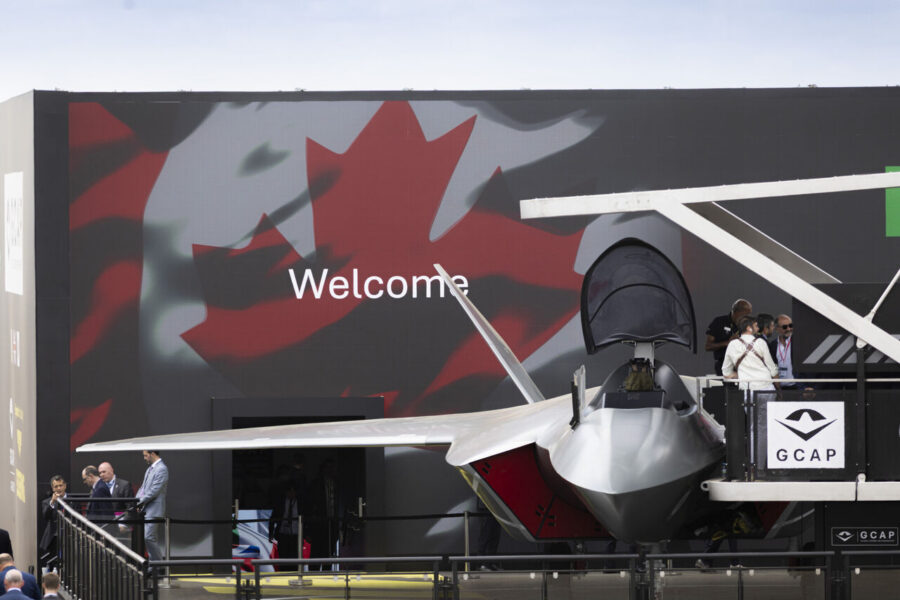
Canada’s decision to join a European-Japanese sixth-generation fighter program is another sign of more countries looking to develop their own capabilities instead of relying on the U.S. and American-made systems, experts say—a larger trend that could potentially drive up costs for U.S.-made systems and spare parts.
And while President Donald Trump had previously suggested the U.S. may try to export its own sixth-gen fighter, the F-47, Canada’s move, announced July 21 during the Farnborough International Airshow in England, also reinforces how unlikely that is, the experts said.
Canada will be an observer to the Global Combat Air Programme, or GCAP, a joint venture between the U.K., Italy, and Japan. The U.K.’s Ministry of Defence said in a release that Canada, as the first observer nation in GCAP, will receive direct insight into its capability development, industrial collaboration, and long-term delivery plans. Canada has not yet committed to buying GCAP and will not have a say in making decisions on the program, but the U.K. release said Canada’s observer status will give it privileged access to the program and “paves the way for discussions on Canada’s future participation and contribution to GCAP.”
Doug Birkey, executive director of the Mitchell Institute for Aerospace Studies, noted that Canada’s decision fits a larger trend of “allies pushing to buy domestic systems for a variety of reasons. Part of it can be politics. Pat of it can be just desire to keep the money within the nation or the region.”
The political relationship between the U.S. and Canada has deteriorated as of late. Trump has called for the U.S. to annex Canada as its “51st state” and announced a new slate of tariffs on July 20. Canadian Prime Minister Mark Carney has argued for a “middle powers” strategy whereby Canada relies less upon the U.S. and other global superpowers.
Canadian defense minister David McGuinty said at a July 21 press briefing in London that his country would still be joining GCAP even if the U.S. and Canada were not in the midst of a trade dispute—though he did call the latest U.S. tariffs “unilateral.”
“This is about recognizing that we have got to come together,” McGuinty said. At the recent NATO conference in Ankara, Turkey, he said, multiple members asserted “it was time for our member states to come together in a way that we haven’t previously done, that no one nation is going to be able to deal with these challenges alone, and that there is strength in cooperation.”
U.K. defense minister Wes Streeting said the four nations’ participation shows a commitment to shared values and interests, and a commitment to deepen defense and industrial cooperation “with a close ally.”
F-47
The U.S. is deep into developing its own sixth-gen fighter through the F-47 program, with a planned first flight in 2028. And when Trump announced the designation and named Boeing as the contractor in March 2025, he suggested allies may one day get their hands on the air dominance platform.
“Our allies are calling constantly, they want to buy them also,” Trump said. “And certain allies, we’ll be selling them perhaps toned-down versions. We’d like to tone them down about 10 percent, which probably makes sense, because someday maybe they’re not our allies, right?”
Despite those comments, Canada was unlikely to ever join the F-47 program, experts said.
The F-47 will likely be too expensive for Canada, Birkey said, and its status as a long-range air-to-air fighter, best geared towards a Pacific theater fight against China, makes it a poor fit for Canada.
Indeed, Bryan Clark, a senior fellow at the Hudson Insitute, said there have been no public indications besides Trump’s initial comments that foreign sales are in the cards. Defense budget analyst Bryon Callan wrote in a July 21 newsletter that F-47 “may have no export prospects given its cost and the desire of the U.S. to protect its technology.” A desire to protect key technologies previously led Congress to ban any exports of the fifth-generation F-22, which the F-47 is meant to replace.
“The U.S. has already boxed itself out when it comes to next-generation aircraft” sales, Clark said in an interview with Air & Space Forces Magazine.
With the F-47 off the table, countries who want sixth-generation fighters have to develop them themselves. Germany, Spain, and France had been pursuing such a program, the Future Combat Air Systems’ fighter project, but that effort collapsed earlier this year. That meant GCAP is “the only game in town” for a country like Canada, Clark said.
Bigger Picture
While Canada was never likely to join the F-47 program, its turn to GCAP fits with a broader trend of hedging against reliance on U.S.-made systems.
Canada, the U.K., and Italy were all partners in developing the Lockheed Martin-made F-35 Joint Strike Fighter, and Japan has bought F-35s as well. But now, “these countries are looking at [the current environment] and saying, ‘Well, do I want to be in a situation where I have to have good relations with the U.S. because I’m dependent upon a U.S. company to support my sophisticated piece of hardware?” Clark said.
Indeed, Canada has recently paused plans to buy 88 F-35s and is now considering a mixed fleet of F-35s and Canadian-made Saab Gripen-E fighters. The Canadian government is on contract for 16 F-35s but could stop procurement after that.
Another hedge took shape earlier this month, when NATO announced it will buy Saab’s GlobalEye airborne early warning and control system aircraft instead of Boeing’s E-7 Wedgetail as previously planned. Birkey said the Pentagon’s indecision since summer 2025 over whether or not to build an Air Force fleet of E-7s to replace its aging E-3 Sentries was also a likely factor in NATO’s decision.
If partners and allies turn away from the United States and buy their own homegrown systems, that could have second and third order effects on the U.S. military, Clark and Birkey said.
If allies’ militaries are flying or using different systems than U.S. forces, Birkey said, that could hinder joint interoperability between partner forces.
And if not as many foreign customers are buying U.S. systems, Birkey said, that means the contractors aren’t building as many, which makes achieving economies of scale harder. So with fewer customers spreading out the costs, that could drive up prices the Pentagon pays, he said.
Clark said that could particularly hurt prices on spare parts needed for repairs and sustainment in years to come.
“If there’s fewer customers, there’s fewer fees for parts,” Clark said. “The scale of parts production might be lower. … It’s indicative of the challenge the U.S. is going to have going forward with selling military hardware to allies who are going to be reticent to get tied up with the U.S., given the U.S. track record on how they treat allies.”