
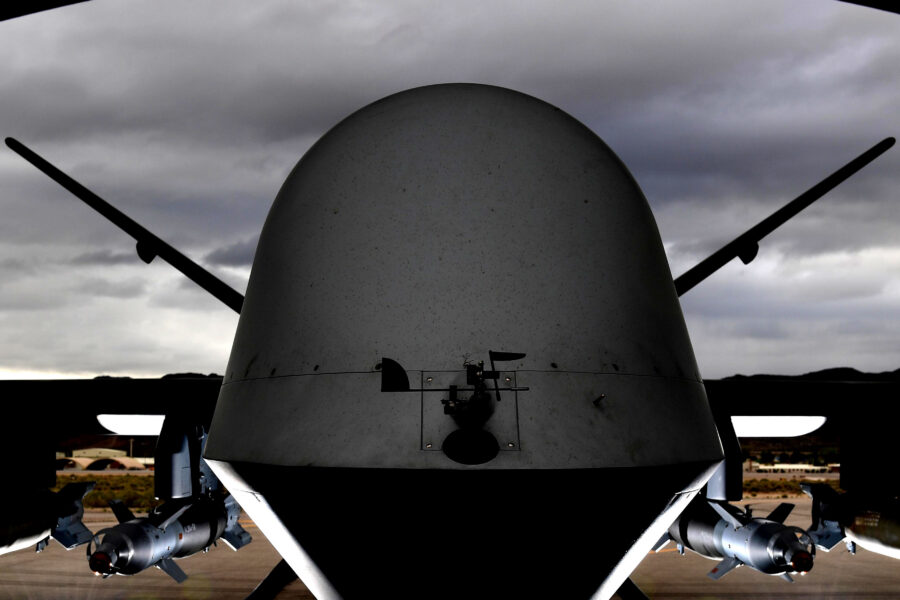
A reported surge of MQ-9 Reaper drones to Latin America could widen the scope of intelligence gathering and free up more strike options against cartels in the region, experts tell Air & Space Forces Magazine.
According to numerous media reports, the Pentagon has supplied Colombia and Ecuador with several Reapers and transferred an undisclosed number of MQ-9s from U.S. Africa Command to U.S. Southern Command.
Officials from Colombia and Ecuador have confirmed they are receiving MQ-9s to local media outlets, and CNN, the New York Times, and the Wall Street Journal have all reported that Reapers are moving from Africa to Central and South America.
Spokespeople from AFRICOM and SOUTHCOM both declined to comment on the movement of any aircraft, but the reports indicate how Reapers, long known for their role in counterinsurgency operations in the Middle East and Africa, are becoming more and more important to the U.S. military’s counter-narcotics efforts.
“We’re helping our partners build up their capabilities, and then that allows us to kind of push more resources into countries with fewer capabilities,” Henry Ziemer, an associate fellow with the Center for Strategic and International Studies Americas Program, told Air & Space Forces Magazine.
Marine Corps Gen. Francis L. Donovan, head of SOUTHCOM, has made a point of emphasizing the use of unmanned, autonomous systems in the region since taking command in February.
“U.S. Southern Command is focusing on integrating autonomous warfare systems to enhance domain awareness across maritime, air, and border areas,” SOUTHCOM spokesperson Steven McCloud told Air & Space Forces Magazine in an email. “These unmanned systems allow our partners to monitor their territory better and facilitate informed interdiction decisions. Improved data flows and situational awareness benefit everyone.”
SOUTHCOM established an Autonomous Warfare Command in April to lead its efforts on that front.
Any increase in the number of long-endurance intelligence, surveillance, and reconnaissance platforms in SOUTHCOM—both piloted and remotely piloted—will give the combatant commander more options and allow them to share intelligence with their counterparts, retired Air Force Maj. Gen. Julian “Ghost” Cheater told Air & Space Forces Magazine.
And demand for intel is surging amid a growing effort to combat the cartels and the flow of drugs in the region, led by President Donald Trump and boosted by allies and partners in the region.
Beginning in March, a U.S.-led effort helped create the Americas Counter Cartel Coalition, which has grown from an initial dozen members to 19 nations, with Colombia being the most recent. In August, SOUTHCOM announced its new Joint Task Force-Western Hemisphere, the region’s “action arm” for missions like counter-narcotics.
At the time, former Air Forces Southern Commander Lt. Gen. Norm Seip told Air & Space Forces Magazine that the new task force could lead to more prioritization of assets for the SOUTHCOM commander.
Cheater, who retired in June and most recently served as the director of strategy, policy, and plans for SOUTHCOM, added that any new allocation of ISR assets would be based on the combatant commander’s priorities—which would suggest Donovan is putting an emphasis on intelligence gathering.
“Ultimately, AFSOUTH is responsible for providing that comprehensive command and control of airborne operations in theater,” said Cheater, who has more than 3,700 flight hours, a good chunk of that on drones, and commanded drone units such as the 432nd Wing out of Creech Air Force Base, Nev. “This component reports directly to the combatant commander, and if AFSOC or another entity provides those assets, those are generally commanded and controlled via AFSOUTH.”
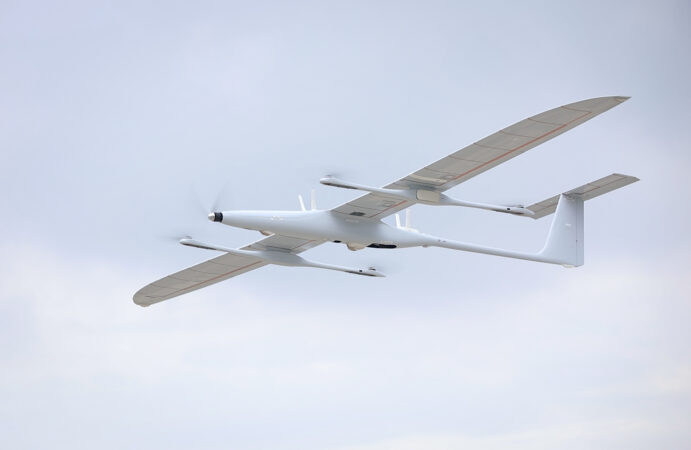
In addition to the reported MQ-9 transfers, SOUTHCOM also announced in mid-September the sale of more than $6 million worth of K1000 ultra-long endurance drones to Panama to “monitor remote borders, safeguard strategic maritime corridors, and dismantle illicit drug trafficking and human smuggling networks,” according to a command release.
Built by Kraus Hamdani Aerospace, the K1000 is a 45-pound, 9.8-foot-long drone with a 16.4-foot wingspan that can reach speeds up to 75 miles per hour and has a ceiling of 20,000 feet. It can fly continuously for 24 hours in its solar-recharge configuration or 12 hours in its electronic vertical take-off and landing configuration. It has a range of about 1,000 miles and can be controlled via line of sight comms within 90 miles or beyond line of sight using satellite comms. A three-person crew can pack it into Pelican cases in under 15 minutes.
The Reaper’s airframe costs between $30 and $50 million each; sensors and weapons can add to that cost. It is a medium-to-high-altitude, long-endurance drone with a 66-foot wingspan and a 50,000-foot ceiling. The drone can fly for 27 continuous hours and up to 42 hours in extended-range variants with a range of 1,000 to 1,400 nautical miles. It has similar line of sight/beyond line of sight command and control capabilities to the K1000.
As of Sept. 30, 2025, the Air Force reported 182 Reapers in its inventory, though at least 45 have been lost during operations against Iran.
What’s Changing
As operations in SOUTHCOM have ramped up under the Trump administration, the MQ-9 has already played a role.
Since September 2025, SOUTHCOM has conducted at least 71 lethal, kinetic strikes targeting alleged drug boats. The strikes, some of which have reportedly been made with MQ-9s, have killed at least 215 people, with another 17 missing or presumed dead, according to government accounts and media reports.
The strikes have mostly targeted vessels near Venezuela’s shores, in the Pacific Ocean, and across the Caribbean. Early strikes began before the Pentagon formally announced Operation Southern Spear in November 2025, the wider effort to target cartel assets with kinetic strikes and other means. That temporary operation has become the more permanent JTF-WH.
Drug Boat Strikes
| Month | Total Killed |
|---|---|
| September 2025 | 17 |
| October 2025 | 44 |
| November 2025 | 21 |
| December 2025 | 32 |
| January 2026 | 2 |
| February 2026 | 24 |
| March 2026 | 13 |
| April 2026 | 21 |
| May 2026 | 16 |
| June 2026 | 8 |
| August 2026 | 6 |
| September 2026 | 7 |
| October 2026 | 4 |
| Total | 215 |
Those strikes have sparked intense debate among legal experts and lawmakers, and the Washington Post reported in July that a Drug Enforcement Administration assessment found that they have not been effective in stemming the flow of cocaine into the U.S.
Ben Friedman, policy director at Defense Priorities, a D.C.-based think tank that promotes a restrained U.S. foreign policy, told Air & Space Forces Magazine that he doubts the strikes will ever be effective.
“I don’t think it—using military forces to counter the flow of narcotics—works particularly well, and we have decades of experience at that. Even if we intensify it, I think we’ll get the same result at a higher price,” Friedman said.
During Congressional testimony in March, Donovan indicated that SOUTHCOM is shifting to take a more comprehensive approach to the counter-cartel fight.
“We’ve seen changes in the narco-traffickers’ patterns, and in a closed setting I’d like to provide some more details specifically on that, but … the boat strikes aren’t the answer,” Donovan told Sen. Mark Kelly (D-Ariz.) on March 19.
“What we’re moving for right now [is] … really a counter-cartel campaign process that puts total systemic friction across this network,” Donovan added.
More MQ-9s in theater could aid this expanded effort.
Currently, Reapers are tasked out of various locations, including U.S. facilities in Puerto Rico. And while the platform has a long loiter time, its eye-in-the-sky is not infinite. Having Reapers actually located in Ecuador and Colombia extends the regional reach by freeing up assets for other operations with other partners.
“These drones to SOUTHCOM, they can also be operated out of Colombia. I think the drones of Panama [are] really going to help find the targets that they’re looking for, targets being drug traffickers,” Wilder Alejandro Sanchez, president of the D.C.-based consulting firm Second Floor Strategies and nonresident senior associate at the CSIS Americas program, told Air & Space Forces Magazine.
Potential MQ-9 Operating Locations
| Air Base | Location | Distance to Colombia (mi) | Distance to Ecuador (mi) |
|---|---|---|---|
| Soto Cano Air Base | Comayagua, Honduras | 1,080 | 1,320 |
| Comalapa Air Base | San Luis Talpa, El Salvador | 1,150 | 1,280 |
| Hato International Airport | Willemstad, Curaçao | 620 | 1,210 |
| Flamingo International Airport | Bonaire, Caribbean Netherlands | 660 | 1,250 |
| Muñiz Air National Guard Base | San Juan, Puerto Rico (U.S.) | 1,080 | 1,670 |
| Naval Station Guantanamo Bay | Guantanamo Bay, Cuba | 920 | 1,510 |
| Homestead Air Reserve Base | Homestead, Florida, USA | 1,510 | 1,980 |
| MacDill Air Force Base | Tampa, Florida, USA | 1,680 | 2,110 |
Ziemer said increased use of drones like the MQ-9 will widen the ISR and data and communications sharing between the United States and regional allies and partners.
“Long-endurance UASs are tremendously useful to patrol large swaths of the jungle, patrol large maritime borders, looking for illicit activity,” Ziemer said.
That can include illegal mining and fishing, human trafficking and a host of other nefarious cartel and criminal organization or foreign terrorist organization practices, Ziemer said.
Retired Air Force Lt. Gen. Mark “Chris” Nowland, former deputy chief of staff for operations and commander of Air Forces Southern, told Air & Space Forces Magazine that the airborne assets will prove vital for building “patterns of life” on cartel activities.
“The advantage of the Reaper being there is it gives you this incredible distance that you can cover now and put ISR on,” Nowland said. “Now you just have something that you can cue and go and get better vigilance on or discover new stuff that you couldn’t because of the sensor capabilities they have.”
Risks
While the experts and former military officials lauded the increased capabilities the new MQ-9s could bring, they also noted limitations and risks with the move.
Sanchez, a Peruvian native, and Ziemer agreed that MQ-9s are not the only drones needed. Long-endurance, high-altitude drones play a crucial role, Sanchez said, but under the canopy of dense jungles or on remote mountaintops, smaller, nimbler, backpack-portable drones already feature in counter-narcotics operations and will become even more necessary.
“It’s not just big, expensive Reapers or MQ-4 Tritons, but also small … [drones] that they can transport in a backpack, so the small squads can deploy them and find the objective much faster when they’re on the ground,” Sanchez said.
Sanchez also noted that regardless of the platform, communication and intel sharing must ramp up, which will require building that capacity within under-resourced partner nations.
“Imagine the Reaper drone has some information. It’s going to be sent to a base … and then how long does it take for that information to be sent to the troops, who need to go to that location?” Sanchez asked.
Presuming Reapers operate out of partner bases, they face their own dangers, Nowland added.
“If these U.S. assets are effective, [they] could become targets,” Nowland said. “So how do you protect them wherever you put them…? This is a dilemma that I’m sure SOUTHCOM is thinking about.”
Friedman also worries that with a change in government, assets sold or given to partner nations could be used for unintended measures.
“South American politics are not nearly as unstable as they used to be, but there are changes of government, changes of leadership, even the potential for coups,” he said. “They might be doing things that lack discretion and control… to see a South American government just doing the kind of drone strikes that we do against their own populations with capability that we gave them.”
More broadly, Friedman argued that the overall push of military assets in Latin America is an escalation in the region and threatens to make the decadeslong Drug War into a literal war.
“I don’t see a lot of virtue in having a more militarized approach to the Western Hemisphere,” said Friedman. “In practice, I think you wind up doing a bunch of things if you’re doing it with the Pentagon that probably don’t make sense.”
“If I had my druthers, they’d probably be using [them] more for training in the United States and not either of these missions,” he said. “You know, preparing for a war that actually involves some kind of core U.S. interest.”
SOUTHCOM Shifts
- On Jan. 20, 2025, President Donald Trump signed an executive order declaring cartels Foreign Terrorist Organizations (FTOs) and asserting that the U.S. is in a “non-international armed conflict” with drug-trafficking entities.
- On Sept. 2, 2025, Trump and SOUTHCOM confirmed the first lethal drug boat strike, saying it killed 11 individuals belonging to the Tren de Aragua gang.
- In December 2025, the Trump administration released a new National Defense Strategy and National Security Strategy prioritizing the Western Hemisphere and military actions against drug cartels, including “targeted deployments to secure the border and defeat cartels, including where necessary the use of lethal force to replace the failed law enforcement-only strategy of the last several decades.”
- On March 5, 2026, at a Americas Counter Cartel Coalition conference, Trump said the U.S. will work with Latin American countries “to do whatever we have to do. We’ll use missiles. … But we’ll do whatever you need. The only way to defeat these enemies is by unleashing the power of our militaries.”
