
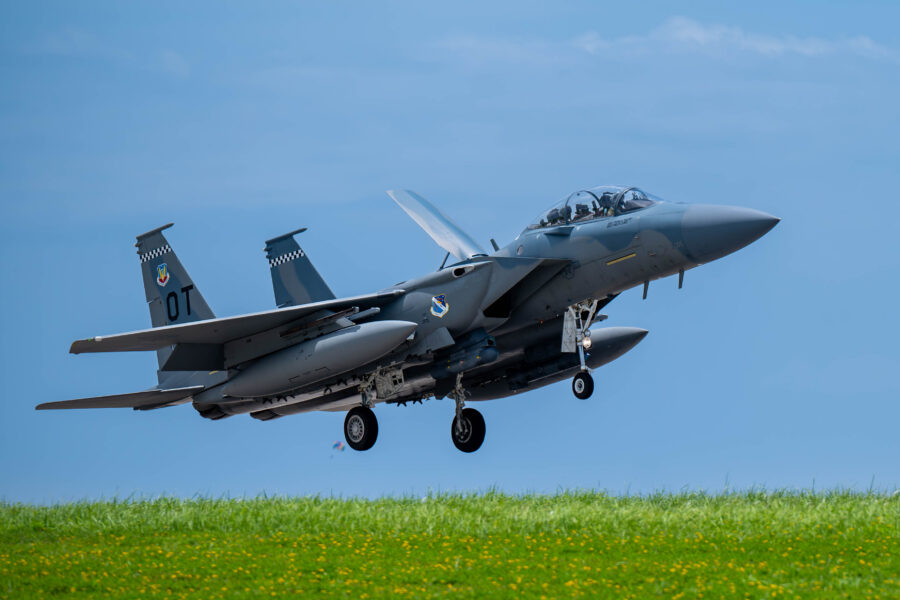
The Air Force is looking for ways to add an integrated missile warning system into the F-15EX Eagle II fighter for the first time.
The Air Force Life Cycle Management Center posted a sources sought notice Sept. 29 as part of a market research effort, looking for potential vendors for a missile launch and approach warning system that could be quickly installed on the F-15EX.
The system has to be able to alert the fighter’s aircrew about missile threats without distracting them with too many false alarms, the notice states. It also has to use the F-15EX’s six preexisting sensor locations already earmarked for missile warning, as well as the jet’s data cables, power cables and cooling capabilities. And it has to be able to be quickly and easily installed or removed in the field by Air Force maintainers, without requiring any changes to the aircraft itself aside from installing line replaceable units in the six sensor locations, per the notive.
The notice did not say how much such a system could cost or how long the contract could last, but said those details will be in line with what such work typically requires.
The Boeing-made F-15EX is a more advanced version of the F-15E Strike Eagle, with upgrades including fly-by-wire controls and a new electronic warfare system. But while the jets are built with the features necessary for a missile warning system, they do not actually come with that capability, even though other variants like Saudi Arabia’s F-15SA and Qatar’s F-15QA do.
The F-15EX does have the Eagle Passive Active Warning Survivability System, an advanced electronic warfare suite that can jam enemies’ radar systems and thus defend against radar-guided missiles. But a new missile warning system would help defend against infrared-guided vehicles.
Other Air Force fighters have missile warning systems that can detect infrared-guided threats—the F-35 has the AN/AAQ-37 Distributed Aperture System, built by Northrop Grumman, and the F-22 has the AN/AAR-56 Missile Launch Detection system.
Years ago, the F-15C was supposed to be equipped under the Common Missile Warning System, a joint program between the Army, Navy, and Air Force. But the Air Force dropped out of that program in 2000, according to a report from the Institute for Defense Analyses. The Common Missile Warning System eventually became the AN/AAR-57, built by BAE Systems. The F-15SA has the CMWS from BAE.
The threat of infrared-guided missiles was underscored during Operation Epic Fury, when an F-15E Strike Eagle, the EX’s predecessor, was downed over Iran in April. President Donald Trump said Iran used a shoulder-fired missile—often called a man-portable air defense system or MANPADS—to hit the fighter, and MANPADS often use infrared sensors.
While the Air Force is not committing to buying a new system, the request shows it is giving serious consideration to adding it at a time when the service’s plans for the F-15EX are rapidly expanding. Just this past April, the Air Force announced it was expanding its planned fleet size from 129 aircraft to 269.
AFLCMC wants potential respondents to say what military aircraft their missile warning systems are already approved on for operational use, whether the system is currently in active production, and how many months after the contract award could the companies start delivering the system, among other issues.
Companies have until Nov. 12 to submit unclassified white papers on their systems’ technical capabilities to the Air Force.
