
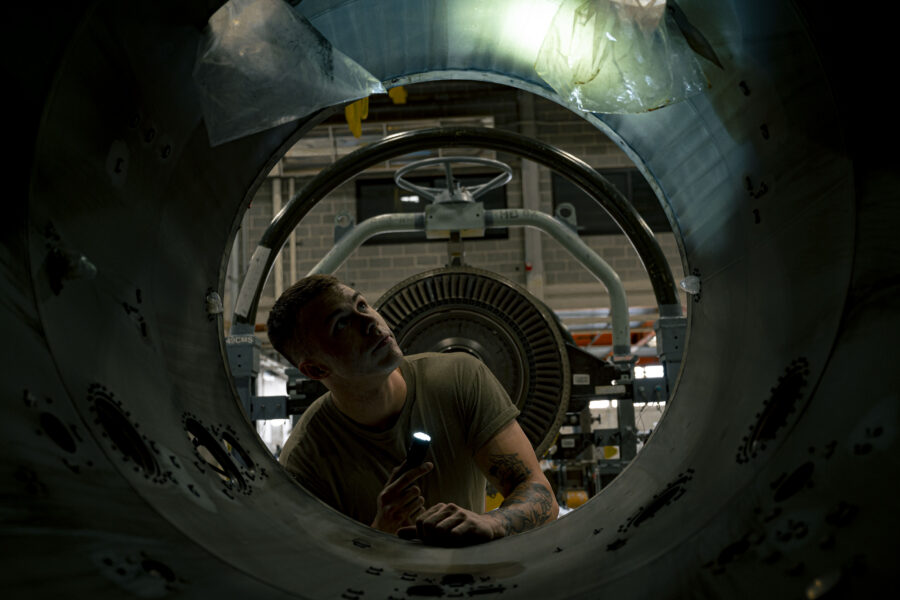
The Air Force has figured out a way for maintainers to inspect what had been a “blind spot” in F-16 engines, after problems in that area led to the catastrophic crashes of two jets in recent years.
A spokesperson for the Air Force Life Cycle Management Center confirmed the new procedure to Air & Space Forces Magazine last month. Task & Purpose first reported the development.
AFLCMC’s propulsion directorate developed the new process, which does not require any modifications to the engine or new equipment, the spokesperson added. The inspections is meant specifically for Pratt & Whitney F100 engine models—some F-16s are powered by GE Aerospace F110 models.
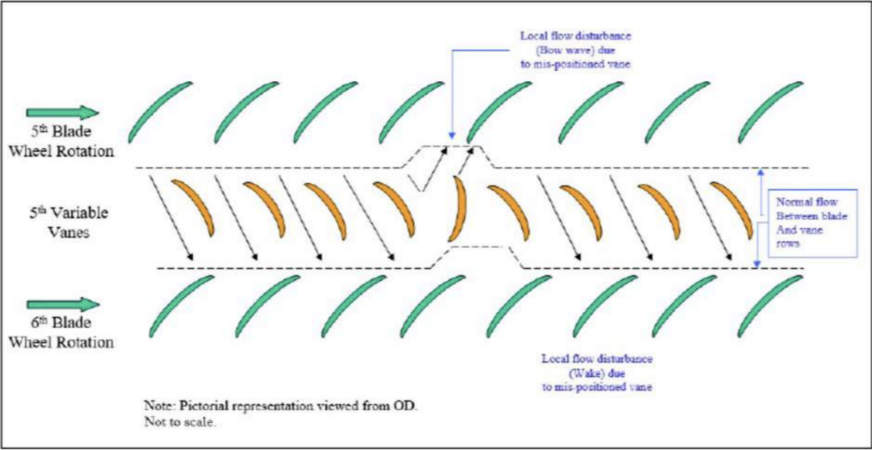
The F100 engine consists of 13 “stages,” each with variable vanes and compressor blades. Air flows through the stages, which rotate to accelerate, compress, and then regulate the airflow before releasing it into the engine’s combustion chamber. If a vane is turned or misaligned, however, it creates “abnormal aerodynamic forces” and “irregular wake patterns” that put stress on the compressor blades in the following stages, according to Air Force reports. That can lead to vanes or blades cracking or breaking, causing the entire engine to fail.
Maintainers can inspect many of the F100 engine’s stages using a borescope—a camera mounted on a flexible tube. There are even borescope ports for them to do so. But the fourth and especially the fifth stages are hard to reach. Before the development of this new inspection process, the Air Force said it was impossible for maintainers to inspect them without completely disassembling the engine, something only done at depots and not while the engine is installed on the aircraft.
This blind spot proved dangerous. An F-16 crashed near Holloman Air Force Base, N.M., in April 2024, and another jet, belonging to the U.S. Air Force Thunderbirds, crashed in the California desert in December 2025. Subsequent investigations determined that in both cases, the F-16s’ engines had failed because of misaligned vanes in the fifth stage.
The pilots in both crashes were able to safely eject, but both jets were completely destroyed and the total damages exceeded $54 million.
Notably, both F-16 engines in question had experienced foreign object debris, or FOD, events in the years prior to the crashes. In both cases, maintainers noted damage to early stages of the inlet fan but found no issues with the fourth, seventh, or eighth stages—and the F-16’s technical orders did not require maintainers to remove and disassemble the engine core to inspect the fifth and sixth stages after a FOD event if no damage is found in the surrounding stages.
While investigators were unable to conclusively say if the FOD events led to the vanes becoming misaligned, the Air Force has now updated its technical orders to require the new inspection procedure to check the fifth stage of the engine after every FOD event.
“Additionally, the program office has worked with Pratt & Whitney to redesign the vane arm to be more impact resistant. The new design is qualified, on order, and will be installed via forced retrofit as soon as available,” the AFLCMC spokesperson said.
