
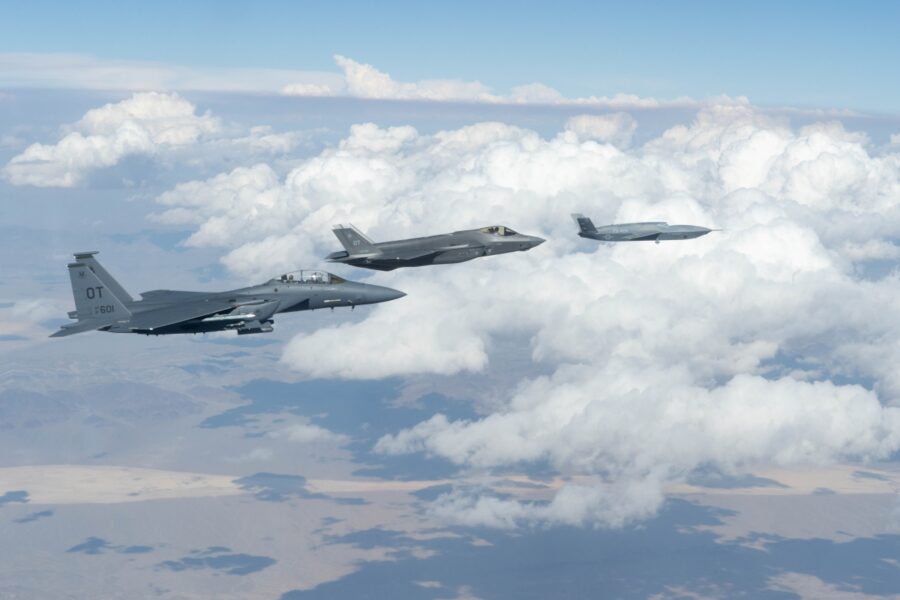
General Atomics Aeronautical Systems Inc. and Anduril Industries both say they’re ready to produce Collaborative Combat Aircraft in volume as they wait for a fiscal 2027 budget to fund that work.
General Atomics announced earlier this week it has the capacity to produce its FQ-42A Vengeance drones at a rate of “six aircraft per month to meet USAF goals” and could make more if needed. Competitor Anduril, which started production of its FQ-44A Fury at its new Arsenal-1 facility in Ohio in March, aims to build 150 aircraft annually, its officials said last week at AFA’s Air, Space & Cyber Conference.
The Air Force’s 2027 budget request includes $996.5 million to acquire production CCAs in fiscal 2027, plus another $150 million in advance procurement funds for 2028. But USAF has not specified how many aircraft that might cover.
General Atomics spokesman C. Mark Brinkley declined to tell Air & Space Forces Magazine exactly how many FQ-42s are rolling off the company’s production line right now, but did confirm production is underway. “Some of those aircraft will become company aircraft,” he said, meaning that not all are for its Air Force customer.
Brinkley said the company’s potential production expansion could be used to answer international demand for its Gambit series of autonomous drones, which are closely related to the FQ-42.
General Atomics also said in its statement that it is self-funding FQ-42 production today as it awaits Congressional fiscal 2027 appropriations. The new fiscal year launches Oct. 1, but lawmakers failed to pass a budget for fiscal ’27, and instead passed a continuing resolution that would hold current year funding steady, but provides no new funding. The measure ensures funding through Dec. 11, 2026.
GA’s self-funding will help support the government’s procurement plans and prevent delivery delays, the company said, and building aircraft for its own fleet will help it invest in new technologies that reduce risk and increase capabilities.
The Air Force plans to use CCAs as a complement to crewed fighters in a bid to add combat capacity at a lower cost than convention fighter jets. CCAs are designed to be flown semi-autonomously, at times alongside piloted fighters like the F-22 and F-35 Lightning II, and could eventually carry out a variety of missions including air-to-air or air-to-ground strikes; intelligence, surveillance, and reconnaissance; or electronic warfare operations. The concept is still comparatively early in its development.
Air Force Secretary Troy Meink said Sept. 14 that USAF is aiming to field at least 500 CCAs by 2032. The Anduril and General Atomics CCAs were selected following a competition in April 2024, andboth companies won initial production contracts in June 2026.
General Atomics said a new FQ-42 was delivered to Creech Air Force Base, Nev., on Sept. 18, for test and evaluation. Creech is home to the Air Force’s Experimental Operations Unit, which has been experimenting with CCAs to develop approaches to how they might be employed in real-life operations.
Jason Levin, Anduril’s senior vice president for air dominance and strike, said Sept. 14 that his firm delivered an FQ-44 to the EOU in August. Prior to that, the YFQ-44A prototype took part in two exercises with the EOU, the first in April and the second in July.
The July exercise at Creech, Levin said, demonstrated that CCA had advanced enough for a single Air Force operator to launch and recover an aircraft on his own after just a few hours of training.
“The Air Force was operating mission autonomy by themselves, which was a first,” Levin said. “They were flying multiple times a day, operating mission autonomy without Anduril personnel—they were on-site kind of helping, but it was really the Air Force operating that.”
Levin said that during the July exercise, Fury flew in the same airspace as crewed fighters and other drones using mission autonomy, helping build Airmen’s trust that CCAs can operate in congested airspace.
The production model of the FQ-44 that will start to roll off the line next year at Arsenal-1 will be able to carry four air-to-air weapons, such as the AIM-120 Advanced Medium-Range Air-to-Air Missile, or AMRAAM, under its wings.
The FQ-42, General Atomics said, has flown in formation with piloted F-35 Lightning II and F-15E Strike Eagle jets to prepare for future test flights, when fighter pilots will actually command the drones. The FQ-42 represents fifth-generation stealth and operates with an internal weapons bay.
General Atomics previously conducted flights of its MQ-20 Avenger drone, operating as a CCA surrogate, to demonstrate how collaborative control flights might work. The company said its aircraft, including the Vengeance, Avenger, and XQ-67A Off-Board Sensing Station, have flown both semi-autonomously and autonomously using AI pilots and under the collaborative control of human pilots flying in the F-22 Raptor and F-35.
“The CCA program’s rate of progress has been incredible,” said Mike Atwood, vice president of advanced programs at General Atomics Aeronautical Systems, in a company statement. “Every week, the Air Force is pushing forward with new and more impressive accomplishments using Vengeance. It’s amazing to think of how far this program has come in such a short amount of time.”