
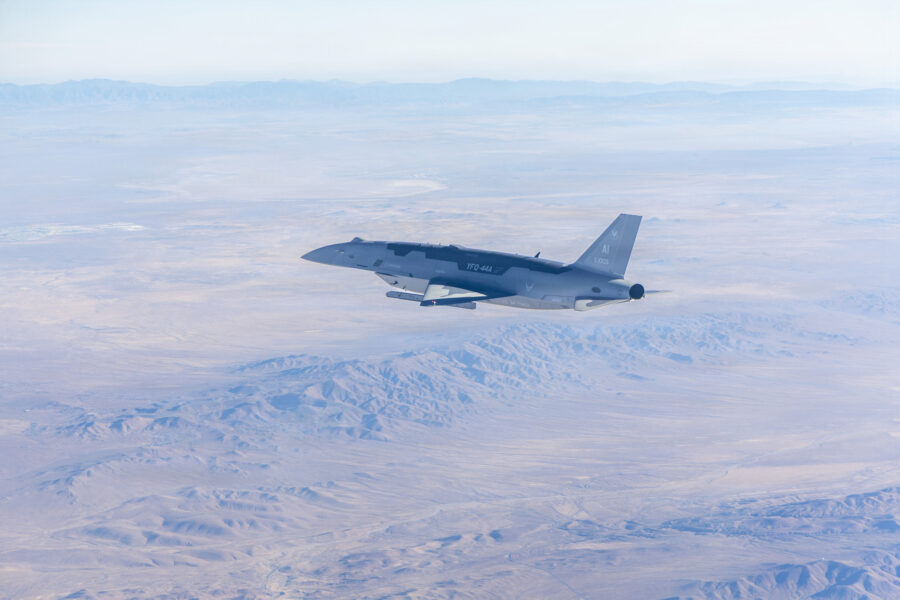
A U.S. Air Force F-22 pilot controlled a YFQ-44A Fury Collaborative Combat Aircraft this month while both aircraft were in flight, according to an Oct. 16 release, another milestone in the service’s ambitious CCA efforts.
The human F-22 pilot acted as an “airborne quarterback” for the YFQ-44 drone by sending it high-level tactical directives, according to the Air Force statement. The YFQ-44’s on-board autonomy software then interpreted and carried out those orders in real time to carry out “dynamic flight maneuvers and simulated combat tasks,” the statement reads.
Anduril Industries, the manufacturer of the Fury, said in follow-up statements that the flight took place out of Edwards Air Force Base, Calif., during the week of Oct. 5.
Mark Shushnar, Anduril’s vice president of autonomous airpower, said the Fury and F-22 both took off at Edwards, and then joined up midair. The Raptor pilot then sent an updated mission plan to the Fury CCA using a tactical data link, “commanding Fury through operationally relevant maneuvers from the cockpit of the crewed quarterback” fighter.
For this demonstration, the F-22 was controlling a single YFQ-44A. But the Air Force’s plan is to eventually have each fighter pilot capable of controlling multiple CCAs as a formation—extending the service’s combat mass and reach.
In a statement, Air Force Chief of Staff Gen. Kenneth S. Wilsbach said the demo “shows the power of crewed-uncrewed teaming and the advantage it provides our warfighters” and pledged to build on it quickly.
“We must test often, learn fast, and give commanders what they need, when they need it,” he said.
Air Force Secretary Troy Meink also touted the need to move quickly in touting the flight.
“This achievement demonstrates what is possible when we are aligned with industry on a shared imperative: delivering capability to the warfighter at unprecedented speed,” Meink said in a statement. “We are driving urgency into every part of acquisition from rapid integration and flight learning to disciplined assessment, so we can turn promising technology into combat capability at the pace the threat demands.”
The mission lasted multiple hours and was a success, Shushnar said, and shows how quickly progress is being made to creating an operational CCA program.
“The U.S. Air Force’s CCA program is the fastest moving, most mature CCA program anywhere in the world, and will be the first to field operational aircraft,” Shushnar said. “Getting there demands that Anduril and the U.S. Air Force work together to prove out the capability, define the operational procedures, and build trust between operators and their semi-autonomous wingmen.”
The Air Force said data from the test will help with future software integration, developmental testing, and future CCA concepts.
The test included personnel from the Air Force’s 412th Test Wing at Edwards, the 422nd Test and Evaluation Squadron at Nellis Air Force Base, Nev., the 309th Software Engineering Group at Hill Air Force Base, Utah, the CCA Experimental Operations Unit at Creech Air Force Base, Nev., the F-22 System Program Office, and the CCA Software Autonomy and Teaming Branch.
The Air Force has previously conducted flight tests with a “surrogate” drone meant to represent a CCA—General Atomics’ MQ-20 Avenger. In February, an F-22 in the air controlled an MQ-20 Avenger, and in May, an F-35 that remained on the ground also controlled an Avenger that was in the air.
The Air Force wants to have 500 CCAs in the field by 2032, and eventually a fleet of 1,000 or more to carry out a variety of missions that could include air-to-air strikes, air-to-ground strikes, intelligence, surveillance and reconnaissance, or electronic warfare. This first iteration—which includes General Atomics’ FQ-42 and Anduril’s FQ-44—is focused on the air-to-air mission. The Air Force wants them to cost at most $20 million apiece for the air vehicle, excluding the cost of sensors, weapons or other equipment CCAs might carry on board.
While the focus of the CCA program has been on manned-unmanned teaming with pilots in the air, the Air Force has also been working on a capability for Airmen to command the CCAs using stations on the ground.