
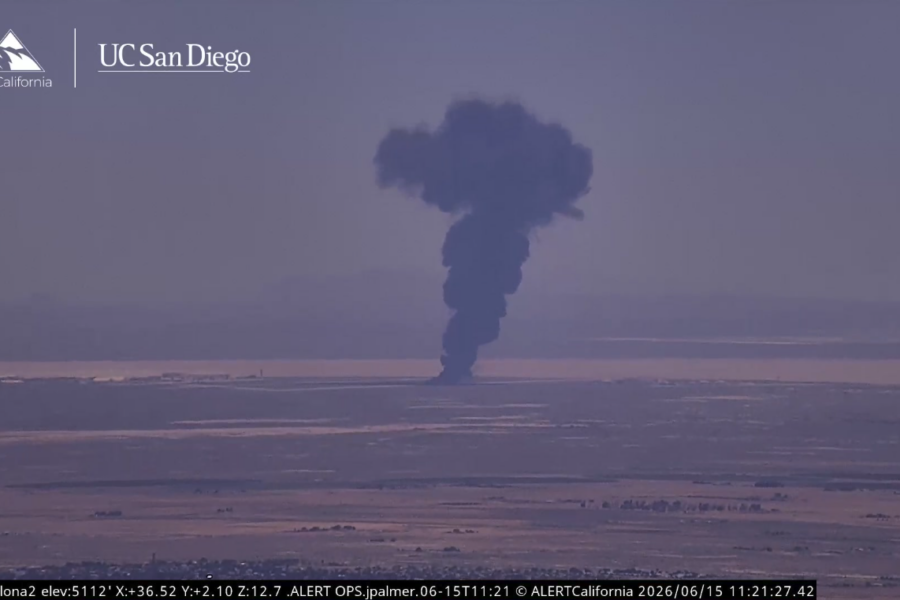
Eight people who were aboard a B-52H Stratofortress bomber died in a fiery crash shortly after takeoff June 15 at Edwards Air Force Base, Calif., the base confirmed.
“Today, Edwards Air Force Base experienced a horrible tragedy and we lost eight great Americans,” Col. James Hayes, deputy commander of the 412th Test Wing at Edwards, said in a news conference. “This crash is deemed to be unsurvivable, and right now, our thoughts and prayers are with the families of those that lost their loved ones.”
The B-52 crashed at around 11:20 a.m. local time. Hayes said the crash occurred immediately after taking off on a “local test sortie” and burst into flames. Hayes said the B-52 was supporting the radar modernization program, which is a central component of a sweeping series of upgrades now in the works for the six decade-old bomber fleet.
Edwards said that emergency response personnel immediately responded to the scene and worked to put out the flames.
Hayes said Edwards does not yet have any indication what caused the crash. An interim safety board will be convened to gather initial facts, which will then lead to a safety investigation board that will look at the root causes of the crash, Hayes said. That will likely take 30 days, he said.
The safety board will be followed by an accident investigation board, Hayes said, which will determine what information can be released to the public and next of kin. The entire process could take six months, he said.
The recovery operation now under way is looking for the B-52’s flight recorder, and if found, its information will be analyzed by the safety investigation board to determine the root cause.
The airfield at Edwards is closed, the base said in an update to a social media post earlier in the day. Hayes said the base is temporarily halting operations, primarily due to the condition of the runway.
Hayes told reporters that teams were in the process of notifying the next of kin of the crew members who died. He said the B-52 had a mixed crew of military service members, government civilians, and contractors supporting the test mission. Hayes declined to provide any further details about the crew members because notifications were still under way.
Images and videos circulating on social media show fire crews spraying water on a smoldering wreck. A live camera feed from UC San Diego’s ALERTCalifornia program shows a tower of black smoke rising from the area around the time of the crash.
BREAKING: A U.S. Air Force B-52 bomber crashed shortly after takeoff at Edwards Air Force Base, triggering an emergency response.
— Fox News (@FoxNews) June 15, 2026
Emergency crews rushed to the scene as thick black smoke billowed from the wreckage scattered across the desert airfield.
More details, including… pic.twitter.com/JRx3R4ElJW
Edwards is the Air Force’s premier test base, and a B-52 arrived there in December to start testing the bomber’s new radar. The Radar Modernization Program is one of several upgrades planned for the Stratofortress. B-52s also fly from Edwards to test new weapons like the hypersonic Air-launched Rapid Response Weapon and the nuclear Long-Range Standoff cruise missile
It is unclear which aircraft crashed June 15.
The B-52 is one of the oldest aircraft in the Air Force inventory, with the 76-aircraft fleet’s average age exceeding 64 years. The Air Force plans to keep flying the bombers until 2050.
According to Air Force statistics, the last “Class A” mishap involving a B-52 occurred in fiscal 2018, but the service has not lost one of the bombers since 2016, when one crashed at Andersen Air Force Base on Guam after an aborted takeoff.