
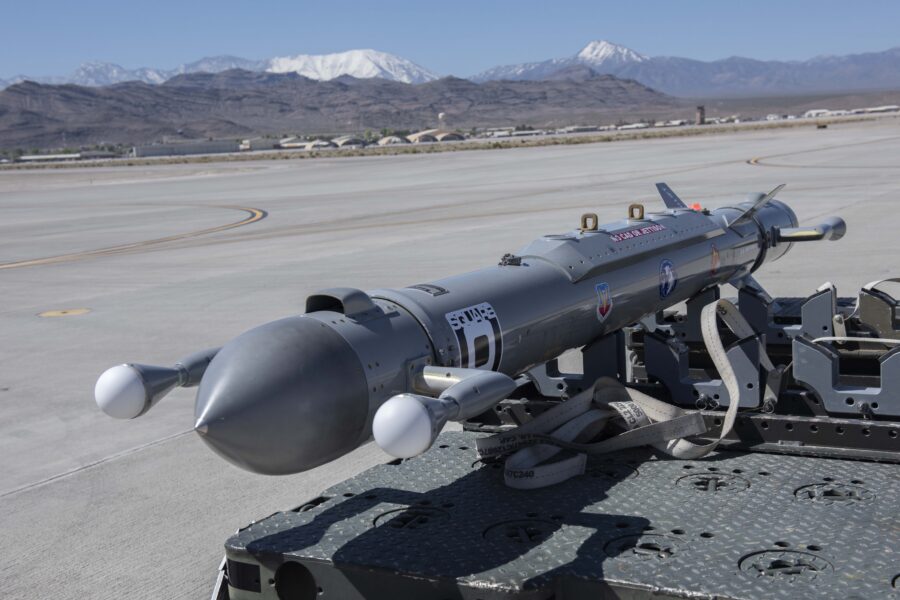
The Air Force recently tested its “Angry Kitten” electronic warfare pod on an HC-130J during Exercise Bamboo Eagle, showing the pod can turn the rescue platform into a command-and-control node and protect it from enemy radars.
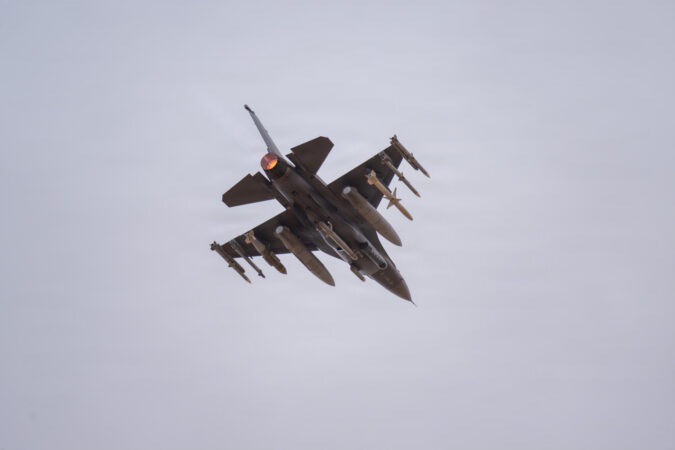
It’s the latest development for the new pod, which was also spotted on an Air Force F-16 Fighting Falcon in a U.S. Central Command-released photo showing aircraft deployed in Operation Epic Fury—indicating it may have been used in combat for the first time.
The Air National Guard Air Force Reserve Command Test Center, or AATC, worked with the 129th Rescue Wing to evaluate the pod during the joint all-domain operations exercise in the Pacific, according to an AATC release.
The wing’s 130th Rescue Squadron flew the pod against simulated ship- and ground-based platforms to evaluate survivability and the system’s electronic attack capability.
In the same evaluations, AATC also worked on “near-real-time electronic warfare reprogramming via satellite link,” using a new Ka/Ku band communications suite in deveopment.
Legacy EW platforms require manual reprogramming, creating a time lag when updating radio spectrums in operational scenarios, a requirement experts say will be necessary when facing peer threats with complex signature detection and anti-jamming capabilities.
“We’re really pivoting towards that peer threat, and we’re going towards a joint all-domain fight that has to be synchronized and executed within a time and trigger-based effect,” Lt. Col. Alexander Brannon, AATC’s Combat Search and Rescue Combined Test Force director, said in the release.
Angry Kitten finished testing on the F-16 in early 2025 and was slated for evaluations on the A-10 Thunderbolt II and C-130 Hercules, AATC said in a March 2025 release. The KC-46 and KC-135 tankers could be next.
“We had minimal hopes for what we could do for larger body aircraft, but it’s showing that we actually have good effects,” said Chris Culver, an electronic warfare engineer involved with testing.
It was on the C-130 that officials first started to test real-time updates to the pod’s electronic warfare techniques.
“Angry Kitten pod is showing promising results in protecting larger radar cross-section platforms that traditionally lack robust electronic warfare capabilities,” according to the AATC March 2025 release. “This success is particularly significant for combat search and rescue platforms that often operate in contested environments without electronic warfare protection.”
On the F-16, developers used preprogrammed mission data files, according to the March 2025 release. But on the C-130, the development engineers could be on board the aircraft, modifying jamming techniques mid-mission based on range-control feedback.
“They are making changes in real-time to the techniques and pushing updates to the pod, seeing the change in real-time,” Culver explained. This allows for rapid optimization of jamming techniques against various threat systems.
Next steps involve developing Angry Kitten Increment 2 Block 2, which will include a complete hardware refresh and a transition from analog to digital receivers to improve sensitivity and frequency agility, according to the March 2025 release.
“We’re taking a bunch of separate line-replaceable units within the pod and smashing them together into one [line-replaceable unit], saving more real estate inside the pod to make room for new capabilities,” Culver said.
Angry Kitten emerged from a Navy pilot-training tool that evolved into an offensive weapon. In 2013, aggressor squadrons at Nellis Air Force Base, Nev., requested advanced jamming pods for a more threat-based EW environment during training.
The core technology had been developed by Georgia Tech Research Institute, and the Naval Air Warfare Center Weapons Division, or NAWCWD, began adapting the technology into a flyable pod system.
The pod first flew in 2017, and one of its biggest advantages was that government programmers could reprogram the jammer to counter new threats without sending it back to the contractor for expensive, time-consuming code changes, according to a NAWCWD release from March.
“This enabled the government operators of the pods to generate a huge variety of high-performance electronic attack techniques at vastly reduced costs and development times, as compared to other systems,” said Roger Dickerson, principal research engineer at Georgia Tech Research Institute.
In 2022, the Air Force Research Lab funded testing with the pod as part of its App-Enabled Rapidly Reprogrammable Electronic warfare/Electromagnetic Systems experiments, or AERRES.
The experiments sought to assess the advantages of app-enabled EW solutions for battlefield sensing problems.
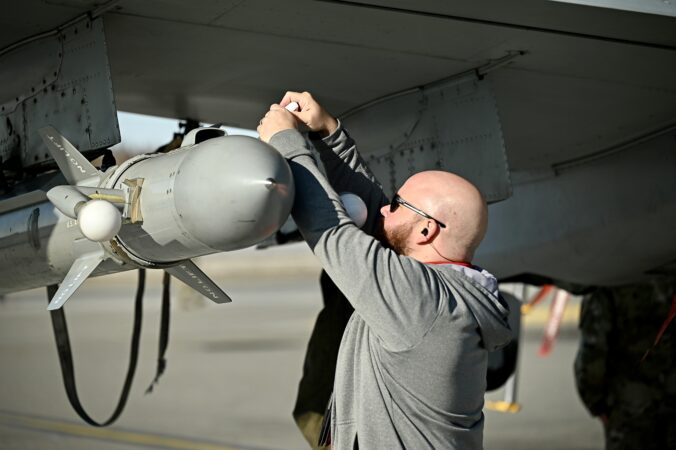
“This is the first operational assessment of a potentially deployable and combat-ready electronic warfare system for fighter aircraft moving in that direction,” Keith Kirk, experiment program manager, said in a 2022 AFRL release.
Kirk compared the new capability to being able to regularly update a smartphone.
“We are making great progress toward software-enabled electronic warfare systems that allow us to quickly update our effects based on the changes in the radio frequency environment and the type of effects that we want to make happen,” he said.
During this development, AATC began using Angry Kitten pods as a red adversary simulator. But the pod, acting as a jammer against Air Force pilots, can also be used as a weapon against enemy systems. That’s because of a technology called Digital Radio Frequency Memory. DRFM allows users to detect and capture radio-frequency signals used by adversaries and retransmit them to mask or spoof enemy radar and sensors.
“We developed this system as a training tool to test our radars, and now we’re bringing that same capability to warfighters as an offensive electronic attack jammer to protect their aircraft in real situations,” said Keith Yuen, a supervisory engineer with NAWCWD who helped develop Angry Kitten. “We take the lessons learned from jamming our own radars and bring that capability to our operators in harm’s way.”
In April 2023, the Air Force’s 556th Test and Evaluation Squadron at Creech Air Force Base, Nev., conducted the first round of tests with the pod mounted on an MQ-9 Reaper drone.
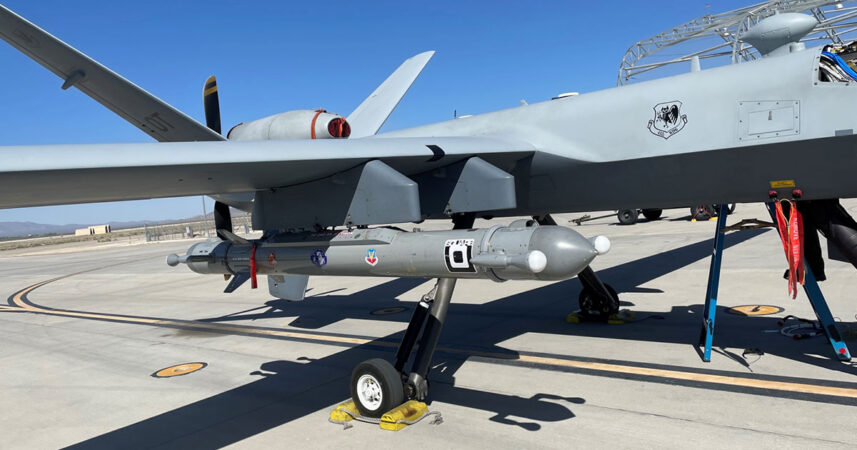
Adding the pod to the widely used Reaper gives commanders more intelligence-gathering and mission flexibility options.
“Electronic attack on the MQ-9 is a compelling capability,” said Lt. Col. Michael Chmielewski, 556th TES commander. “15 hours of persistent noise integrated with a large force package will affect an adversary, require them to take some form of scalable action to honor it, and gets at the heart of strategic deterrence.”
During the May 2023 exercise Northern Edge in Alaska, AATC also tested Angry Kitten’s ability to jam simulated enemy systems on both the F-16 and A-10, according to an Air National Guard release.
