


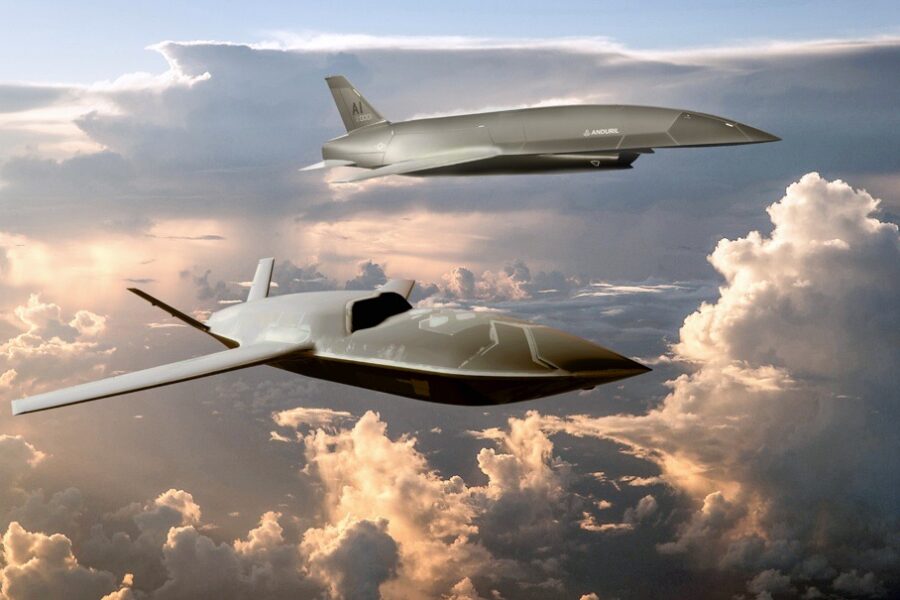
NATIONAL HARBOR, Md.—The Air Force plans to field at least 500 semi-autonomous fighter drones known as Collaborative Combat Aircraft by 2032, and another 500 cheap reconnaissance and strike drones known as Massed Modular Aircraft that same year, Air Force Secretary Troy Meink said Sept. 14.
In his keynote address to open AFA’s Air, Space & Cyber conference, Meink said the service would bolster its combat capability—which for decades has mostly come from crewed aircraft such as fighters and bombers—with lower-cost drones that operate with minimal direction from Airmen.
And that future is coming fast, Meink said.
“Because of the steps we are taking today, we will have a significantly different force by 2032,” Meink said. “By then, our special operators will have the ability to employ thousands of autonomous one-way attack systems, and we will have autonomous fighters like Collaborative Combat Aircraft, or CCAs.”
The first iteration of CCAs—General Atomics Aeronautical Systems’ FQ-42A and Anduril Industries’ FQ-44A—are now rolling off the assembly line and will specialize in air-to-air missions. Future “increments” of CCA could focus on other missions, such as air-to-ground strikes, reconnaissance, or electronic warfare operations.
“We intend to have at least 500 of these in service by 2032,” Meink said, and by that time the drones will be performing many of the same missions crewed fighters perform today, he added.
Meink’s projection is the most ambitious target the Air Force has yet to announce for the CCA program. In 2024, his predecessor as Secretary, Frank Kendall, said the service would have 100 CCAs by 2029. Earlier this year, Meink said he expected to have 150 by the end of the decade.
The Air Force is also accelerating a program called Massed Modular Aircraft, which will field drones to take on some of the missions the MQ-9A Reaper performs today. The service in recent months has grown concerned over the pace of Reaper losses in operations against Iran—roughly 45 have been lost so far, or about a quarter of the Air Force’s fleet—and moved to speed up its plans to field MMAs.
Like CCAs, MMA drones will have autonomous capabilities, but they will be cheaper and less complex than CCAs. Air Force officials told reporters Sept. 3 that the air vehicle of an MMAs will cost roughly $10 million, without sensors or other systems included, while CCAs will cost twice as much, at $20 million per air vehicle.
Meink said the Air Force plans to field 100 MMA drones by 2029 and 500 by 2032—higher than previous estimates from Air Force officials.
In a roundtable with reporters later, Meink also said the the Air Force plans to have multiple types of MMA drones from different contractors in its fleet, similar to how its CCA program is working with multiple vendors.
Asked about the expanded plans for the MMA program, Meink pointed to the program’s relatively low cost and the importance of the MQ-9’s combined strike and recon mission.
“That [ISR and strike] mission is a very important mission,” Meink said. “We’re looking at how we do that with a mix of different platforms. … The ability to bring low-cost mass is a driver here, and we expect these to be significantly cheaper than even the MQ-9s or the CCA.”
When asked if the Air Force could buy more than 500 MMA drones, Meink said that will depend on how much money Congress provides in the budget, but added “I think it should probably be much higher than that.”

When the two autonomous drones—MMA and CCA—are in the field, Meink said, they will transform the way the Air Force fights wars.
The sixth-generation F-47 fighter and B-21 Raider stealth bomber are “phenomenal aircraft” that “will be able to do things no other aircraft has ever done before,” Meink said. But they won’t be able to deliver the “massive scale of combat power we need” on their own, he warned. That’s where lower-cost, uncrewed autonomous platforms like CCA and MMA come in.
“When we pair manned aircraft with lower-cost autonomous systems, we will be able to unlock combat power at scale,” Meink said.
Both CCAs and MMAs are being built around an open systems architecture approach that will make it easier to swap different sensors or other capabilities into the drones, using standardized interfaces. Emphasizing the modularity that comes with open systems architecture will accelerate procurement of the systems, Meink said, and increase competition from industry, which will ultimately lower prices, give the Air Force more choices, and improve the drones’ combat power.
Meink told reporters in the roundtable that CCAs will continually evolve, even within the same increment, but that it was too soon to predict what the fleet of 500 will look like by 2032.
“It depends on how the current ones perform, and what additional capabilities the users are saying they need,” Meink said. “Can we evolve that into the current iteration? Do we need a different iteration? We’re working our way through that right now.”
Meink also said the Air Force plans to have “tens of thousands” of the new low-cost Family of Affordable Mass Munition, or FAMM, weapons in its inventory by 2030, and that they are already being used today.
Meink also revealed a name change for General Atomics’ CCA, which the company had been calling Dark Merlin. The FQ-42 will now be called Vengeance, he said. Anduril’s FQ-44 will continue with the name Fury.

Photo by Jud McCrehin, Air & Space Forces Association
General Atomics spokesman C. Mark Brinkley said in a text to Air & Space Forces Magazine that the company will cease using the Dark Merlin name now that the Air Force has chosen its own moniker.
“We love when our customers name their aircraft,” Brinkley said. “Vengeance pretty much sums up what the FQ-42 brings to the fight.”