


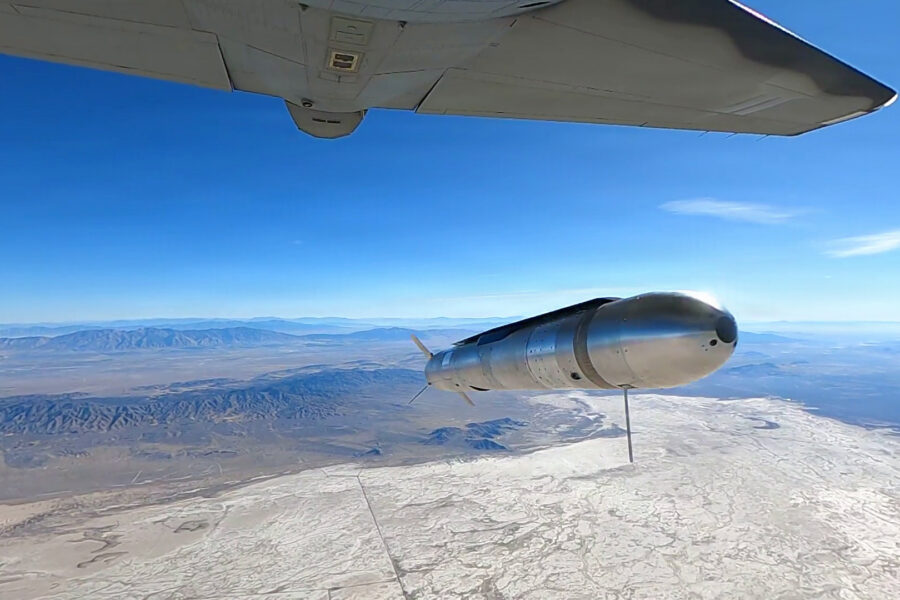
NATIONAL HARBOR, Md.—Air Force Special Operations Command recently fired small cruise missiles from an AC-130J gunship during combat operations in Africa, verifying the developmental weapon’s safety and accuracy.
The combat test validates that the missile, the AGM-190A Havoc Spear, is ready for “broader real-world use,” AFSOC said in a Sept. 14 announcement.
Havoc Spear, built by Leidos and originally nicknamed “Black Arrow,” is a 200-pound class weapon with a range of 400-plus nautical miles.
In a roundtable with reporters before the announcement, AFSOC officials said they fired two AGM-190s this spring at two validated ground targets in the U.S. Africa Command area of responsibility. No further details about the targets were revealed, but AFSOC said the evaluations proved the missile is “accurate, reliable, and operationally ready.”
“Havoc Spear gives commanders the essential standoff capability to neutralize threats without putting our personnel and platforms in immediate danger, and it’s also proving its tactical value on the battlefield,” said Col. Robert Johnston, director of strategic plans, programs, and requirements at AFSOC.
Havoc Spear is among several low-cost cruise missiles developed by industry in recent years in response to the Pentagon’s demand for greater combat mass.
Developed by Leidos, the system dates back to 2021 and the company’s experience with the GBU-69 Small Glide Munition. The company signed a Cooperative Research and Development Agreement in 2022 with U.S. Special Operations Command and AFSOC to further develop the missile, leading up to the combat evaluation four years later.
Now the Pentagon is moving to expand that work. In July, SOCOM awarded Leidos a $27.2 million contract for 45 missiles, putting the average cost of Havoc Spear at around $600,000 per unit. But AFSOC officials noted that total is for low-rate initial production, with the cost expected to drop as much as two-thirds as production ramps up.
The cost, however, will depend on the scale of production, and AFSOC officials are hoping to use Havoc Spear not only across the command, but the entire Air Force.
“Our ultimate goal is to try to get this on every type of SOF platform, as well as conventional platform possible, in multiple launch modes,” said Johnson.
The weapon can be fired via launch tubes off the ramp of the AC-130, but it can also be mounted on pylons or palletized to be dropped from cargo aircraft. Its payload can even be modular, opening up a additional options.
AFSOC officials said they mostly plan to use the initial batch of missiles from the July contract for more testing. The first of those missiles is expected to arrive next fall, officials said.
“We’re still doing further development on other platforms and other launch mechanisms, and so we’ll use that initial tranche to try to get after more development than employment,” said Johnson.
Which special ops aircraft comes next isn’t clear—Johnson said it “really depends on what’s available.”
“To be quite honest, with current operations, we have to piecemeal what assets we can actually employ and get test dates on,” he said.
In the long term, AFSOC is thinking big—Johnson suggested Havoc Spear could one day be incorporated into the Air Force’s Family of Affordable Mass Missiles program.
FAMM is a major Air Force-wide effort to mass produce more affordable, less exquisite air-to-ground missiles. In July, the Pentagon announced framework agreements for multiyear production of Anduril’s Barracuda; CoAspire’s Rapidly Adaptable Affordable Cruise Missile, or RAACM; and Zone 5 Technologies’ AGM-188 Rusty Dagger—the service could get a total of 8,000 missiles annually once production ramps up, and budget projections show plans to acquire up to 28,000 over the next five years.