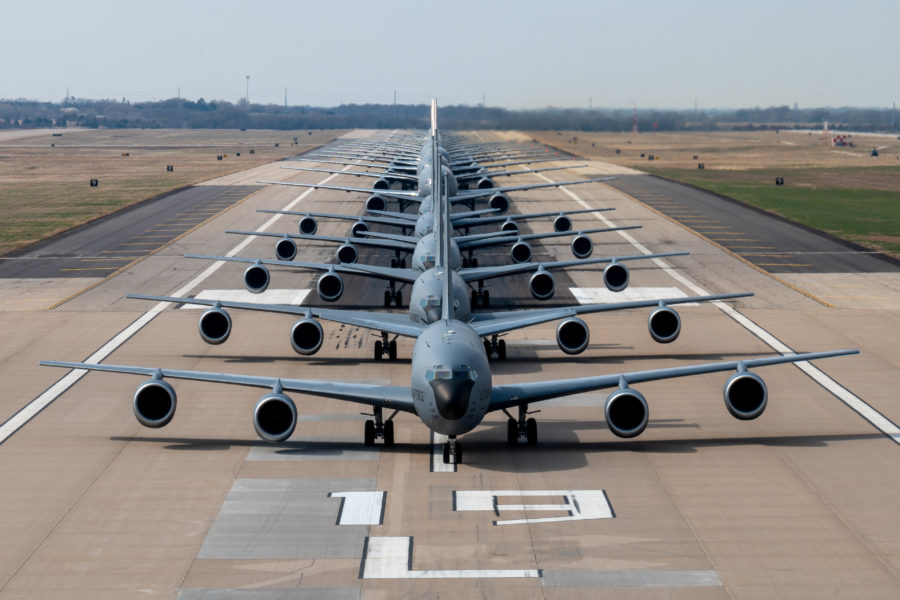
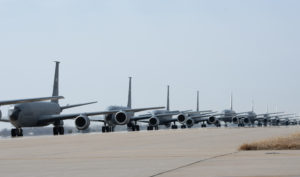
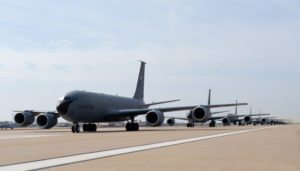
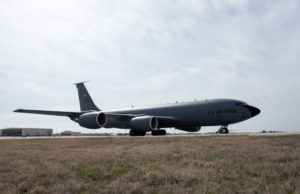
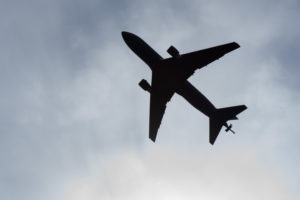
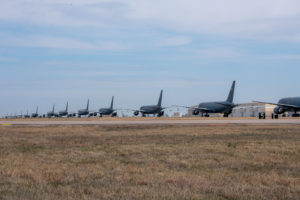
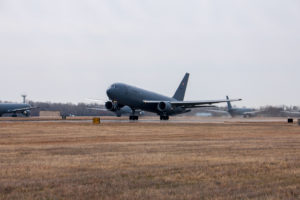
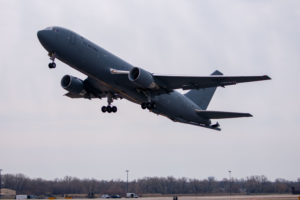
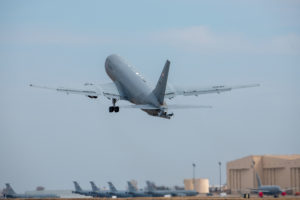
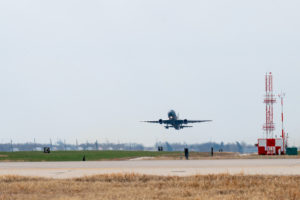
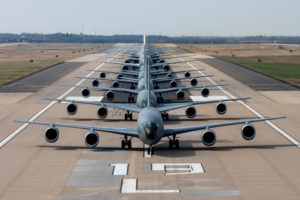
Sixteen KC-46A Pegasus’ and five KC-135 Stratotankers line up for an elephant walk during Exercise Lethal Pride March 27, 2023, at McConnell Air Force Base, Kansas. The elephant walk launched the exercise and consisted of aircraft and air crews from both the 22nd Air Refueling Wing and the 931st Air Refueling Wing. U.S. Air Force photo by Airman 1st Class Brenden Beezley
Audio of this article is brought to you by the Air & Space Forces Association, honoring and supporting our Airmen, Guardians, and their families. Find out more at afa.org
More than 20 tankers lined the runway at McConnell Air Force Base, Kan., on March 27 for the base’s largest mass launch of aircraft ever.
“The premise was essentially a threat was inbound,” Col. George N. “Nate” Vogel, commander of the 22nd Air Refueling Wing, told Air & Space Forces Magazine. “That was the scenario we gave ourselves, and we had limited amount of time to get folks off the ground. So the team generated those jets over the course of about 48 hours, the maintainers did, simulating that we had indicators and warnings that situations in the world were kind of ramping up from a crisis standpoint. And so then we did a crew brief at 7 a.m. for all the crews, they stepped out to the aircraft and then the first thing we did was we just wanted to get a picture of of all the aircraft generated, and then we did the formation launch immediately after that.”
Sixteen KC-46s and five KC-135s participated in the flush, with aircraft and Airmen from the 22nd Air Refueling Wing and the 931st Air Refueling Wing participating. The launch was part of the base’s Exercise Lethal Pride, a weeklong effort to simulate the Air Force’s plan for dispersing aircraft and crews to operate from smaller bases.
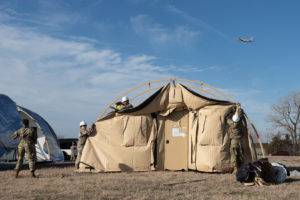
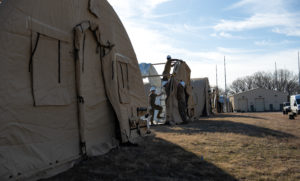
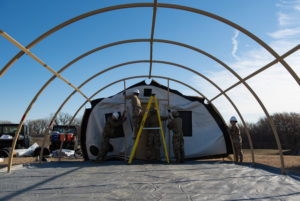
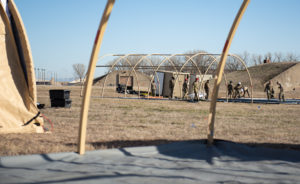
As part of that effort, roughly 100 Airmen from McConnell have spent the last week living in a tent city on base with limited contact with the outside world—simulating what life would be like at the kind of austere forward operating base the Air Force envisions as critical to its concept of Agile Combat Employment, wherein small teams of cross-trained Airmen disperse from central “hubs” and operate from smaller “spokes” to complicate an adversary’s targeting.
The Airmen in the tent city are part of command and control and force generation elements, Vogel said, and have spent the past week doing just that, but with somewhat degraded communications and limited contact with the outside world to simulate what might unfold during a conflict.
In the exercise, McConnell is also treating other bases as the “spokes” in that hub-and-spoke arrangement, including Fairchild Air Force Base, Wash., MacDill Air Force Base, Fla., and Joint Base McGuire-Dix-Lakehurst, N.J.
“We’ve been to nine different spoke locations from our deployed tent city environment that has sent them out to these places,” Vogel said.
To force Airmen to make their own decisions based on commander’s intent, Vogel said his team has taken away communication options over time and forced the command-and-control element in the tent city to rely on solar power rather than existing infrastructure. They’re not always able to stay in touch with tankers depending on where they fly, but the aircrews ”know what authorities they have, and we expect them to make decisions and execute,” he said.
Lethal Pride is McConnell’s first large-scale base exercise. Beyond the mass launch of aircraft and the tent city, Airmen have also conducted an aeromedical evacuation mission, several air refueling missions over land and sea, and night missions.
On top of that, the exercise has included two endurance missions. One involved a KC-46 flying for 24 hours straight, while the other had another KC-46 fly for roughly 20 hours before landing and taking off again without turning off the engines.
“We’ve been doing these things for while,” Vogel said. “We’ve studied to get the best Circadian rhythms and to see how the jet performs and nutrition and all that kind of stuff. We just see that as a part of how conflict could likely go in the future, as far as what would be required of us.”
Boundary-pushing flights have become increasingly common for the Air Force’s tanker fleet. In May 2022, a 22nd Air Refueling Wing crew flew for 24.2 hours in a KC-46, setting an Air Mobility Command record and covering more than 9,000 miles. In October, another McConnell KC-46 flew without a co-pilot as part of a study of limited aircrew operations. And in November, a KC-46 from Pease Air National Guard Base, N.H., flew more than 16,000 miles over 36 nonstop hours.
Audio of this article is brought to you by the Air & Space Forces Association, honoring and supporting our Airmen, Guardians, and their families. Find out more at afa.org
Air Force depots are not typically meant for quick repair jobs, but during Operation Epic Fury, the service moved some of its stateside heavy maintenance capability forward to fix battle-damaged aircraft closer to the fight.
The 55th Wing officially retired the EC-130H Compass Call aircraft in a ceremony Sept. 18 at Davis-Monthan Air Force Base, Ariz., while the 355th Wing there retired its final A-10 Warthog, another major transition for the base.
As the threat of Iranian-made drones grew, the Air Force rushed last year to equip F-15E Strike Eagles in the Middle East with a cheap, cost-effective way of defeating them. The service fielded the new capability in roughly a week.
An F-16 Fighting Falcon assigned to the Texas Air National Guard’s 149th Fighter Wing crashed during a training mission in Michigan on Sept. 17. The fighter's sole pilot ejected and is in stable condition at a local hospital.
The Air Force’s new Collaborative Combat Aircraft will take part in their first large-force engagement exercise in December, the head of the drones’ Experimental Operations Unit said Sept. 15.
The Pentagon announced a deal with Lockheed Martin on Sept. 17 to expand production of the AIM-260 Joint Advanced Tactical Missile, an advanced new Air Force and Navy air-to-air missile meant to equip fifth- and sixth-generation fighters.
Lockheed Martin has unveiled its concept for a modular version of one of the Air Force’s main air-to-ground cruise missiles, opening up a range of possible upgrades and uses for the weapon.
The Air Force will consider acquiring new F-16 Fighting Falcon jets to answer capacity shortfalls in its aging fighter fleet, according to multiple people familiar with the matter. These discussions are happening as the Air Force is building its proposed fiscal 2028 budget and the five-year spending plan that goes…
✓
Thank You!
Check your inbox to verify your email address and finish setting up your AFA account.
★
Welcome Back!
An account with this email already exists. Please log in to continue.
Subscribe to the Air & Space Forces Daily Report
The latest news from Air & Space Forces Magazine, as well as news from other leading publications, delivered right to your inbox every morning!
We’re sorry, there has been an error. Please review your input or try again later.