
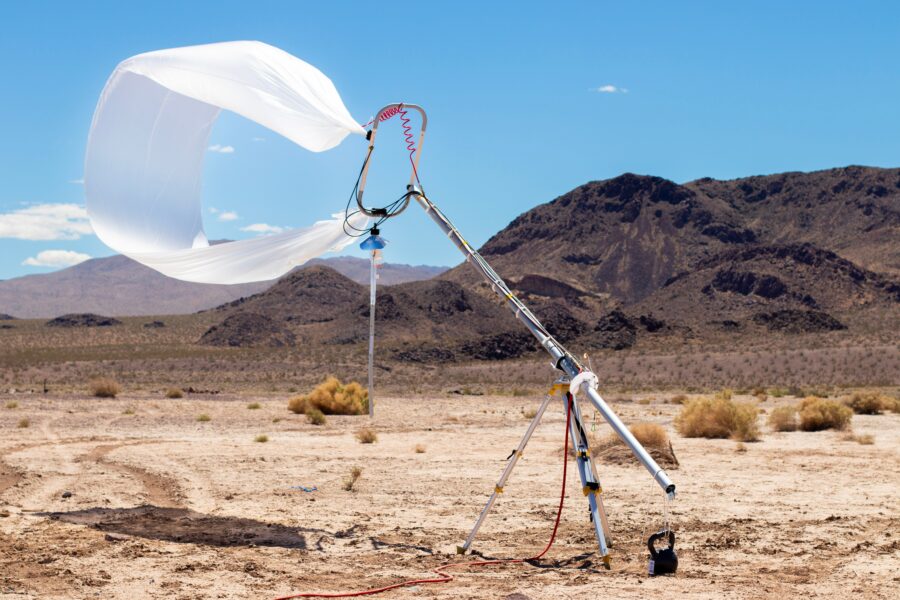
The Air Force recently signed a contract worth nearly $50 million to beef up its weather data collection through a company that has found a way to quickly and cheaply launch thousands of lighter-than-air, autonomous, long-duration weather balloons.
The $48.7 million contract, awarded in late September to Windborne Systems Inc. out of Redwood City, Calif., will give USAF “continuous, global and targeted atmospheric vertical profiling data, from the surface to the stratosphere,” according to a Pentagon release.
The sole-source acquisition contract runs through Sept. 30, 2033. The first task order covers $1.7 million in fiscal years 2025-26.
Currently, USAF uses a combination of “government-owned and partner-provided” sensors and observation platforms, ranging from satellite-based environmental monitoring to aircraft observations, available radar, and tactical radiosonde balloon launches to monitor the ever-changing weather patterns that can quickly affect operations.
“In data-sparse regions, those sources often provided limited geographic coverage, irregular revisit rates, and/or only localized vertical profiles of the atmosphere. Radiosondes, for example, provide temperature, humidity, pressure, and wind data through the upper atmosphere, but require personnel, equipment, and access to a launch location,” a program official with the Air Force Life Cycle Management Center told Air & Space Forces Magazine in an email.
By using autonomous balloon constellations such as those provided by Windborne, the Air Force expects to increase the frequency and geographic distribution of upper-air observations, the official wrote.
“The primary benefit is not necessarily faster model computation; it is more timely atmospheric data for model initialization, data assimilation, forecast verification, and forecaster situational awareness,” the official wrote.
How It Works
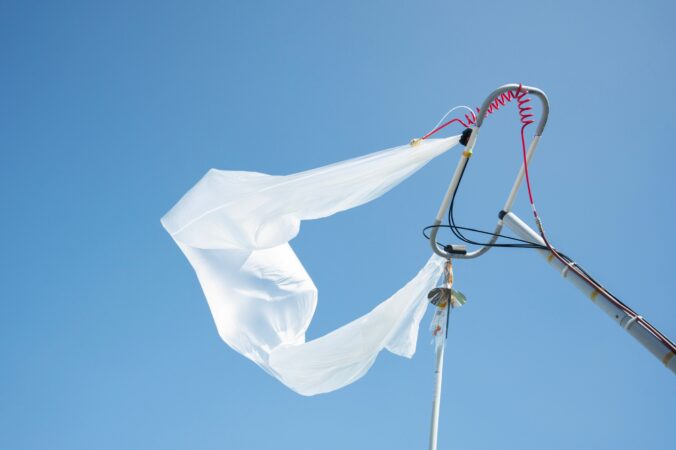
Historically, weather balloons have been made of latex, which expands as it rises and then often bursts after a few hours in operation. But Windborne, spokeswoman Ellie Yoon told Air & Space Forces Magazine, uses a proprietary material that, on average, keeps the balloons aloft for as long as 21 days. Some have been airborne for a year.
“Each balloon has a vent-and-ballast mechanism that allows it to steer by changing altitude,” Yoon wrote. “Winds blow in different directions at different heights, so a balloon picks a direction by moving into the layer that’s going where it needs to go. To climb, the balloon drops ballast; to descend, it vents hydrogen gas. A small solar panel powers the onboard electronics, and altitude changes happen autonomously.”
The company’s Mission Control Center monitors the entire company constellation 24 hours a day, seven days a week. Operators can pause the autonomous movement and take manual control at any time.
“That endurance and control let the balloons cross oceans and polar regions where traditional weather balloons can’t be launched,” Yoon wrote.
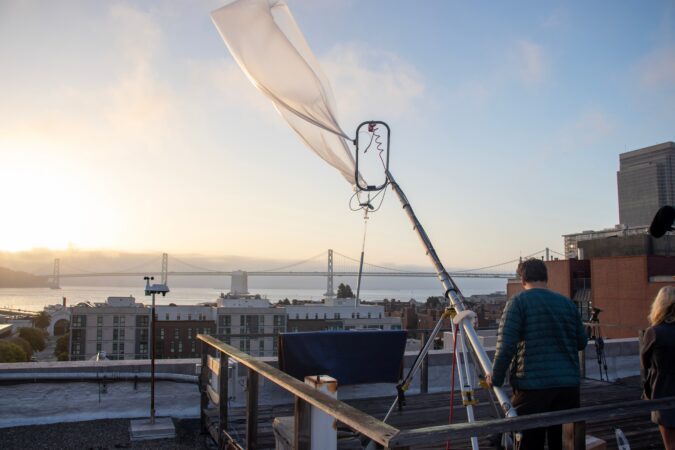
Mike Sierks, a Windborne machine learning engineer, told Air & Space Forces Magazine at an October balloon launch in Arlington, Va., that because the balloon can ascend, descend, and repeat the vertical up-and-down maneuvers for weeks at a time, it can provide much richer data.
“We’re not only able to collect data over the land where we’re launching, but as the balloon sails across the atmospheric current, it is able to take data over regions where there’s just no substitute,” Sierks said.
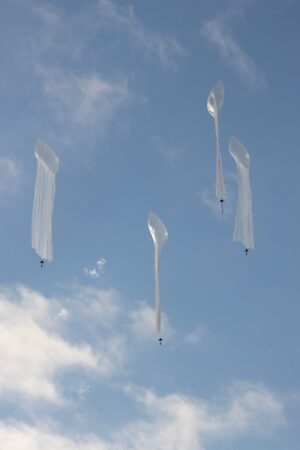
To conserve energy, the balloons travel horizontally across vast regions using the wind. Operators only need to vent gas when they want it to move vertically.
The balloons take about 45 minutes to reach 30,000 feet, where they typically stay until directed to another altitude for measurements or positioning.
The company uses FAA and other data to avoid interfering with any aircraft or other aerial platforms.
In October, the company deployed an onboard receiver and software that let each balloon “talk” to other balloons in the area, share data, and transmit it through the aerial balloon network to a ground- or maritime-based platform.
This past summer, Windborne took a balloon launched from the company’s Hawaiian site and steered into Typhoon Dolphin by switching through wind layers.
“It flew above 20 kilometers to catch fast easterly winds, then dropped a few kilometers whenever it needed to slow down or change direction, while staying clear of deep thunderstorms on the storm’s outer edges,” Yoon wrote.
The balloon then descended into the eye of the storm, going as low as 8 meters above the sea, then climbing past a kilometer, making three loops inside the eye, measuring central pressure, and recording sustained 155 mile-per-hour winds.
That data proved crucial to understanding the storm’s strength and nature from the inside out, in a sustained way.
“A forecast can only be as good as its starting snapshot of the atmosphere, and large parts of the globe have very few in-situ observations, especially over oceans and polar regions. Our balloons collect that missing data,” Yoon wrote.
As of October, the company had 500 balloons in the sky at various locations worldwide. The number fluctuates depending on customer needs.
It has had as many as 700 and plans to expand to 10,000 in the coming years, placing a balloon about every 100 miles across major regions of the planet.
“With enough balloons, you don’t need one balloon taking all of that data,” said Gene Bradley, Windborne director of aviation. “The constellation is the tool, not necessarily each individual balloon.”
Improving USAF Weather Modeling
By grabbing data from these added platforms, the Air Force expects to reduce observation gaps and improve how personnel can understand atmospheric conditions.
“The operational value will depend on data quality, latency, coverage persistence, interoperability, and demonstrated forecast impact against established government and partner observations,” the Air Force official wrote.
By using the quickly launched balloons, USAF weather personnel can get the data they seek without using a permanent ground-based sensing site, giving better information for flight planning, route selection, mission timing, aviation-hazard assessment, and tactical forecasting, the official wrote.
This has extra value in contested environments, where balloons that can ride winds to steer themselves into position can reduce the need to deploy humans, especially in communication-restricted areas.
The USAF Weather Systems Branch, under AFLCMC but housed at Hanscom Air Force Base, Mass., has worked with defense-focused nonprofit MITRE to develop a prototype artificial intelligence model to verify the provenance and integrity of weather data provided by Windborne and other sources, the official wrote.
The prototype is now being used operationally.
For weather systems, the next major milestone includes enterprise integration of commercial atmospheric data feeds into USAF’s Weather Data Analysis Increment 5 cloud environment.
That integration is expected to enable controlled exposure of user applications and weather prediction workflows across the various data enclaves being used across the Air Force’s weather tracking and forecasting efforts.
As part of that work, USAF weather experts are validating data quality, delivery, and availability for operational-scale coverage and demonstrating the data’s forecasting and mission-planning impacts against existing models, the official wrote.