
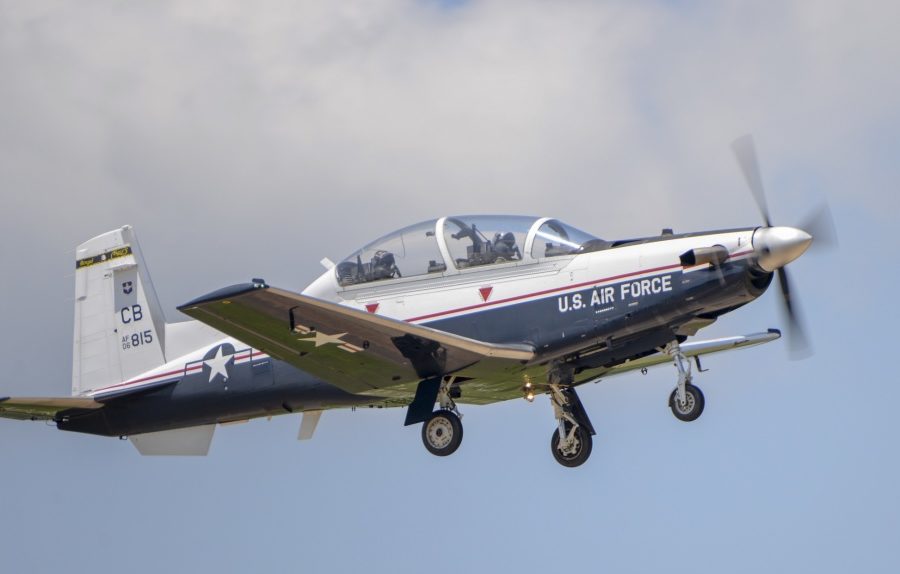
The T-6 is a joint Air Force/Navy undergraduate pilot trainer developed under the Joint Primary Aircraft Training System program. The aircraft is based on the Swiss-designed Pilatus PC-9, and the Navy version is designated T-6B.
Mods include a strengthened fuselage, zero/zero ejection seats, upgraded engine, increased fuel capacity, pressurized cockpit, bird-resistant canopy, and digital avionics with sunlight-readable LCDs. The tandem student and instructor positions are interchangeable, including single-pilot operation from either seat.
The T-6 is fully aerobatic and features an anti-G system. T-6s completed Next-Generation Onboard Oxygen Generation System (OBOGS) upgrades in 2024, drastically reducing hypoxia-type incidents that previously plagued the fleet. Ongoing mods include a crash-survivable flight data recorder and the Avionics Replacement Program (ARP), which will replace the T-6A’s aging HUD cockpit displays and interface, integrate simulated air-to-air/air-to-ground weapons and EW, and modernize debriefing aids. Future development includes controlled flight-into-terrain-avoidance systems.
The T-6’s mission capable rate fell to 54 percent last year, impacting pilot production and leading to discussion of shifting some T-6 training to the future T-7A when it enters service. The Japan Air Self Defense Force (JASDF) signed a contract for the first two T-6JPs to replace the Fuji T-7, becoming the type’s 15th foreign customer on Dec. 12, 2025.
T-6 Texan II Technical Data
Contractor: Beechcraft/Textron Aviation Defense (formerly Raytheon).
First Flight: July 15, 1998.
Delivered: May 2000-May 2010.
IOC: May 2000.
Production: 452 (USAF); 328 (USN).
Inventory: 442 (USAF).
Operator: AETC, USN.
Aircraft Location: USAF: Columbus AFB, Miss.; Laughlin AFB, JBSARandolph, and Sheppard AFB, Texas; Vance AFB, Okla.; NAS Pensacola, Fla.
Active Variant: •T-6A. Joint service primary training aircraft, based on the Pilatus PC-9.
Dimensions: Span 33.5 ft, length 33.4 ft, height 10.7 ft.
Weight: Max T-O 8,300 lb (T-6).
Power Plant: One Pratt & Whitney Canada PT6A-68 turboprop, 1,100 shp.
Performance: Speed 320 mph, range 1,035 miles.
Ceiling: 31,000 ft.
Accommodation: Two pilots on Martin Baker MK16LA zero/zero ejection seats.