
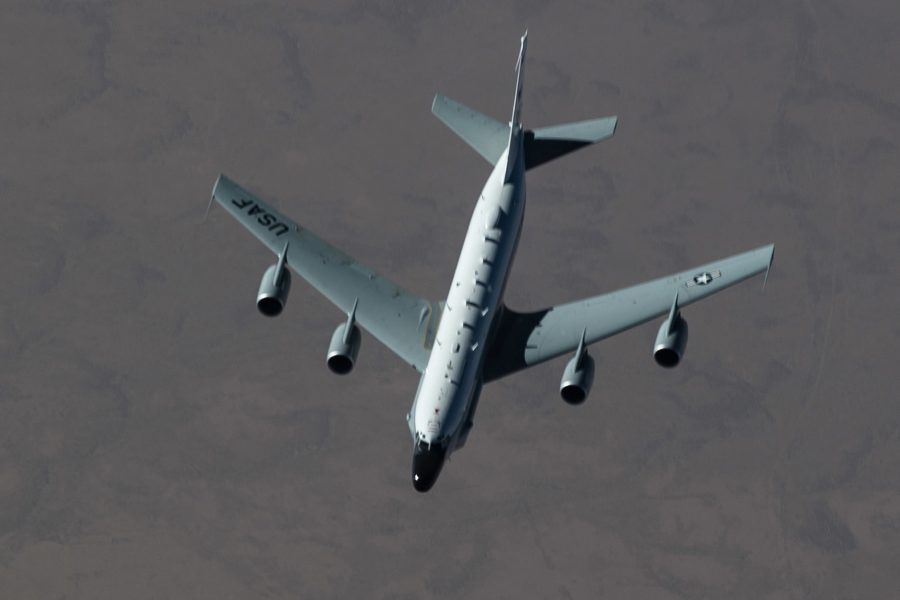
The RC-135V/W is tasked with real-time electronic and signals intelligence gathering, analysis, and dissemination in support of theater and strategic-level commanders. The extensively modified C-135s detect, identify, and geolocate signals throughout the electromagnetic spectrum. Rivet Joint is mostly used to exploit electronic battlefield intelligence and deliver near-real-time ISR information to tactical forces, combatant commanders, and National Command Authorities.
The British Royal Air Force also operates three RC-135W Airseeker aircraft, which are co-crewed by USAF/RAF personnel under an agreement through at least 2035. Onboard capabilities encompass rapid search, detection, measurement, identification, demodulation, geolocation, and fusion of data from potentially thousands of electronic emitters.
Continuous baseline upgrades keep the fleet viable and drive standards for Combat Sent/Cobra Ball. Flexible funds permit rapid, variant-specific mods in response to emerging/evolving threats. The earlier Baseline 11/12 modernized cockpit and operator interface added new direction finding COMINT and precision ELINT/SIGINT, improved collection in dense-signal environments, enhanced near-real-time data dissemination, and integrated RC-135 with the Distributed Common Ground Station (DCGS). FY26 efforts focus on upgrading remaining Baseline 12 aircraft to Baseline 14 and starting test and integration of Baseline 15 on the eight most recently upgraded Baseline 13 aircraft.
Baseline 13 included signal search and geolocation improvements, wideband signal recording, jam-resistant search, moving emitter target location and tracking, and wideband data link improvement. Baseline 14 will incorporate signal recording and spectral receiver enhancements, modernized navigation, surveillance, and air traffic management (CNS/ATM), advanced Mode 5 IFF, and upgraded autopilot. Baseline 15 will add automated search and detection, employment of artificial intelligence, and collaboration to speed collection, analysis, and distribution.
The full fleet is receiving Starshield secure SATCOMS, and FY26 also fields Rivet Joint ground networking, data processing, and crew trainers. USAF recently tested an Electromagnetic Warfare Integrated Reprogramming (EWIR) concept to enable the RC-135 to quickly respond to evolving adversary tactics in a high-threat environment.
RC-135V/W Rivet Joint Technical Data
Contractors: Boeing (airframe); L3Harris (mission systems).
First Flight: N/A.
Delivered: Circa 1973-99 (continuous equipment updates).
IOC: Circa 1973.
Production: Converted.
Inventory: Eight (RC-135V); 12 (RC-135W); three (TC-135W).
Operator: ACC, AFMC.
Aircraft Location: Offutt AFB, Neb.; forward operating locations: Elmendorf AFB, Alaska; Kadena AB, Japan; RAF Mildenhall, U.K.; RAF Waddington, U.K. (USAF co-manned).
Active Variants: •RC-135V/W Rivet Joint. Standoff airborne SIGINT variant of the C-135. •TC-135W. Training version of the operational aircraft.
Dimensions: Span 131 ft, length 135 ft, height 42 ft.
Weight: Max T-O 297,000 lb.
Power Plant: Four CFM International F108-CF-201 turbofans, each 21,600 lb thrust.
Performance: Speed 500+ mph, range 3,900 miles (farther with air refueling).
Ceiling: 50,000 ft.
Accommodation: Three pilots, two navigators, three EWO, 14 intelligence operators, four airborne maintenance technicians (six additional, if required).