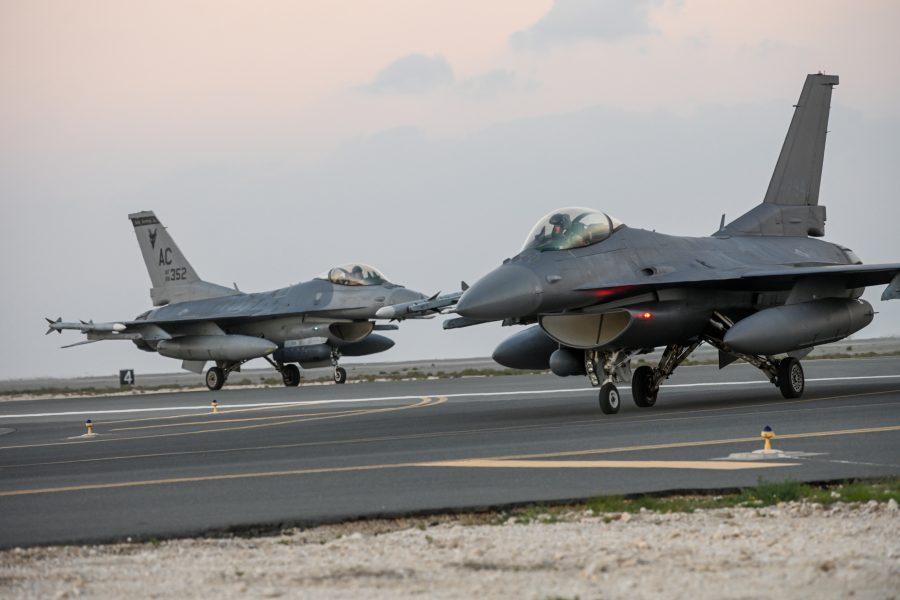
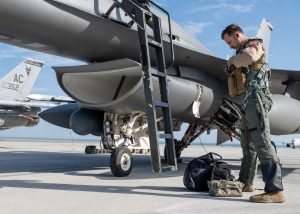
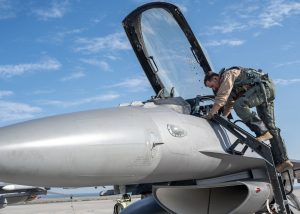
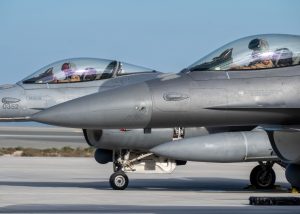
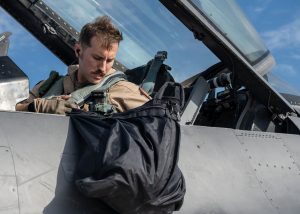
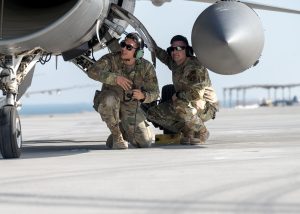
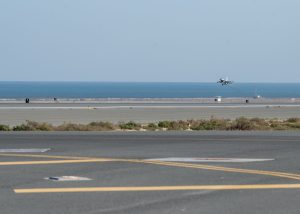
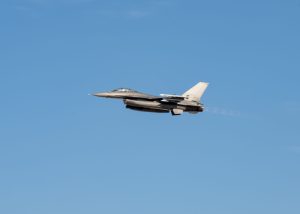
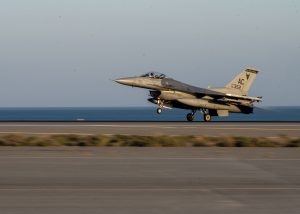
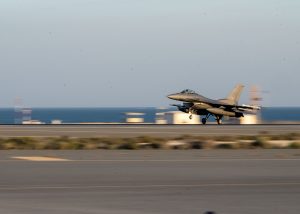
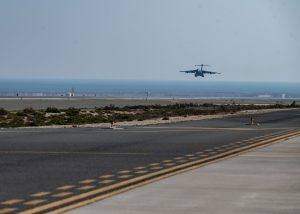
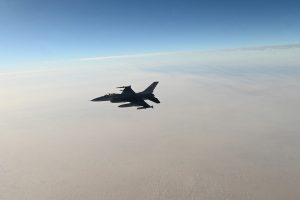
U.S. Air Force F-16 Fighting Falcons taxi at an undisclosed location in the U.S. Central Command area of responsibility in preparation for combined Exercise Ballast Cannon, Jan. 6, 2024. Exercises like Ballast Cannon allow the U.S. and partner nations to improve interoperability, the ability to address adversaries and provide stability in the region. (U.S. Air National Guard photo by Tech. Sgt. Megan Floyd)
Audio of this article is brought to you by the Air & Space Forces Association, honoring and supporting our Airmen, Guardians, and their families. Find out more at afa.org
U.S. Air Force F-16 fighters are in the midst of a weeklong training exercise with the Royal Bahraini Air Force, Air Forces Central announced.
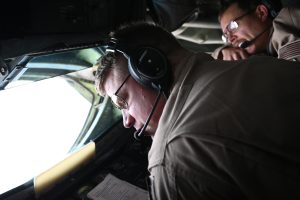
The exercise, named Ballast Cannon, started Jan. 6 and will last until Jan. 12. In addition to the F-16s, KC-135 tankers are participating. Airmen are incorporating Agile Combat Employment (ACE) objectives into the exercise, as well as practicing aerial refueling, coalition command and control, and tactical integration between the USAF and the RBAF.
“By constantly integrating with our partners at the tactical edge, while still testing our expeditionary capabilities, we are building readiness and developing operational approaches that complicate the adversary’s problem as well as maintains our strategic advantage.” Brig. Gen. Quaid Quadri, 378th Air Expeditionary Wing Commander, said in a statement.
Images released by AFCENT show the F-16s participating in the aircraft to be from the New Jersey Air National Guard—the 119th Expeditionary Fighter Squadron arrived in the Middle East in late October to bolster the Air Force’s fighter footprint in the region amid increased attacks by militia groups aligned with Iran and concerns about possible region-wide escalation of the Israel-Hamas war.
An Air Forces Central release emphasized that this latest exercise is a “routine” event, with new editions of Ballast Cannon occurring roughly every three months. Previous iterations have not been publicized, but the USAF and RBAF have worked together before, participating in regional coalition operations, contributing to missions over Yemen and Iraq against Islamic State group fighters. In 2022, the two organizations also conducted a subject matter expert exchange focused on the C-130J aircraft.
“Through decades of collaboration and cooperation with our wonderful partners in the region, we have developed key relationships, bolstering our ability to integrate and employ airpower across the coalition,” Quadri said.
Agile Combat Employment is the Air Force’s operational concept whereby teams of Airmen and aircraft disperse from large central bases to various remote or austere locations, where they can operate with fewer resources and move quickly as needed.
Bahrain has operated F-16s of its own since the early 1990s. In 2018, the Gulf nation ordered 16 of Lockheed Martin’s newest Block 70 F-16s in a $1.1 billion contract. After completing flight tests at Edwards Air Force Base, Calif., the initial batch of these jets are set to be delivered to the RBAF this year.
Audio of this article is brought to you by the Air & Space Forces Association, honoring and supporting our Airmen, Guardians, and their families. Find out more at afa.org
A combined Navy and Air Force program is seeking to build a smaller version of a ubiquitous air-to-air missile that could give advanced aircraft, such as the Collaborative Combat Aircraft, greater magazine depth in a high-end fight.
The Air Force is about to start considering alternatives for eventually replacing the B-52 Stratofortress, even as it prepares to upgrade the decades-old aircraft to a J-model featuring new engines, landing gear, avionics, and radar.
The U.S. military conducted strikes on Iranian targets around the Strait of Hormuz on May 7, as the conflict with Iran flared up again—though officials say the ceasefire remains in effect.
The Air Force’s BACN may be cooked—the service plans to retire its entire E-11A Battlefield Airborne Communications Node fleet in fiscal 2028 and equip aircraft to use satellite communications instead.
Operations Midnight Hammer and Epic Fury make this crystal clear: Bombers that can precisely deliver large payloads halfway around the world are crucial assets. Given the small size and advanced age of America’s current bomber inventory, it is time to boost investment in the B-21 Raider to ensure long range strike remains a viable option at scale for the foreseeable future.
The Air Force has finished resurrecting a B-1B Lancer, completing a yearslong process to transform a bomber that had been stored for parts in the Arizona desert into the new flagship of the 7th Bomb Wing at Dyess Air Force Base, Texas.
Lockheed Martin’s aeronautics division is getting new leadership, with president Greg Ulmer retiring and Skunk Works general manager O.J. Sanchez tapped to succeed him.
F-22 Raptors from two squadrons have arrived at Kadena Air Base in Okinawa, the latest rotation of fighters at the key Japanese base as its awaits its delayed F-15EX Eagle IIs.
✓
Thank You!
Check your inbox to verify your email address and finish setting up your AFA account.
★
Welcome Back!
An account with this email already exists. Please log in to continue.
Subscribe to the Air & Space Forces Daily Report
The latest news from Air & Space Forces Magazine, as well as news from other leading publications, delivered right to your inbox every morning!
We’re sorry, there has been an error. Please review your input or try again later.