
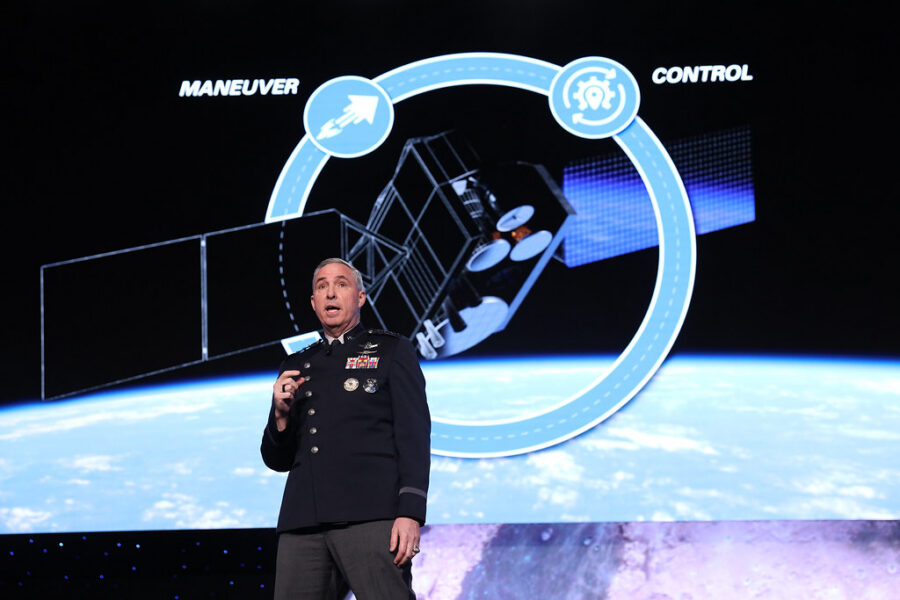
COLORADO SPRINGS, Colo.—U.S. Space Command has tasked a team of internal analysts with laying the foundation for a future maneuver warfare strategy that uses advanced, on-orbit mobility to “shatter the enemy’s cohesion,” the command’s top officer said April 13.
SPACECOM leadership has in recent years stressed the need for a more dynamic approach to space operations—from tactics and doctrine to spacecraft that can move unrestricted by the amount of fuel in their tanks. In January, SPACECOM Commander Gen. Stephen Whiting introduced his vision for a series of exercises called the “Apollo Maneuvers” to test such concepts. The idea is rooted in the Army’s 1941 Louisiana Maneuvers, a series of major battle management exercises designed to test ground tactics during World War II.
In the months since, the command has convened a team of analysts who, using modeling and simulation tools, have created a digital environment they will soon hand off to SPACECOM’s wargaming branch to run tabletop and larger, live-fly exercises using on-orbit spacecraft to test the concepts.
“Right now, we’re in the modeling and simulation space and making progress there,” Whiting told reporters at Space Symposium here. “I would expect later this year for us to begin executing [tabletop exercises] and wargames.”
Whiting said he expects the exercises will coincide with several on-orbit refueling and logistics demonstrations the Space Force has planned for this year and next.
“Obviously those programs will have their own technical mission requirements that they need to test out certain things, and we don’t want to interfere with that, but we have high confidence that we’ll be able to partner with those organizations to to demonstrate capability, and then to also leverage their test points as part of a broader tabletop exercise,” he said.
Those exercises will feed the development of concepts for employment and operations and ultimately doctrine. Whiting said the command is likely “a long way from truly getting doctrine,” but will start codifying early documents “in the coming future.”
In a speech at the conference, Whiting said the need for space maneuver has grown over the last year, following China’s 2025 on-orbit refueling and logistics demonstration.
“When we look at scenarios involving a protracted conflict against a peer opponent, we need a new strategy that isn’t predictable or static,” he said. “A satellite which is locked in a predictable orbit is fighting from a fixed position, and its target. It’s a known position on a map, waiting to be bypassed or neutralized. A force that can maneuver, however, and not be limited by the fuel that it was launched with and reposition as operationally needed is the one that holds the initiative.”
The Space Force has acknowledged the operational imperative of maneuver warfare and has pursued one-off capability demonstrations but hasn’t revealed a long-term plan to develop the supporting architecture or invested sufficient resources. However, the service’s new 15-year roadmap, called the Objective Force, includes plans to possibly field an on-orbit refueling capability between 2030 and 2035 and field an initial on-orbit logistics architecture by 2040.
Speaking with reporters April 14, Chief of Space Operations Gen. Chance Saltzman said those timelines are notional and highly dependent on the outcome of upcoming demonstrations.
“It’s a recognition that as a part of this maneuver element, one way to maneuver is to be able to refuel,” he said. “If we say yes and like the technology, we like where it’s headed, we think there’s a viable operational concept, we want to have a marker out there that says, this is when we think we could exploit that and go forward.”
Saltzman said he agrees with Whiting that the service needs a maneuver force and he supports the push to model and wargame the capability. Both he and Whiting indicated there may be funding for additional demonstrations in the fiscal 2027 budget, though neither discussed the details.
“We are expecting some additional good news in the area of sustained space maneuver,” Whiting said. “I believe it’s a departmental priority. Now we’ll see exactly what form that takes. We certainly need to do some prototyping, need to demonstrate some capability. But from a U.S. Space Command perspective, we need to be heading in the direction of then fielding operational capability.”
As Space Command wrings out its maneuver concepts, Space Force acquirers are thinking about how to build systems that have the capabilities needed for advanced mobility—and how to do so affordably. For example, Space Systems Command is considering a requirement for refuelable satellites as part of its RG-XX program and the Space Rapid Capabilities Office has explored refuelability for some of its systems.
Speaking on an April 15 panel, Col. Bryon McClain, program executive officer for space combat power, said that while refuelability may be ideal for some missions and orbits, it’s not the only way the service can achieve sustained space maneuver. McClain highlighted electric propulsion as an emerging technology that could be promising. These types of systems use electric energy to fly for longer durations and perform more advanced maneuvers.
“Sometimes we hear the word maneuver and people instantly say refueling,” he said. “But that‘s not the only aspect of maneuver.”
Maneuver warfare not only requires harnessing new technology, officials said—it also requires the Space Force to produce satellites in large enough numbers that they can employ new tactics like flanking enemy spacecraft to cut off lines of communication and project strength in ways that small numbers of mobile satellites can’t. One way to get that mass is to invest in more affordable production methods, McClain said.
“That is something we have not been doing in the space environment,” he said. “But I see the industry environment changing and so now that opens up an opportunity.”
