


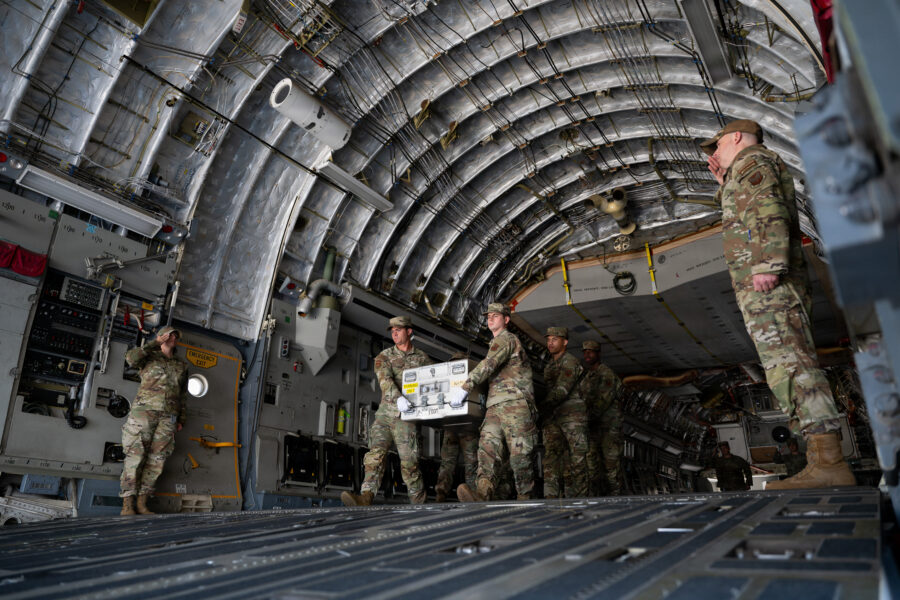
Two Airmen supporting the U.S. conflict against Iran died this month in “non-hostile” incidents, according to the official count recently updated by the Pentagon.
The Pentagon has not publicly identified the two Airmen nor said where their deaths occurred, but both were assigned to U.S. Central Command, U.S. officials said. Listing a death as “non-hostile” means the cause was something other than direct military action.
One of the deaths was described as the result of “illiness/injury.” That Airman died in the United States after being medically evacuated due to an illness, U.S. officials said. The other death’s cause is listed as “pending,” according to the Defense Casualty Analysis System, or DCAS. The Airman died in the Middle East and the cause is under investigation, the officials said.
Both deceased Airmen were mid-to-senior enlisted personnel, between the E-5 and E-9 paygrades. Statistics indicate one was 31-35 years old and the other was older than that, according to the database, which is current as of Oct. 29.
At least 23 U.S. service members have been killed in ongoing action against Iran. Fifteen of those occurred during Operation Epic Fury, the initial strike campaign against Iran that the Trump administration says lasted until early May. Eight more have died during operations that followed. The Pentagon has used “Overseas Operations” to refer to its ongoing military pressure campaign and blockade of Iran.
Iranian missile and drone attacks attacks have killed U.S. personnel at Prince Sultan Air Base, Saudi Arabia, and Muwaffaq Salti Air Base, Jordan. Some deaths have also been caused by accidents. Six Airmen were killed in a mid-air collision between two KC-135 Stratotankers over Western Iraq on March 12, when one of the tankers crashed, killing its crew.
At least 865 service members have been wounded in action since hostilities kicked off on Feb. 28. The vast majority are attributed to “hostile” acts, including 64 Airmen.
A shaky cease-fire is now in place between the U.S. and Iran, and the U.S. has maintained a blockade of the country since early April.
The Trump administration is weighing its next move and the Wall Street Journal reported Oct. 28 that Trump met with Secretary of Defense Pete Hegseth, Chairman of the Joint Chiefs of Staff Gen. Dan Caine, and U.S. Central Command’s Adm. Brad Cooper U.S. Central Command boss Adm. Brad Cooper on military options beyond the blockade. President Trump later hinted at future action, saying during a mid-term campaign event, “We may do another little Epic Fury.”