
Editor’s Note: This is the first in a multipart series on military training during the summer at the U.S. Air Force Academy. The second, on Combat Skills Training, is available here. The third, on the Soaring Program, is available here.
AIR FORCE ACADEMY, Colo.—It’s 0459, and Cadet 1st Class Abigail Anderson is standing outside the door, her hands poised over the wooden surface, waiting. All up and down the long hallway, others hold the same position.
0500 hits, and the yelling and pounding is instant.
“Get up! Rise and shine! Shave your face! Make your bed!”
Another day of Basic Cadet Training at the U.S. Air Force Academy has begun.
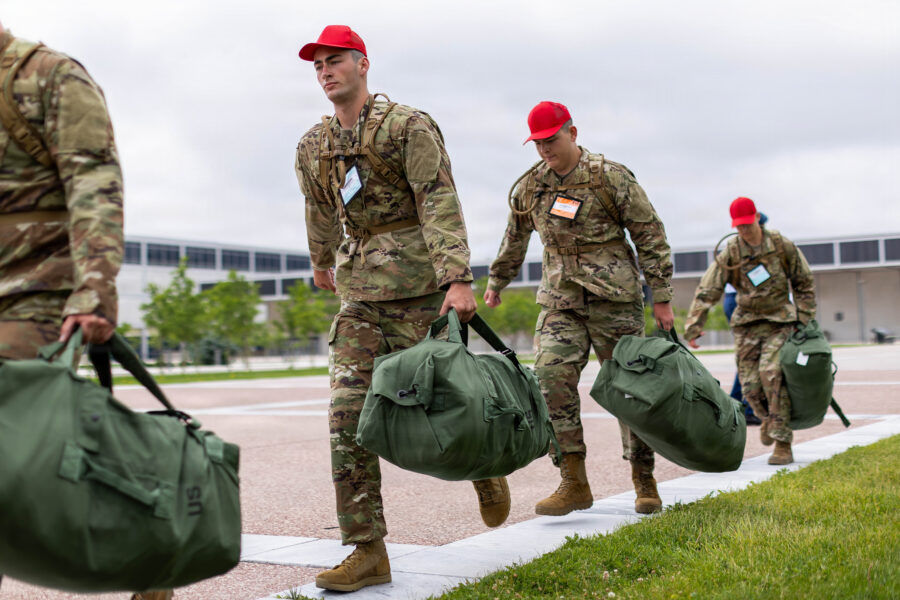
Inside the dorm rooms, mostly 17- and 18-year-olds, just a few weeks out of high school, scramble to make their beds, get to the bathrooms, and don their workout uniforms: blue shorts, grey T-shirts, red caps, and CamelBaks. The yelling cadets charged with overseeing them—cadre in USAFA parlance—continue their harangue until the newbies are assembled in flights of 20-30 before them.
Some basic cadets admit to waking up early to get a head start before the chaos. But cadre are always on the lookout. Knowing sleep is a precious resource, they sometimes confiscate the basics’ watches.
With the flights formed, cadre pace up and down, correcting cadets’ appearance and issuing instructions for the day ahead. When Col. Sarah J. Brehm and Cadet 1st Class Sarah M. Price—BCT commander and cadet group commander, respectively—pass in review, the basic cadets yell “GOOD MORNING,” followed by their full names and titles.
Errors prompt corrections: Price blasts one cadet for not having his socks pulled up properly, Brehm notes a flight got her middle initial wrong.
Two and a half weeks after the Academy’s Class of 2030 arrived for In-Processing Day—an event that always garners media attention— Air & Space Forces Magazine got a rare glimpse of Basic Cadet Training in progress.
The first half of BCT is about discipline: early wakeup calls, PT, march and drill, customs and courtesies, and the bureaucracy of distributing uniforms and equipment.
The second half, at the Jacks Valley complex a few miles away, tests the basic cadets physically and mentally through a series of crushing obstacle courses and scenarios famed among Academy grads. The six-week program ends Aug. 5 with the Acceptance Day parade, when the basics are formally accepted into the Cadet Wing and become cadets fourth class.
BCT is Basic Military Training for cadets, a rough equivalent to the training given to the enlisted force. Indeed, military training instructors from BMT actually roam BCT’s morning formation, and BCT cadre visited Joint Base San Antonio-Lackland, Texas, to observe the instructors in their element at BMT.
And Like BMT, BCT is an institution unto itself. Many in the “Long Blue Line” fondly recall memories from their time as basics, the trauma-bonding that forges deep friendships with their classmates and the common bond of overcoming the same challenges as their forebearers. Many of the cadre who spoke to Air & Space Forces Magazine cited their own experiences in BCT as their motivation for returning to help lead it.
“Our mission is to turn all … of these basic cadets from civilians into military members,” Price said. “That is a daunting feat. It is also a great responsibility, because we are teaching them on military standards, teamwork, knowledge, and truly getting them to appreciate what our profession of arms is.”
Yet BCT is not static. Price and other cadet leaders have been working for months to craft their specific vision for this summer’s program, a vision informed by larger Air Force changes.
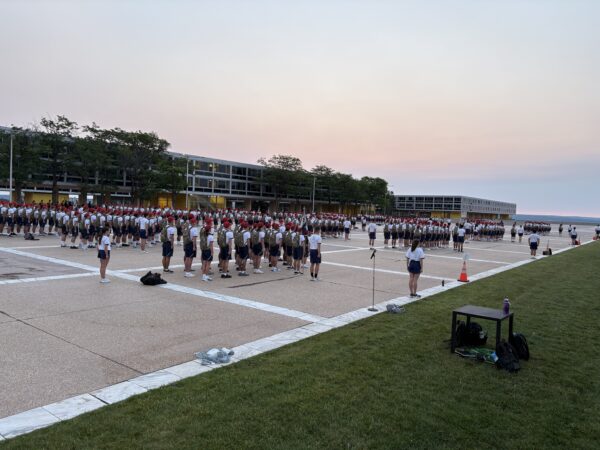
After the 0500 wakeup, the 1,163 basic cadets assemble on the Academy’s “Terrazzo,” divided into eight squadrons (Aggressors, Barbarians, Cobras, Demons, Executioners, Flying Tigers, Guts, and Hellcats) with five flights each (alpha, bravo, charlie, delta, echo).
After a brief inspection and the raising of the flag, warmups begin. PT time was extended this year from 60 to 90 minutes per day—just like for BMT.
“We’ve increased our PT duration and intensity to try to align with some of that broader military intent coming from the Secretary of War, our superintendent, all the way down to us,” Price said.
That extra time isn’t just more situps or pushups. Cadets go through a series of detailed exercises led by instructors from the Academy’s physical education department along with other cadets—including, on this day, All-American gymnast Maggie Slife.
More warmups, recovery time, and sophisticated exercises are now hallmarks of PT across the Air Force, as officials seek to minimize injuries and keep trainees on track. Throughout the morning’s PT, cadre frequently command basic cadets to “Hydrate!”
Price and Brehm join half the cadet group in a continuous run around the Academy’s parade grounds, cruising past many cadets still adjusting to the thin mountain air 7,200 feet above sea level. They call out, urging the basics to keep moving.
Later, at the poolhouse, cadets work through a swim “screening” event. In groups of 10, they float on their stomachs and backs, tread water, swim freestyle and backstroke. Most jump off a 5-meter platform, while a few opt out. An instructor makes clear this is not a test. Some will need remedial swimming lessons once the academic year begins, but for now they don’t have to worry. This, he says, “is the most fun you’re going to have all day.”
The BCT cadre and instructors say their goal this summer is to reinforce the Academy’s military mission and fulfill Defense Secretary Pete Hegseth’s demand for a “warrior ethos.”
“Our main charge is to up the intensity,” Brehm said.
Price said the work on that front started months ago. “When we looked across our cadet wing, we looked at the incoming classes that we’ve seen, and we asked ourselves what we think we need,” Price said. “What we believe we needed as a vision was re-grounding ourselves in our Air Force and Space Force core values.”
From that vision, the team developed “enhanced” evaluations on uniform standards and customs and courtesies, plus a new requirement to learn the Constitution, Price said. At the 0500 wakeup call, loud music echoes through the hallways, making things a little more stressful.
Cadre training was also intensified. “We trained them up really hard this year,” Price said. The cadre swap out halfway through BCT so that the basic cadets don’t get too comfortable with familiar faces.
The Academy’s new Commandant of Cadets Col. Brandon Tellez said it’s critical that added intensity doesn’t turn negative.
“My number one job right now, as I’ve been going around and watching everything, is to look at the attitude and the intent of all of our cadre and how they’re approaching the engagements with these young basic cadets, making sure that you don’t fall into the ‘payback mode’ or ‘this is what happened to me’ kind of thing, and make sure that we never get close to that,” Tellez said. “And thankfully, I can tell you, we’re not. What you see is folks grab this as a marked experience in their cadet career, and want it to be as significant, if not more, for these new arrivals.”
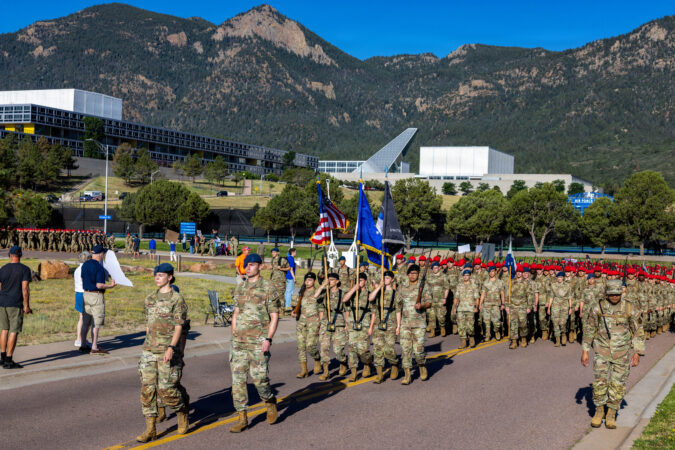
On July 12, Price, her deputy commander C1C Natalie Rupp, and cadet group chief of staff C1C Simeon Rate led the basic cadets, sporting their new OCP uniforms and rifles on a march with six decades of history.
About four miles from the main cadet area, Jacks Valley has been a part of BCT since 1966. Today, it is one part expeditionary base with tents, CONEX boxes, and low-slung metal buildings, and one part summer camp from hell with a series of courses designed to stress basic cadets both physically and mentally.
If the first part of BCT gives the cadets their first taste of life in the military, the second part, which lasts two weeks, gives them their first taste of deployed life, said Lt. Col. Dexter Webb, commander of Jacks Valley.
“We’re pivoting from, ‘Hey, now you’ve gotten a few weeks under your belt of this is what it means to be in the military,’ to ‘Now let’s go apply those lessons,’” Brehm added.
There’s a “confidence course” to push basic cadets to overcome their fear of heights and an obstacle course basic cadets will run through over and over to test their endurance. There’s a “leadership reaction course,” where teams of cadets must work together to maneuver through scenarios, and a chamber where cadets get a taste of tear gas for chemical, biological, radiological, and nuclear defense training.
And there’s the famed “assault course,” complete with mud, barbed wire, “air cannons going off, [and] smoke grenades,” to simulate the fog of war, Webb said. Images from the assault course are featured in Academy promotions, especially exhausted basic cadets, caked in grime, finishing in front of a red sign that declares “ONLY THE STRONG SURVIVE.”
The grueling Jacks Valley courses already fit leadership’s goal of intense training, and Brehm noted many of the courses are “enduring”—the same challenges generations of cadets have overcome.
“Jacks Valley is kind of that great equalizer, to most of the alumni as well,” Webb added. “Everybody remembers their Jack experience because probably it’s one of the hardest things they will ever do.”
Yet even here, there is room for change. Price noted that basic cadets are “going to have to complete nearly 100 percent of those courses to pass and enter our cadet wing,” a stricter standard than previous years, she said.
And as part of the Combat Arms Training and Maintenance course, they will also have to qualify the M4 carbine after previously doing so on the M18 pistol. It’s the first time the Academy has required basic cadets to qualify on, not just familiarize themselves with, the two weapons.
“That’s all part of getting us forward into the operational skills that we may need in combat,” Price said.
A 24-hour Foundational Expeditionary Skills Training course introduced in recent years pushes basic cadets to learn how to establish and defend a bare-bones base—just as trainees must do at BMT’s similar course.
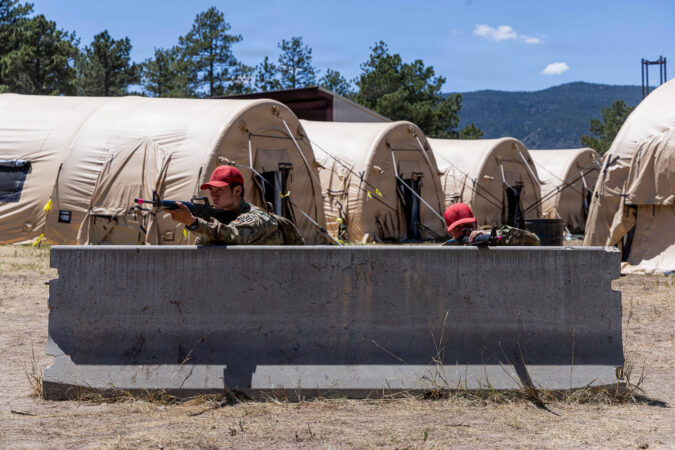
Finally, there is a “culminating exercise” introduced last year meant to mirror the Academy’s school-wide “CULEX” event that took place this spring.
“They will take all previous days’ lessons and apply them through an exercise through multiple lanes where they’ll be put to the test on how much they retain,” Webb explained.
On July 23, the 0500 wakeup call will be “air cannons and whistles, and a bunch of what you could expect if you were just getting shelled,” Webb said. The aim is “to kind of put them in that warrior mindset of ‘all right, it’s real now, you’re disoriented, now you’re going to have to respond, get to your firing positions.”
Basics will have to fend off drones flying overhead and simulated red forces attacking as they try to defend the base and care for combat casualties.
“That training exercise has been in the planning phase for months now, and a lot of resources are going into it,” Price said.
The following day, the basic cadets will march the four miles back to the Cadet Area and begin the process of preparing for the academic year, which launches Aug. 5. From that day onward, they’ll become full-fledged members of the Cadet Wing—cadets fourth class. They’ll go through plenty more over the next four years but their experience will be framed by the way it began.
“This is really cementing the foundation for that warrior ethos for the rest of their time here,” Webb said.
