


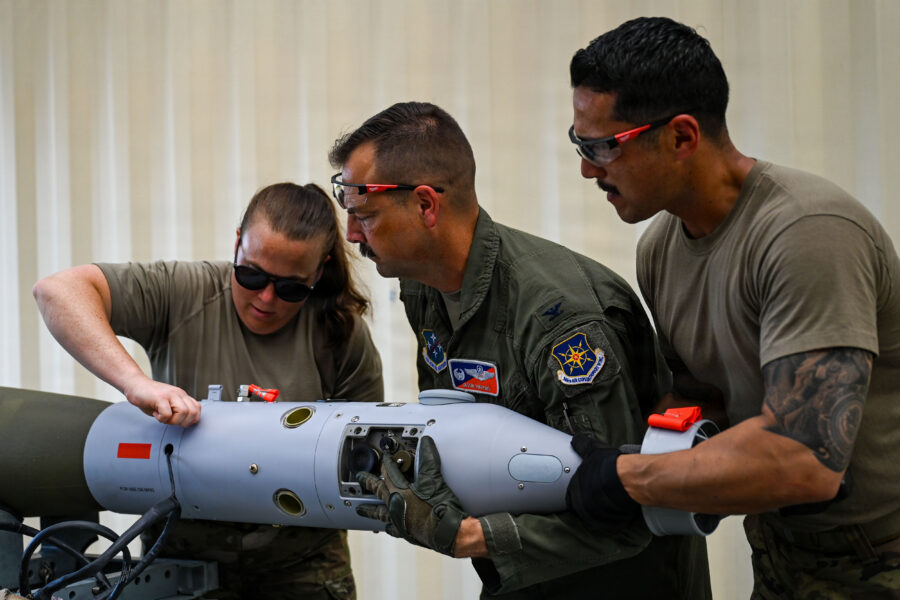
NATIONAL HARBOR, Md.—Defense industry leaders say the Air Force needs to be able to update the software on its munitions multiple times a day, not every few months, and a new Pentagon instruction released last week could enable that.
The instruction, titled “Accelerated Mission Software,” went into effect Sept. 8 and mandates that Pentagon acquisition offices use agile models for software acquisition and testing like development, security, and operations, or DevSecOps.
Speaking Sept. 14 at AFA’s Air, Space & Cyber conference, Rise8 CEO Bryon Kroger said the war in Ukraine have shown that the current model, where munitions technicians might wait months or longer to update software, doesn’t work on the modern battlefield.
“I don’t think that it’s a foreign concept to anybody in this room, but when it comes to software, we’ve just historically been bad at this,” said Kroger, a former USAF intelligence officer and cofounder of Kessel Run, the service’s first software factory. “In some cases, we’re fielding software slower than hardware.”
That slowness has often been the result of software not being prioritized during a weapon’s development, testing, and deployment—creating a challenge for Airmen in the field.
“You wouldn’t think about not establishing a refueling apparatus for aircraft that need it across long distances, but we haven’t really thought about, from an enterprise IT perspective, how to create a similar refueling apparatus, right?” Kroger said.
Pointing to Ukraine’s defense against Russia’s invasion, he called static software “dangerous at this point.”
“We end up talking a lot about hardware and stockpiling everything from munitions to rockets,” Kroger said. “But the question I’d add in the mix is whether the systems can change after we field them.”
The new Pentagon instruction could set the stage for faster software updates. It modernizes software practices such as built-in cybersecurity features, zero trust architecture, continuous testing, and software reuse before introducing new code.
The instruction bolsters software’s prominence by making its development and deployment a strategic asset across the DOD and establishes continuous monitoring across industry to manage supply chain risk.
It also sets rules to manage AI integration and maintain various validations for AI-generated code to protect government data.
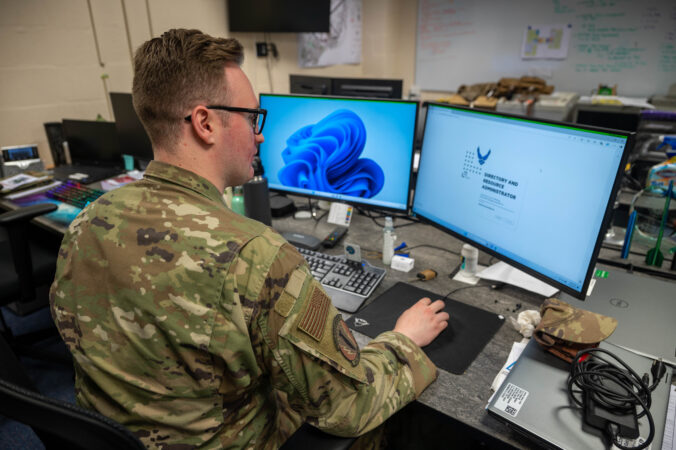
The new rules for software development and deployment are based around how the commercial tech industry operates. Kroger made the case that the Pentagon and defense contractors need to follow commercial tech’s lead by decoupling software development cycles from hardware cycles—like how smartphone makers release software updates in between new phone models.
“And we need to set the bar high” Kroger said. “I hear people talking about, ‘Oh, it’d be really nice to get monthly software updates.’” Instead, he argued for updates multiple times a day to “get an update to the field on demand as soon as we need.”
Kroger said the software is critical to the service’s goal of growing its stockpile of munitions, which could become obsolete if the weapons don’ have the proper software to evolve with changing threats.
“The thing the commander actually needs to know isn’t just inventory,” Kroger said. “It’s those effects and both knowing the effects and producing them.”
Ursa Major CEO Chris Spagnoletti echoed Kroger’s comments on speeding up the software update and integration process with munitions hardware.
“When you mentioned software updates, I used to be an avionics guy years ago. The hairs on my back, my neck went up just because it’s so painful,” Spagnoletti said. “… When you make a software change, you have to do this battery of massive testing to make sure that you didn’t screw something else up.”
What’s key, he said, is to push boundaries on how to do the software work faster, while still maintaining the safety and rigor of the current process.