


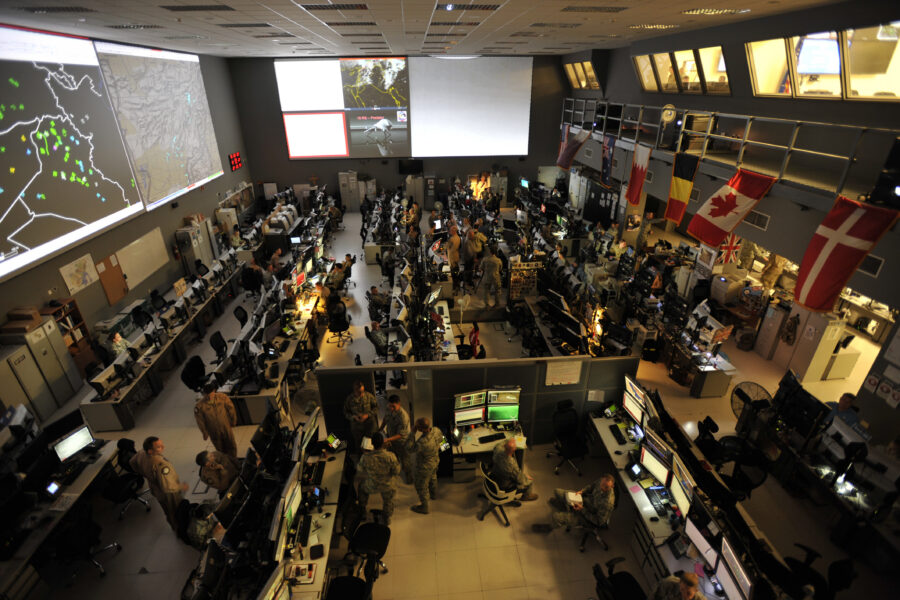
After decades of building isolated, vendor-locked systems to run the Air Operations Centers that serve as the Air Force’s “combat brains,” the program office tasked with creating the next-generation AOC is working to fold those systems into a new cloud-based system.
Col. Brian Viola, the newly appointed commander of Kessel Run, the government-led, vendor-managed program office underneath the portfolio acquisition executive for command, control, communications, and battle management, told Air & Space Forces Magazine in a recent interview that his team is standardizing how cloud-based applications and software updates to AOCs get accessed worldwide in real time.
Starting this spring, Kessel Run launched the Dynamic Unified Net-enabled Environment, or DUNE, which merges cloud and on-premises capabilities for AOC operators, commanders, and their customers—the rest of the operational Air Force.
“Evolving the architectural foundation is vital because the information our warfighters rely on depends on the integrity, speed, and agility of the underlying domain,” Viola said. “We are rapidly entering the era of software-defined warfare, where tactical superiority belongs to the force that can iterate, secure and deploy code faster than the adversary can adapt.”
Essentially, DUNE standardizes how legacy and current software communicates across the Air Operations Center’s systems.
It’s unclear whether the DUNE acronym is a nod to the popular book, film and TV franchise of the same name. But the Air Force has a history of using sci-fi-inspired names and acronyms—Kessel Run itself is named after a Star Wars reference.
Speaking the Same Language
Currently, Viola said, AOC operators must choose between using real-time, cloud-based tools or sticking with the often aged, legacy hardware they have on hand.
“The ability to rapidly integrate new mission capabilities, enable distributed command and control, and incorporate new technologies depends on the architecture beneath them,” he said.
DUNE is an overarching project that builds on Kessel Run’s Applications Transformation project, or AppTX, which the service introduced to conduct large-scale migrations of legacy software apps to the cloud. Companies such as Parsons, General Dynamics Information Technology, and Astrion compete for taskings through AppTX.
DUNE focuses on the issue of Data Definition Language, which has gained prominence with the recent push to rush artificial intelligence into systems across the Pentagon. DDL is a kind of programming language that can create, modify, or delete database structures without modifying the data itself—it allows legacy infrastructure and software “talk” with new software and applications, breaking down silos and stovepipes.
Without it, Viola said, “you’re going to have to work with what you have”—an Airman in an AOC will only be able to draw from a tool or solution they have in their local network, on site near the tactical edge, without access to the cloud.
“We don’t want to necessarily have every AOC be a snowflake that we have to go, ‘this is tailored for you now, AOC 1, and this is tailored for the 613th [AOC], this is tailored for the 607th [AOC],” Viola said.
Tailoring the solutions by AOC is “sucking away from the innovation we really want to get after,” he said.
Project DUNE aims to get the continuous delivery of cloud-based capabilities and applications down to an on-premises solution, he said.
Solutions won’t be as “elastic” as the cloud, but they will be a resilient capability that users can rely on, he said.
Beyond DUNE, Viola said next steps include building the “Revolutionary AOC” with industry partners. The effort will involve operators, mission partners, engineers and acquisition teams working together in operational scenarios to identify gaps and improve the system architecture.
Work on DUNE and recent pushes in the PAE C3BM and Kessel Run specifically predate Viola’s tenure. Air & Space Forces Magazine reported in February that Kessel Run was launching its “next generation” AOC effort, which seeks to integrate AI, machine learning, data fusion, and cloud-based software into the centers.
The Air Force has 21 AOCs across the force and sees these operational hubs as weapons systems in their own right, calling them AN/USQ-163 Falconers.
In 2022, the Air Force awarded SAIC a $374 million contract through mid-2027 to sustain and modernize its AOCs. The current Falconer system is in Increment 10.1, with a 10.2 (aka Block 20) upgrade in progress.