


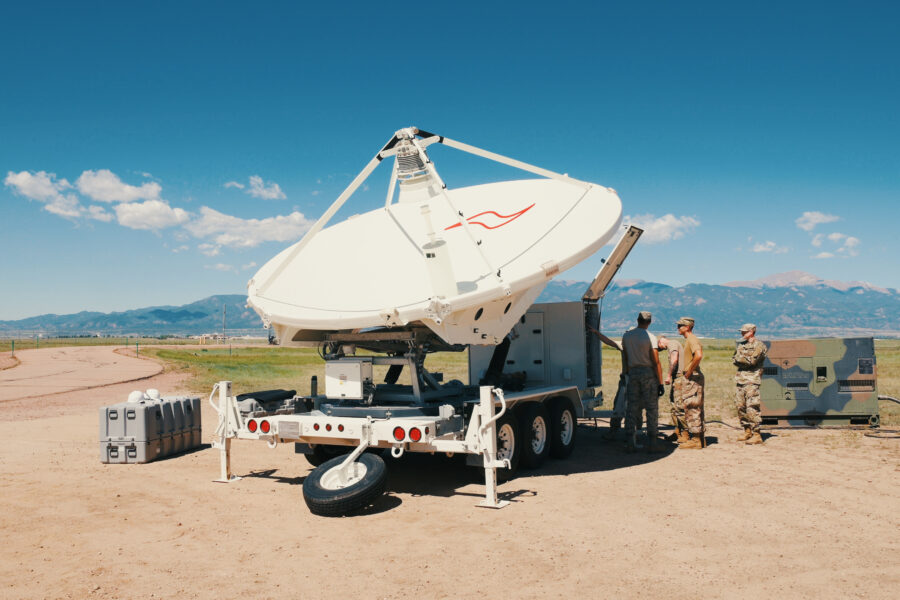
The Space Force is preparing to launch hundreds of satellites with countless sensors into orbit over the next few years—sensors that will give commanders vast troves of data.
But the long-standing method for communicating data down from space via radio frequencies has the potential to create deadly data bottlenecks that could slow and stymie future operations, according to a new report.
The report, to be rolled out Oct. 1 by AFA’s Mitchell Institute for Aerospace Studies, makes the case for combining RF with optical communications technology, or laser comms, for a “hybrid” system.
Retired Air Force Col. Jennifer Reeves, now Mitchell’s senior resident fellow for space studies, authored the 37-page analysis and recommends that USSF get moving soon.
Her findings show that the military’s space-based sensors and communications systems are generating as much as 200 times more data than the force consumed two decades ago.
The ability to collect data, however, has not been matched yet by the ability to deliver it quickly to users, Reeves said.
The Space Force has made some moves to field laser comms, which advocates say is harder to disrupt and capable of transmitting more data faster. The Space Development Agency plans to field hundreds of data transport satellites with optical communications terminals in low-Earth orbit for its Proliferated Warfighter Space Architecture.
In a Sept. 29 media briefing, Reeves called that effort “an important step towards … building a proliferated network designed to move data across space and ultimately to the warfighter. But that’s one piece of a much larger communications architecture.”
The first batch of operational data transport satellites is in orbit, and scores more are already under contract and being prepped for launch. The problem is that all of that data is being pushed through a legacy network never designed for that volume, according to Reeves’ report.
“I think the space layer is getting out ahead of us, and we’re going to have too much information to be able to manage effectively,” Reeves said. “We really need to earnestly move forward.”
Yet even as Reeves and others argue for the Space Force to develop laser comms even more, there has been pushback. In 2025, Air & Space Forces Magazine reported on a Government Accountability Office report that dinged the service for spending too much on the not-yet-ready-for-prime-time tech.
“Without demonstrating key laser communications technology capabilities, or [minimum viable products], SDA is risking not being able to leverage past experiences into the investments either under contract or planned for in the future,” GAO wrote. “These investments are substantial—nearly $35 billion.”

RF and Lasers
Radio frequency methods work by broadcasting RF down from space, which makes signals easy to detect, intercept, and jam with the right equipment and skills.
“The [laser] link is so much safer just because of that beam spread, that’s so tiny compared to what you’re getting with RF,” Reeves said in a Sept. 28 media briefing. “Whereas anything inside the footprint of RF, all you have to do to overcome is use power, and you are turning that off.”
As an example, she showed RF communications from space blanketing much of the United States East Coast, while a laser comms shot covered the equivalent to the size of Ellis Island, home of the Statue of Liberty.
“A much smaller footprint reduces spillover and the opportunity for detection, interception, or interference,” she said.
Laser comms can transport data 10 to 40 times faster using a beam nearly 1,000 times narrower. But that precision comes with reliability tradeoffs.
Satellites in low-Earth orbit travel at about 17,000 miles per hour. At that speed, the time window to find another satellite and blast a laser beam to it while keeping the link steady is small. Any physical movement, even small vibrations, can disrupt the signal.
Reeves doesn’t want to ditch RF. The report highlights the technology’s capabilities and its widespread use and applications. But it can’t be the only method, she said.
Moving Data Smarter
Additionally, the report identifies a need for on-platform edge processing to use AI tools and data filtering in space.
“Edge processing and artificial intelligence can help identify and prioritize what’s operationally relevant,” Reeves said.
That will avoid raw data eating up tons of bandwidth on the front end, she said.
The edge processing challenge is that most space assets currently still rely on ground station downlinks for complex command-and-control decisions and target processing, among other tasks. That’s largely due to thermal, power, and radiation thresholds on much space hardware.
In the near-term, USSF’s work building the Space Data Network aims to standardize optical intersatellite links and edge routing.
By using onboard sensor triage methods, USSF hopes that equipment can better process high-resolution imagery and other data on the space asset.
While the paper notes tech fixes such as laser comms and edge processing to move data around space and down to and back up from Earth, Reeves also advocates for reducing data flows and building self-healing, smart networks that reroute information to the best possible pathway to deliver relevant information to operational commanders in minutes, not hours.
“The goal isn’t simply to move every bit faster. It’s to move the right information towards the right user for the most effective available pathway,” Reeves said in the media briefing.
Time Sensitive
Building out a hybrid RF/laser space communications network isn’t an overnight affair. But Reeves argues an initial operational capability could be running within the next five years if Congress and DAF prioritize funding to mature the technology.
That, she said, is critical because the Chinese military isn’t ignoring this capability.
The Chinese government and People’s Liberation Army have two major satellite projects, both utilizing laser communications— the Guowang Constellation (National Network), and the Qianfan Constellation (Thousand Sails).
Guowang began launches in 2024 and currently has as many as 204 active satellites, with plans to deploy nearly 13,000. It uses standard broadband RF, high-resolution radar, and high-capacity laser cross links. The Chinese government views this network as an unjammable military communications backbone for the PLA.
Qianfan has 248 active satellites, Reeves said. It aims to contain 15,000 satellites by 2030. This network is the Chinese government’s testbed for optical terminals with high-speed laser nodes and has secondary military communication lines and maritime tracking assets.
For the U.S., optical communications are already in use among industry and some NASA satellites.
The agency has used the technology on its Orion spacecraft during the Artemis II mission, testing high-bandwidth video transmission from the distance of the Moon, or nearly 240,000 miles away.
The NASA Psyche spacecraft has conducted experiments with laser communications on deep-space laser links. And in 2021, the agency launched the Laser Communications Relay Demonstration and has conducted more than 2,600 experiments with its two ground stations.
The Space Force is also working on its Enterprise Space Terminal program, a $100 million prototyping initiative to build smaller, lighter laser comms terminals that use a standardized waveform.
Mitchell Report Recommendations
- Accelerate and Sustain Communications Modernization Through Stable Resourcing and Adaptive Acquisition.
- Operationalize Hybrid RF-Optical Architectures Across the Force
- Lead Interoperability and Standards Development for the Future Communications Ecosystem