
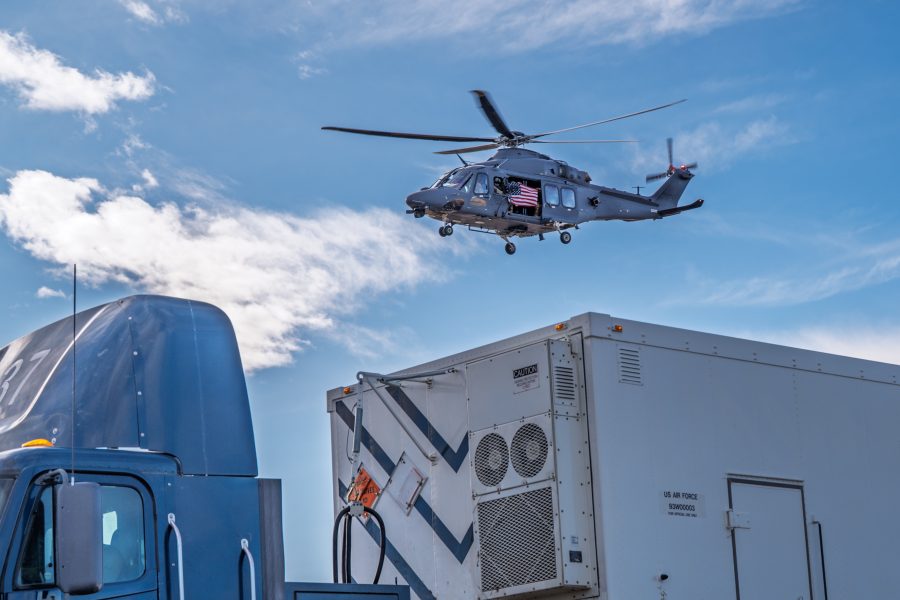
The Air Force’s new nuclear security helicopter, the MH-139A Grey Wolf, achieved initial operational capability in August—a significant milestone in the service’s effort to replace its Vietnam War-era UH-1N Hueys but years later than originally planned.
In an Aug. 31 release, Air Force Global Strike Command said it declared IOC for the Grey Wolf on Aug. 10. IOC occurs when a system can be fielded and maintained by some of its operational units. In the case of the MH-139, that’s the 40th Helicopter Squadron at Malmstrom Air Force Base, Mont.
More units will soon follow. The 37th Helicopter Squadron at F.E. Warren Air Force Base, Wyo., opened a new operations facility to support the MH-139 on Aug. 14, setting the stage for helicopters to arrive there in the coming weeks. After that, the 54th Helicopter Squadron at Minot Air Force Base, N.D., is next up to get the Grey Wolf helicopters.
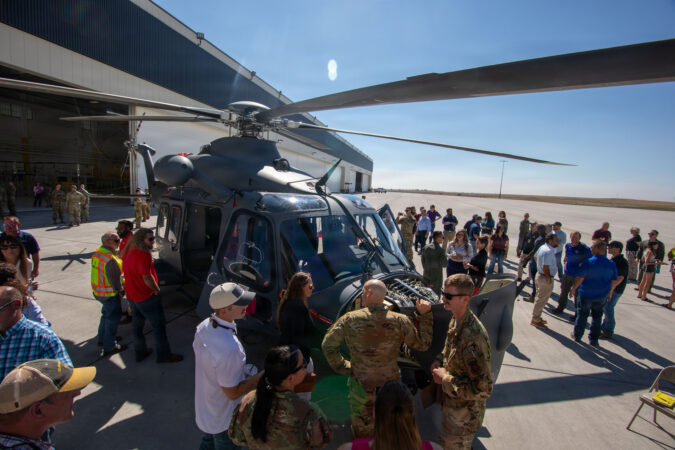
The Air Force first awarded Boeing a $2.4 billion contract for the MH-139—based on the civilian Leonardo AW139—in 2018. It was the first time the service had procured a helicopter directly, and it was the first major acquisition program for Global Strike Command. The first aircraft was delivered in December 2019, and the goal was to achieve IOC by 2021.
The need for the Grey Wolf was and is driven by the aging Huey fleet, whose average age is now past 50 years old. Air Force security forces use the helicopters to patrol and escort convoys around sprawling intercontinental ballistic missile fields that cover a combined 33,600 square miles. The MH-139 can fly farther, faster, higher, and with more weight than the UH-1N.

| Contractor | Bell Helicopter |
| First flight | April 1969 |
| Rotor diameter | 48 ft |
| Length | 57.1 ft |
| Height | 12.8 ft |
| Max gross weight | 10,500 lb |
| Top speed | 149 mph |
| Range | 300+ miles |
| Ceiling | 15,000 ft |
| Load | 6-13 troops or 6 litters |

| Contractor | Boeing (prime); Leonardo (airframe) |
| First flight | 2019 |
| Rotor diameter | 45.2 ft |
| Length | 54.7 ft |
| Height | 16.3 ft |
| Max gross weight | 14,110 lb |
| Top speed | 167 mph |
| Range | 890 miles |
| Ceiling | 20,000 ft |
| Load | 15 passengers or 4 litters + 5 medical |
Originally, the Air Force planned to buy up to 84 Grey Wolves and use them not only for nuclear security, but also for aircrew survival training and contingency response in the Washington, D.C., area, where the 1st Helicopter Squadron flies the Huey.
But the program was beset by delays: Federal Aviation Administration certification presented one holdup, a swath of testing problems emerged, and there were even concerns that the helicopter risked not meeting operational requirements.
The Air Force revamped its plans in 2024, cutting the planned fleet size to 42 aircraft, all for ICBM security, but that drove costs up, triggering a “critical” cost breach and congressional notification under the Nunn-McCurdy Act.
Since then, however, the program has bounced back on several fronts. Congress included $210.3 million in the One Big Beautiful Bill Act passed last July to procure an extra six MH-139s, and in its fiscal 2026 budget, the Air Force increased its objective to 56 aircraft. House lawmakers have since followed by voting to authorize four additional aircraft in their version of the 2027 defense policy bill, which is still well short of becoming law.
Operational test and evaluation, which began in January 2025 and was led by the 550th Helicopter Squadron at Malmstrom, wrapped up in June 2025. A pair of MH-139s flew their first operational mission in January 2026, escorting an ICBM convoy at Malmstrom about 100 miles out and back.
