


Lawmakers on a key Senate panel want to put their stamp on the Space Force’s missile warning plans, pushing for more satellite sensors that can detect and track hypersonic and ballistic missiles in real time and attempting to block an effort to cancel satellites that provide Polar coverage.
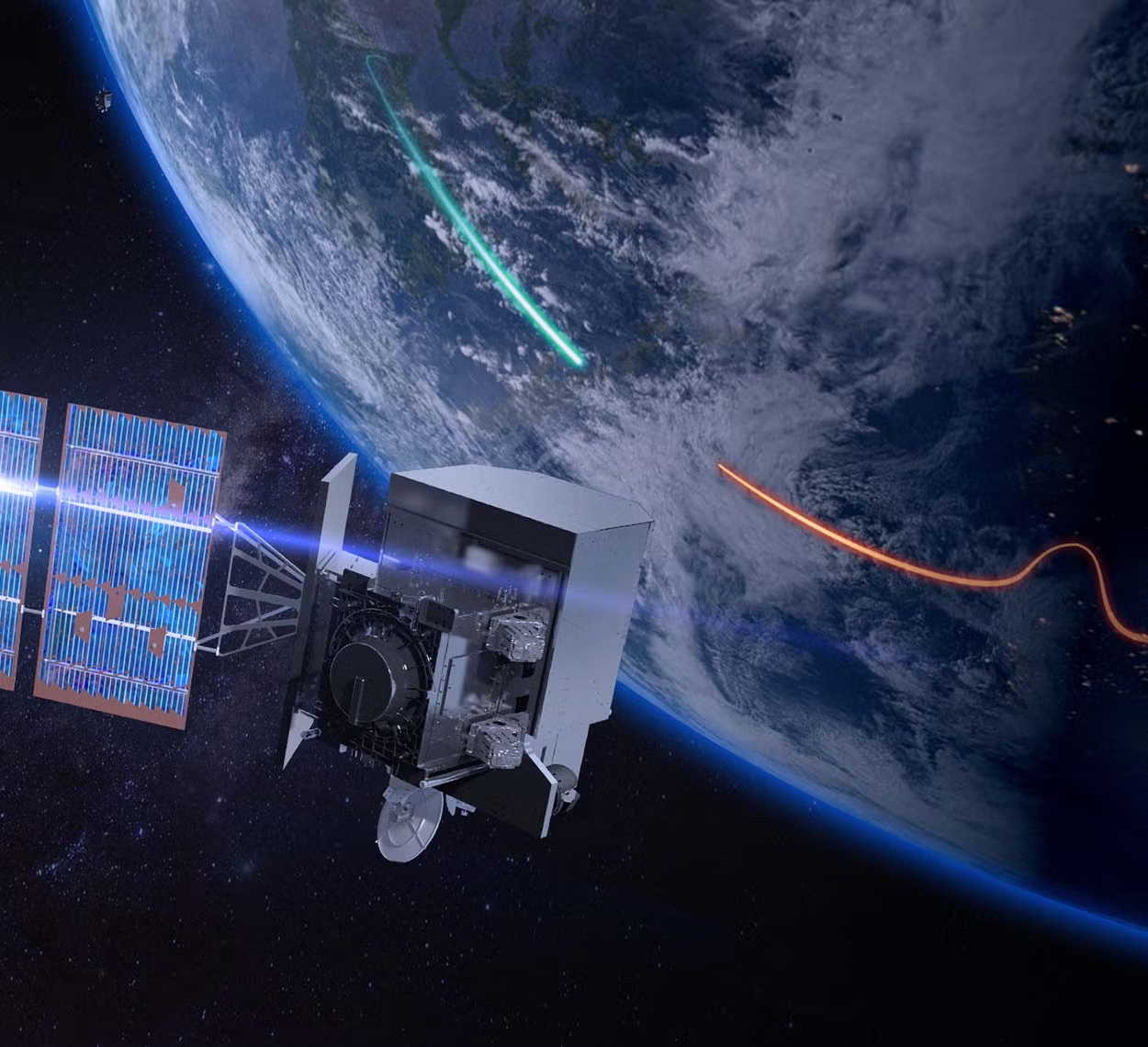
The sensor is the Hypersonic Ballistic Tracking and Space Sensor—the Space Force already has two test payloads in low-Earth orbit as part of its Space Development Agency’s missile tracking layer of satellites.
The Senate Armed Services Committee, in its version of the fiscal 2027 defense policy bill approved June 11, directs the Space Force to commit to fielding at least 45 HBTSS sensors as part of a future iteration of that satellite architecture called “Tranche 3.”
The bill, which hasn’t yet been approved by the full Senate, cites Defense Secretary Pete Hegseth’s acquisition reform push, calling for the service to move quickly to field the “already competed” sensor “while maintaining rigorous oversight and accountability.”
“In the spirit of the Acquisition Transformation Strategy’s focus on delivering capability at speed and scale, embracing proven capabilities that are ready now, the committee directs the U.S. Space Force to prioritize acquisition and operational deployment of a full constellation of at least 45 space vehicles equipped with proven HBTSS payloads,” the committee wrote in a report accompanying the bill.
SDA has already awarded contracts for its Tranche 3 Tracking satellites, selecting Northrop, L3Harris, Rocket Lab, and Lockheed Martin to build 18 spacecraft each for a total of 72. It’s not clear how many of the 45 satellites the committee wants the Space Force to buy are already baked into that total.
The Missile Defense Agency developed the HBTSS prototype, and officials have praised the performance of the first two sensors, which flew on a 2024 SDA launch. The director of the Pentagon’s massive Golden Dome missile defense program has indicated he wants to leverage the capability too. In March, Gen. Michael Guetlein said the program increased its $175 billion cost estimate by $10 billion to speed up several programs, one of them being HBTSS.
The Pentagon’s fiscal ‘27 reconciliation funding request includes $17.5 billion for Golden Dome, and a portion of that funding would support “accelerating” HBTSS, according to a DOD budget document. The document doesn’t say how much funding the program wants for the space sensor.
Maintaining Polar Coverage
The Senate committee’s bill also rejected a Space Force move to cancel the Next-Generation Overhead Persistent Infrared-Polar program, the third of four defense committees to push back on the proposal.
The SASC bill includes $500 million for the effort. The House Armed Services Committee and the House Appropriations defense subcommittee also supported maintaining the program in their own bills. The Senate Appropriations defense subcommittee has not yet released its bill
Northrop has been under contract since 2020 to build two Next-Gen OPIR Polar satellites, and budget documents indicate the effort will cost $3.4 billion through fiscal ‘26. Lockheed Martin is building two satellites under a similar effort in geosynchronous orbit called Next-Gen OPIR GEO. The two programs, together, were intended to replace the service’s legacy Space-Based Infrared System satellites.
However, as the Space Force pursues more proliferated missile warning constellations in other orbits, it has taken steps to reduce its investment in Next-Gen OPIR, claiming requirements for detecting and tracking traditional and advanced missiles can be met by these new satellite fleets. In fiscal 2023, it shrunk the size of the geosynchronous constellation from three satellites to two. Its move to eliminate the Polar arm of the program continues those reductions.
“Due to projected polar coverage from the low-Earth orbit and medium-Earth orbit layers of the Resilient Missile Warning/Missile Tracking [program], a risk informed decision has been made to terminate the Next-Gen OPIR Polar program,” the Space Force said in justification documents submitted with its fiscal ‘27 budget request.
Following the budget’s release in April, Northrop issued a statement saying it would “continue to support” the Space Force’s missile warning mission needs and reiterating that its work on the program is “on schedule and on budget.”
The service’s new proliferated constellations include one in medium-Earth orbit, overseen by Space Systems Command, and another in low-Earth orbit, built by the Space Development Agency. The Space Force’s budget requests $3.5 billion for SDA’s fleet, called Resilient Missile Warning and Tracking LEO, and $1.4 billion for the MEO layer. SDA expects to launch its first operational missile warning satellites this year, while SSC’s first MEO spacecraft are slated to fly in 2027.
Both of those efforts will likely play a role in the Golden Dome program.