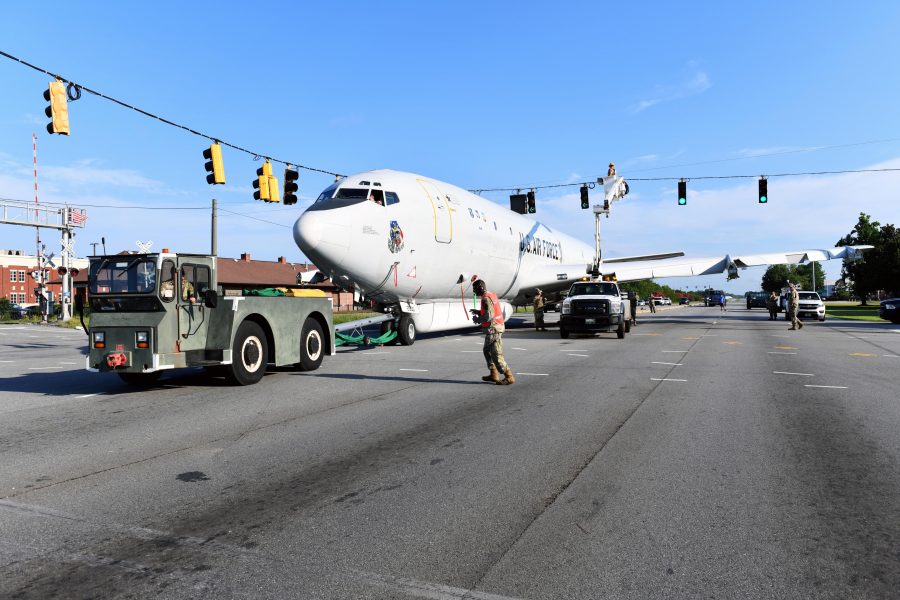
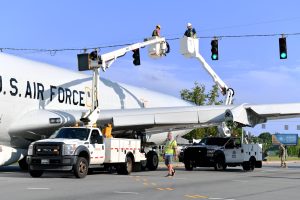
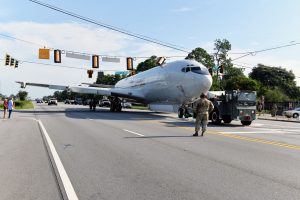
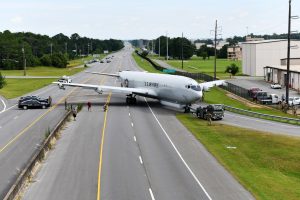
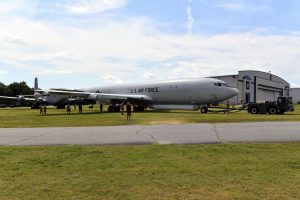
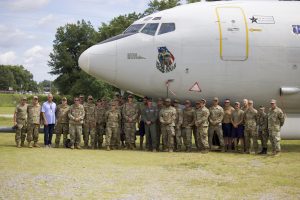
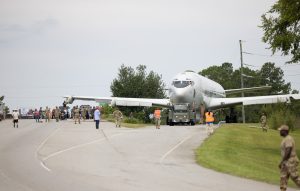
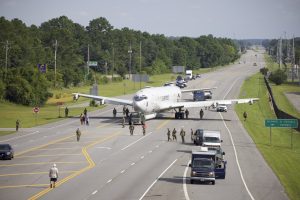
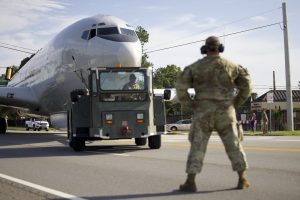
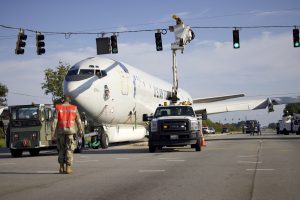
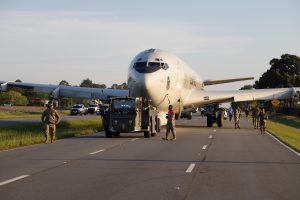
461st and 116th Air Control Wings’ maintenance crews guide the E-8C Joint STARS 00-2000, along Georgia Highway 247 towards the Museum of Aviation at Robins Air Force Base, Georgia, July 16, 2023. A Georgia Department of Transportation high-lift truck worker raised the traffic signal wires at the intersection of Watson Boulevard and Highway 247 to provide clearance for the aircraft. U.S. Air Force photo by Rodney Speed
Audio of this article is brought to you by the Air & Space Forces Association, honoring and supporting our Airmen, Guardians, and their families. Find out more at afa.org
An unusual vehicle made its way down Georgia State Highway 247 on July 16—an E-8C JSTARS aircraft.
Airmen from the 116th and 461st Air Control Wings helped tow the airframe, tail number 2000, four miles down the road from Robins Air Force Base, Ga., to the local Museum of Aviation, where it will remain on display. The targeting, battle management, and command and control jet was retired in May, a spokesperson for the 78th Air Base Wing told Air & Space Forces Magazine.
Images shared on social media and with Air & Space Forces Magazine show Airmen working with Georgia Department of Transportation workers and the Houston County Sheriff’s Office to maneuver the 171,000-pound jet past traffic lights and other obstructions.
One image particular shows the aircraft’s nose art and nickname, “The Watchman,” with Col. Christopher Dunlap, commander of the Georgia Air National Guard’s 116th Air Control Wing, and other Airmen involved in the operation.
The move marks yet another milestone for Robins as it goes through the process of transitioning away from the E-8 and standing up four new missions. In June 2021, the Air Force first announced plans to cut the JSTARS from Robins, which has hosted the aircraft since 1996.
In its place, Robins is getting a Battle Management Control squadron, an E-11A Battlefield Airborne Communication Node (BACN) squadron, a Spectrum Warfare group, and support units focused on the Advanced Battle Management System.
This past March, the Air Force budget request revealed a plan to accelerate the divestment plan, with the entire fleet retiring by the end of fiscal 2024. Lawmakers have not signaled any interest in blocking those retirements.
Robins, meanwhile, is winding down its E-8 mission. The 16th Airborne Command and Control Squadron, one of two JSTARS squadrons under the 461st Air Control Wing, was inactivated in February, and the 129th and 330th Combat Training Squadrons flew their final flights the same month.
Exactly how many E-8s are still in the fleet is unclear. In December, the 78th Air Base Wing said in a release that six had been divested, but a spokesperson declined to offer an exact number this week, citing operational security. With at least one more gone in tail number 2000, though, things are clearly winding down, and the spokesperson confirmed the final retirements are still planned for “early fiscal year 2024,” which starts Oct. 1, 2023.
The 12th Airborne Command and Control Squadron, the last flying unit left in the 461st Air Control Wing, made its final operational flight July 12.
Audio of this article is brought to you by the Air & Space Forces Association, honoring and supporting our Airmen, Guardians, and their families. Find out more at afa.org
One of the Air Force’s developmental Collaborative Combat Aircraft fired a live missile in a recent test, marking a critical step forward in the development of the service’s fleet of semi-autonomous drone fighters.
The Pentagon announced framework agreements for new multiyear deals with three companies to mass-produce more affordable, less exquisite air-to-ground missiles for the Air Force, part of a larger strategy to bring cheaper firepower to a future fight.
The Air Force plans to buy up to 11,200 copies of the Joint Air-to-Surface Standoff Missile and its anti-ship variant over the next five to seven years, a dramatic increase in production for the critical long-range cruise missiles
Northrop Grumman is deep into testing two upgrades for the F-16 as the Air Force looks to keep the fourth-generation fighter ready for the future fight, company officials told reporters this week.
The Air Force’s “software sold separately” plan to buy critical autonomy software decoupled from the physical air vehicle for its nascent Collaborative Combat Aircraft fleet could help the drones evolve quickly, foster competition, and avoid vendor lock-in, experts and service officials told Air & Space Forces Magazine.
Boeing’s MQ-28 Collaborative Combat Aircraft worked with multiple F-35 variants and battle management aircraft during a recent major Pacific exercise, the contractor announced this week.
F-22 Raptors that had been stationed in the Middle East arrived in England on July 10, the latest batch of U.S. warplanes to leave the region despite ongoing tensions with Iran.
The Air Force and Space Force want approval from Congress to shift more than $900 million in fiscal 2026 funds to cover higher-than-expected personnel costs.
✓
Thank You!
Check your inbox to verify your email address and finish setting up your AFA account.
★
Welcome Back!
An account with this email already exists. Please log in to continue.
Subscribe to the Air & Space Forces Daily Report
The latest news from Air & Space Forces Magazine, as well as news from other leading publications, delivered right to your inbox every morning!
We’re sorry, there has been an error. Please review your input or try again later.