
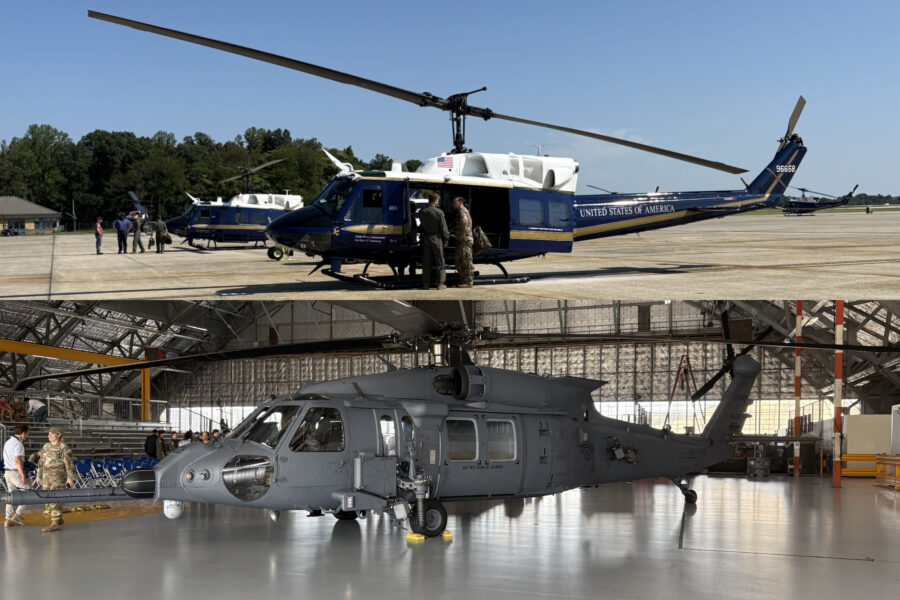
JOINT BASE ANDREWS, Md.—The iconic “whup-whup-whup” of the 1st Helicopter Squadron’s UH-1N Hueys still echoes in the skies of the Washington D.C. area, as the choppers flit around the U.S. Capitol, the Pentagon, and elsewhere, carrying senior government officials or training for contingency response.
But on Aug. 27, a new helicopter that first flew half a century after the Huey sat beside the stage for the activation of a squadron that’s a full 57 years younger than the 1st. It was the beginning of the end for the UH-1N—though there is still much to do before the true finale, officials say.
The new 5th Helicopter Squadron, commanded by Lt. Col. Jonathan Bonilla, will take the lead in transitioning the 316th Wing from the Huey to the new HH-60W Jolly Green II, or “Whiskey” as it is commonly called. Earlier this month, the Air Force confirmed Andrews as its “preferred location” to host 26 of the HH-60Ws, combat rescue helicopters that will be modified for the executive airlift mission. During the activation ceremony, Bonilla called it “one of the most significant rotary wing transitions our Air Force has undertaken.”
The mission at Andrews is more than just ferrying VIPs to and from the Pentagon. It’s about being prepared to respond in a crisis to carry leaders and ensure continuity of government operations. Crews are always on alert at a facility just steps away from the flightline at Andrews, prepared to spring into action if the call comes. During the 9/11 terrorist attacks 25 years ago, UH-1Ns were in the air before the Pentagon was struck and provided aid and medical evacuations.
The 24/7 nature of this mission means the 1st Helicopter Squadron can’t just retire its UH-1Ns and then make the preparations to transition to the HH-60W, like most units do when they’re getting a new aircraft. That’s where the 5th Helicopter Squadron comes in.
“As they activate, all of their aircrew members that are currently flying the Huey will begin the transition to the HH-60 Whiskey first,” explained Lt. Col. Kristopher Schmautz, director of operations for the 1st. “And as they convert those aircrews, the 1st will hold down the mission that we are here [to do] as they are getting up to being able to take part of the mission. And then it’ll be a slow transition working with the 5th Helicopter Squadron leadership to transfer some different pieces of our mission, so that we can then convert the members of the 1st Helicopter Squadron to the new HH-60 Whiskey.”
A new squadron will mean about 60 additional personnel at Andrews, but for now, the 5th is a small team, mostly coming from the 1st and with a deep attachment to the UH-1N.
“For about a decade, this is the only aircraft that I’ve known and operated,” Master Sgt. John Griggs, senior enlisted leader of the 5th Helicopter Squadron, said. “So it’s a little bittersweet to to move from something I have such a tenure with, and such a legacy across all the conflicts. … It’s very humbling to be able to see what this helicopter has done for the Air Force, and to be a part of transitioning to a newer airframe, to uphold the same mission.”
Iconic but Old
The Huey gained iconic status during the Vietnam War, and it’s been at Andrews almost as long, with the first helicopter arriving in 1971. Indeed, Schmautz said the 1st Helicopter Squadron has traced the maintenance records on three of its 26 Hueys directly back to Vietnam.
Over the years, the Huey has received some updates. But the Air Force never changed the helicopter’s distinctive two rotor blades—the reason for its famed noise—unlike the Marine Corps’ upgraded four-blade UH-1Y Venom.
The interior also remains remains largely old-school: lots of analog cockpit instruments, exposed wires, and a relatively spartan seating area. The Air Force says the cabin can be modified to accommodate up to 13 people, but on an Aug. 24 media flight, just a few TV reporters with bulky cameras had to squeeze in “like a clown car,” one of the pilots on the flight observed.
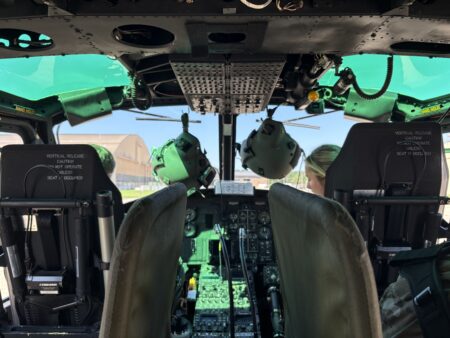
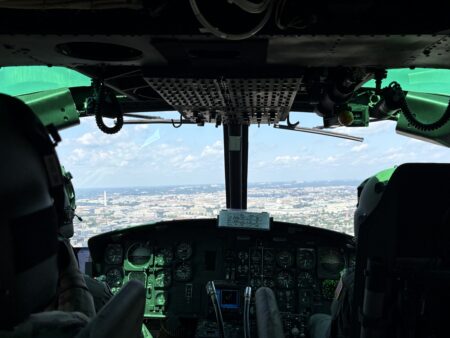
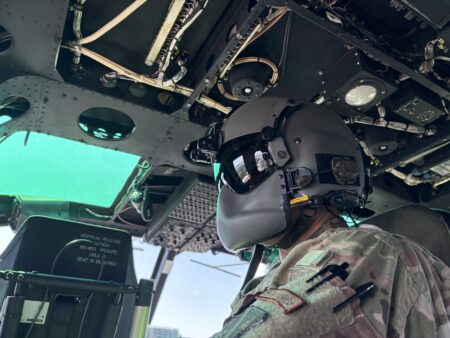
Despite a recent rash of precautionary landings in the past two months, Griggs, a flight engineer, says the Hueys are “as safe as they’ve ever been,” and the Air Force’s statistics show major mishaps on the decline over the past decade.
Many of the flights are training for the contingency mission, or learning how to navigate the notoriously complex airspace of Washington. On Aug. 24, the radio rarely stops buzzing with chatter during a brief 30-minute jaunt around the city—a trip that would take hours in typical D.C. traffic.
Nevertheless, the Huey’s age is undeniable. Like many of the Air Force’s older fleets, spare parts are hard to come by as manufacturers either disappear or stop making them. In turn, the fleet’s mission capable rate slipped below 75 percent in 2024, the most recent year of public data. That’s still far higher than many other aircraft, but the first time it’s been below that benchmark in at least a decade.
The time has come for something new, Griggs said. But in the immediate future, the Huey isn’t going anywhere. The HH-60W at the 5th’s activation ceremony isn’t staying at Andrews—it actually belongs to the New York Air National Guard.
The first HH-60Ws actually modified for the Andrews mission will arrive “soon,” a wing spokesperson said, but they could offer no more specific timeline. In the medium term, the goal is to achieve initial operational capability on the HH-60W by 2029 and full operational capability by 2030. So for the next four years at least, the Huey will keep flying.

| Contractor | Bell Helicopter |
| First flight | April 1969 |
| Rotor diameter | 48 ft |
| Length | 57.1 ft |
| Height | 12.8 ft |
| Max gross weight | 10,500 lb |
| Top speed | 149 mph |
| Range | 300+ miles |
| Ceiling | 15,000 ft |
| Load | 6-13 troops or 6 litters |

| Contractor | Boeing (prime); Leonardo (airframe) |
| First flight | 2019 |
| Rotor diameter | 45.2 ft |
| Length | 54.7 ft |
| Height | 16.3 ft |
| Max gross weight | 14,110 lb |
| Top speed | 167 mph |
| Range | 890 miles |
| Ceiling | 20,000 ft |
| Load | 15 passengers or 4 litters + 5 medical |
A New Aircraft
The HH-60W, originally designed for combat search and rescue, offers a few obvious advantages over the UH-1N—it can fly faster, farther, and be refueled in the air. It has a larger cabin, accommodating more people or cargo.
There are other advantages that are harder to see. Schmautz likened the glass cockpit’s upgraded displays to a Tesla car compared to the Huey’s stick-shift transmission. The Whiskey also has a more advanced version of the ADS-B technology aircraft use to broadcast their location to other aircraft and controllers—while the UH-1N sends an ADS-B signal out, it does not have the ability to receive it. The HH-60W can do both. Officials noted that the UH-1N has other systems for situational awareness, but ADS-B is considered the standard.
Lt. Col. James Gray, director of operations for the 5th, said the HH-60W “actually takes some of the load off of the pilot and the crew at times because it’s just a newer airframe.”
Some features of the HH-60W needed for combat rescue, like its externally mounted guns, won’t be needed for the mission at Andrews. But at the activation ceremony, 316th Operations Group Col. Kevin Geoffroy made the case that the combat search and rescue community that uses the HH-60W now has more in common with the units at Andrews than it appears at first glance.
“We both hold quiet, constant vigils, persistently rehearsing our mission and waiting to respond with exceptional speed and skill when our nation calls,” he said.
A New Unit
The idea to put replace the Hueys at Andrews is not new—for several years, the Air Force planned to use the MH-139 Grey Wolf, a modified commercial helicopter, for the job. Budgetary and programmatic developments led the service to abandon those plans last July and pivot to the HH-60W, using backup inventory.
The idea to activate a new squadron was similarly bandied about for a while, Geoffroy said. But it wasn’t until this June that he and wing leadership pitched the idea to Air Force District of Washington leadership. It moved with unusual rapidity through the Pentagon bureaucracy, and now the 5th must figure out how to manage the delicate conversion process.
Gray said one of his first orders of business is figuring out how to get Airmen qualified on the new helicopter.
“I’m very, very eager to figure out how we start to convert the aircrew. There’s a ton of unknowns still, but I have to build a plan that we can at least start to deviate from. So I’m very much wanting to get down in the weeds, know the aircrew and who we’re going to start moving over,” Gray said. “So that’s my focus from an operational standpoint.”
Members of the 5th will initially fly the UH-1N before becoming dual-qualified on the HH-60W. A handful of crew at Andrews already have experience on both the HH-60 and UH-1, Schmautz among them, but there are many who will need to learn the new system or come in from other bases.
Then there are broader questions about how the new 5th Helicopter Squadron and the HH-60W fleet at Andrews will fit within the broader Air Force. The service is in the midst of reevaluating how it does combat search and rescue, a process that got a bit of extra scrutiny with the dramatic rescue of an F-15E crew in Iran this spring.
The HH-60s going to Andrews are coming from backup inventory, not the operational fleet, and officials took pains at the 5th’s activation ceremony to stress that they want to help the combat rescue team, not be a drain.
“We will work tirelessly to be a value-added addition to your team,” Geoffroy said. “We will welcome the aviators who require a break from the heavy burdens of deployment, and in turn, we will prepare our aircrews to become absolute experts in the Jolly Green II.”
