



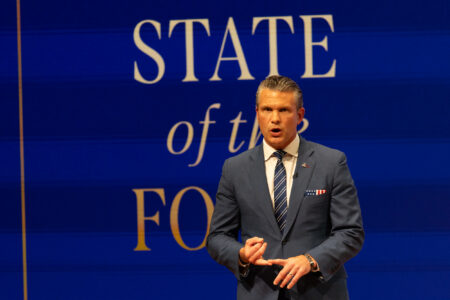
MARINE CORPS BASE QUANTICO, Va.—Secretary of Defense Pete Hegseth announced plans for a new four-star command to lead the military-wide drive to field autonomous systems, as the Pentagon’s takes a bullish approach towards artificial intelligence and drone warfare. He also unveiled five other initiatives during what he promised will become an annual “State of the Force” address here Sept. 30.
Hegseth plans to launch the Autonomous Warfare Command within a year as a combatant command endowed with “service-like authorities, built to scale autonomous and robotic capabilities across the joint force,” he said. Its portfolio will include drones, artificial intelligence, and command and control systems.
Hegseth also announced the creation of a new program office, led by a two-star officer, to ensure military installations can generate their own power to isolate themselves from attacks on public grids. Bases in the homeland are increasingly seen as possibly contested environments where the U.S. military must be able to operate while under threat in a age of increasingly sophisticated cyberattacks and so-called hybrid warfare activities by America’s adversaries.
And he confirmed plans to slash the total number of generals and admirals across the military by 20 percent, a move Air & Space Forces Magazine and other outlets had reported would be part of Hegseth’s speech.
Other initiatives include:
- A new group, dubbed “Project Meridian,” to study the future of warfare led by tech leaders Palmer Luckey and Elon Musk and former Speaker of the House Newt Gingrich, who were in attendance.
- An initiative, called the “Next Great American Base,” to build a new military installation to host 15,000-25,000 service members. Hegseth said governors and adjutant generals from every state will be invited to the Pentagon to pitch locations.
- The creation of five new corps of cadets at Hillsdale College, Louisiana State University, Liberty University, Mississippi State University, and Tuskegee University, which will all be given priority in officer commissioning.
- A new “Office of Religious Affairs” reporting directly to the Secretary of Defense to give chaplains better access to senior leadership.
Exactly one year after Hegseth summoned hundreds of senior officers and enlisted from commands across the globe to Quantico for an address outlining his vision for the U.S. military, he spoke this time to an audience of around 600 E-6 enlisted members and O-3 officers, who the Pentagon said were selected by their units for their performance and leadership potential.
Chairman of the Joint Chiefs of Staff Air Force Gen. Dan Caine briefly addressed the crowd and introduced Hegseth.
Autonomy
The new Autonomous Warfare Command will drive the design, development, and fielding of autonomous and semi-autonomous capabilities and systems.
“The autonomous and robotic revolution has enormous implications for equipment, doctrine, organization, and the assumptions that have governed warfare for decades,” Hegseth said. “Civilian leaders can provide direction and urgency, but lasting change must be anchored in military command structures and operationalized by leaders across our joint force.”
The Pentagon is already leaning heavily into autonomy, and the new command is designed to significantly accelerate that effort. Lawmakers in the Senate had proposed the creation of such a combatant command during deliberations for the 2027 defense policy bill. The measure cleared the committee, but the bill is still pending. To be authorized, the House would also have to approve the measure.
It is not yet clear how the new four-star command will be structured, who will lead it, or how it will work with the autonomy efforts already underway within the different services. In a memo, Hegseth wrote the Pentagon plans to work with Congress to stand up the command by October 1, 2027, a year on from the announcement.
Hegseth said it will start with an interim step, dubbed “Project Agincourt,” named for the Battle of Agincourt in 1415. Project Agincourt will draw from existing efforts like the Defense Innovation Unit and the Drone Dominance program, Hegseth said, and pair “operators with entrepreneurs in rapid adaptation cycles while distributing decisions and dollars closer to frontline units.”
Project Agincourt will be guided by DIU director Owen West and Navy SEAL Senior Chief Max Strasiser, the first enlisted SEAL to graduate from Navy Test Pilot School. Creating Autonomous Warfare Command will take place “over the course of several months,” Hegseth said.
The Air Force and Navy are already developing Collaborative Combat Aircraft: semi-autonomous drones designed to work alongside crewed fighters. The Air Force is also pursuing a lower-cost intelligence, surveillance, and reconnaissance drone with autonomous capabilities under its Massed Modular Aircraft program, and the Navy is working to field an unmanned tanker drone, the MQ-25.
The growth of autonomomy and the Penatagon’s future plans to harvest technology with its new command represent the “fastest peacetime shift in modern military history,” Hegseth said.
“Drone warfare supercharged by SI-enabled targeting is the biggest battlefield revolution in generations,” he added, using an acronym for so-called super intelligence, President Donald Trump’s favored term for AI.
At AFA’s Air, Space & Cyber conference earlier this month, Air Force leadership made it clear they see autonomous systems as central to the service’s future. Air Force Chief of Staff Gen. Ken Wilsbach told Air & Space Forces Magazine at the conference that while true autonomous aircraft are a “few years off,” the service is leaning heavily into autonomy in its current future Force Design model.
“The FQ-42 and the FQ-44 [Collaborative Combat Aircraft] are autonomous fighters, and then we’re going to have perhaps other platforms that are autonomous, where you don’t actually need a crew to do a fighter mission,” Wilsbach said during a session with reporters. “You just send the aircraft off, and it does its mission because it’s automated.”
The Pentagon has deployed uncrewed surface vessels operationally in the Middle East for a few years for maritime surveillance. This summer, a U.S. Navy drone boat was even able to rescue two downed Army Apache pilots near the Strait of Hormuz. U.S. Southern Command, which has been conducting strikes on boats suspected of smuggling drugs for over a year, recently established an autonomous warfare branch that will employ its own uncrewed vessels and aerial intelligence-gathering platforms. On the southern border, the U.S. military is now using 10 uncrewed surface vessels to patrol the Rio Grande River, Assistant Secretary of Defense for Homeland Defense and Americas Security Affairs M. Roosevelt Ditlevson told Air & Space Forces Magazine in a recent interview.
“We’re moving into next-generation tools here that we’re going to employ to make sure that we hold these narcoterrorists at bay,” Ditlevson said, referring to drug smugglers. “I’m very excited about what is going to happen in the autonomy space and how we’re going to employ these different systems.”
But the Pentagon is automating more than aircraft, ships, and vehicles.
The Pentagon’s Maven Smart System has become a key tool for the U.S. military, a system aggregating sensors, intelligence, surveillance, and reconnaissance, and command and control as part of the targeting process. Maven is used for operations ranging from targeting assistance in the Middle East to, more recently, counter-drone and anti-smuggling efforts on the southern border.
Ditlevson said AI, through Maven, will also feed into the Pentagon’s sweeping Golden Dome missile defense shield. “Maven Smart System is going to feed into the Golden Dome picture,” he said.
At the border, the Defense Department also uses autonomy software called Fortress, an adaptation of Anduril’s Lattice, which integrates data and sensors using AI. “All of our systems must be compatible with Maven Smart System,” Ditlevson said. “Everything that we have, that data needs to be integrated into Maven and into Lattice.”
To support all these new autonomous systems, Hegseth said, each military service will phase in new military occupational specialties for autonomy.
“We need institutional knowledge and career paths for a new generation of autonomous warfighters,” he said.
Fortress America
Hegseth also said the Pentagon is creating a new initiative called “Fortress America” to ensure military installations are able to generate their own power. The Pentagon has been working on building nuclear microreactors at key U.S. bases in the homeland and has previously said it plans to field a nuclear reactor at a military base by September 2028.
The Air Force in particular is working on a microreactor at Eielson Air Force Base, Alaska, with plans to build more at other bases in the coming years. The service has also explored using alternate power sources like solar panels, geothermal plants, and more to create so-called “microgirds” for bases so they’re not entirely reliant on local civilian power grids.
The drive to give bases their own energy sources is driven by concerns that adversaries may target critical infrastructure, around 80 percent of which is currently in the commercial sector, to kneecap the military’s ability to generate forces. The Pentagon chief referred to the program as “nation’s insurance policy” in a memo directing the establishment of Fortress America.






“If an adversary takes down the grid by cyber attack, by sabotage, or by any means, our bases stay lit, our aircraft keep flying, our command centers never go dark,” Hegseth said.
Hegseth is also slashing the number of general and flag officers, cutting billets by 20 percent. That doubles down on the 10 percent cut to general and flag officers he ordered last year, which he dubbed the “less generals, more GIs” policy.
“The number-crunchers say we fired 10 percent of the generals and admirals across the force, and that number sounds about right,” Hegseth said. “And I know because I directed it that we’ve also reduced the overall number of general officer slots by an additional 10 percent. So yes, 20 percent reduction across the board.”
Generals and admirals make up less than 1 percent of the military. According to the Congressional Research Service data, there were about 850 general officer positions in 2023. Some of those positions were unfilled at the time, as is the case today.
The maximum number of general officers allowed per service is set by law, though those caps do not apply to joint positions. The law also sets a minimum number of general officers in joint jobs.
The Air Force has roughly 250 generals. The Space Force has roughly 30 generals, and has plans to continue to grow that number.
A year ago, most senior military leaders gave stoic reactions during politically charged speeches from Hegseth and Trump, keeping with the military’s apolitical tradition. The troops at this year’s addres gave Hegseth a more vocal reception, particularly during his reference to Musk, Luckey, and Gingrich, and Hegseth exited to applause from the troops, though service members appeared to avoid visual reactions to Hegseth’s more ideological comments. Attendees were separated by branch, and were given a “War Department Field Manual,” a collection speeches by Hegseth with a forward written by Trump. Earlier in the day, the service members in attendance participated in a physical training session with Hegseth on the grounds of the Pentagon.