


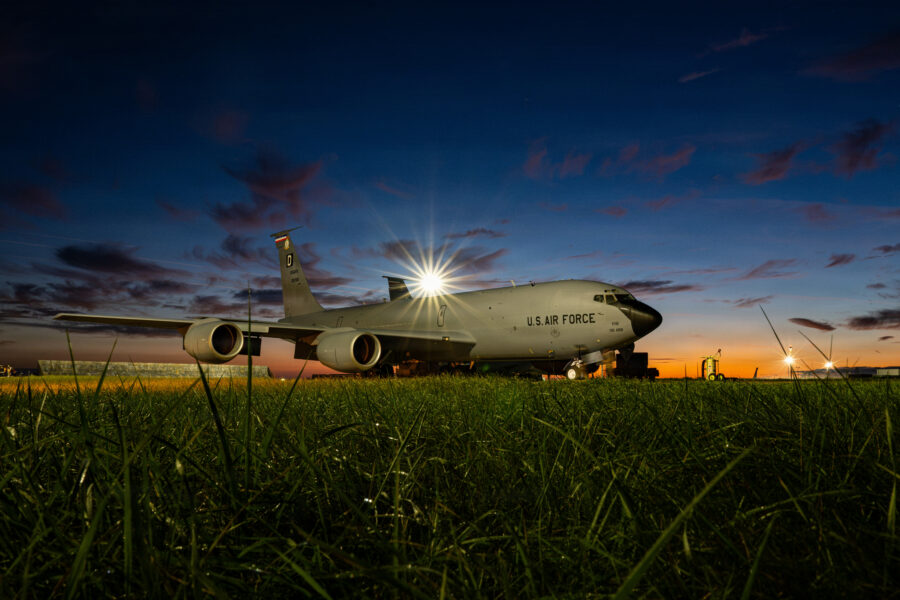
At least two KC-135 Stratotankers that were seriously damaged during Operation Epic Fury are still undergoing extensive maintenance depot repairs, the head of Air Force Materiel Command said Oct. 21.
Six of the Air Force’s six-decade-old refueling tankers received varying degrees of damage in the opening weeks of the war against Iran. One KC-135 was involved in a collision with another Stratotanker over western Iraq on March 12 and lost part of its tail. The other tanker in that collision was completely destroyed, killing all six Airmen aboard. Another five KC-135s were hit during an Iranian missile strike on Prince Sultan Air Base, Saudi Arabia.
During an event with the Mitchell Institute for Aerospace Studies, AFMC boss Lt. Gen. Linda Hurry said her command sent an aircraft battle damage repair team to the Middle East to make temporary repairs to some KC-135s and “get them back into the fight,” Hurry said. Others were patched up enough to fly back to depots in the U.S., she said. She did not specify how many planes fell into each category.
Photographs emerged online showing one KC-135 flying with a transplanted tail, and others landing in the United Kingdom with patches covering the fragmentation damage that peppered their skins.
At least two Stratotankers “received much more significant damage” and are still in depot, Hurry said. She applauded the work the repair team did on these planes to get them airworthy enough to get back to the U.S.
“One had many, many, many holes in the side,” Hurry said. The repair team was “able to patch it up and get the authority to have it [make] a one-time flight back to the depot. It was just phenomenal that they were able to actually save that aircraft. Now they’re rebuilding it.”
Air Force Chief of Staff Gen. Kenneth Wilsbach told lawmakers in June that all of those salvageable KC-135s would eventually return to service, although the most heavily damaged could take a year or two to be completely fixed.
Tinker Air Force Base, Okla., serves as the main KC-135 depot.
Depot Hiring
In addition to Tinker, the Air Force has depots at Warner-Robins Air Force Base, Ga., and Hill Air Force Base, Utah. Officials have called them “national treasures” for their work in repairing critical assets, but there have been concerns about manning and funding for years now.
AFMC as a whole is seeing widespread manpower shortages, Hurry said, with about 8,200 billets—including maintainers, engineers and contracting professionals—currently vacant. The Air Force Sustainment Center, which is part of AFMC and oversees those depots, specifically has a shortage of 2,600 billets, she said.
In response, AFMC is looking to hire depot artisans—the most highly-skilled civilian mechanics, technicians, and engineers—and other maintainers to keep the depots fully staffed, Hurry said.
The command is trying to do more targeted and streamlined hiring to fill the gaps, including by hosting hiring events where they can extend temporary job offers “right there on the spot,” and getting new hires on the job faster, she said.
AFMC is also looking at offering retention benefits and targeted incentives to hold on to vital employees with critical skill sets, “to make sure we’ve got the right artisans to care for some of these airframes that are older than probably most of us on the line,” Hurry said.
But sometimes, Hurry said, the Air Force doesn’t have to wait for a plane to get to one of its three main depots to do some of that necessary work. Airmen have proposed ideas for “a speed line” to push maintainers forward to the field and get the work done on-site, she said.
That would not just help keep planes flying, Hurry said, but also could help with morale and retention.
“They can see what they’re doing would have a direct impact to [U.S. Central Command] operations or operations around the globe,” Hurry said. “It really, really makes a difference. The sense of pride, the sense of purpose, the sense of commitment to our mission has really helped some of our retention.”
When a plane like a KC-135 goes through the depot process, Hurry said, maintainers routinely tear it “down to its ribs to build it back up again, to send it back out to the fight.”
“It is amazing how far we break down the aircraft to build it back up again as part of the routine depot maintenance cycle,” Hurry said.