


For years, U.S. and South Korean officials have said they want to reach an arrangement where, should war break out on the peninsula, Seoul’s military commanders would have operational control of American forces there.
Such a setup would be unprecedented in modern times, and what it would mean for U.S. Airmen, Guardians, and other troops remains to be seen. But recent comments from U.S. and Korean leaders underscore just how complex and even controversial the idea remains.
Since World War II, the U.S. has been the ultimate authority for all its combined forces’ wartime operations. But South Korea—officially called the Republic of Korea—has been pressing to finalize the transfer of wartime operational control, or OPCON. Since taking office last year, President Lee Jae Myung has publicly stated his goal is to reach OPCON before his term ends in 2030, and likely earlier.
But the commander of U.S. Forces Korea, Army Gen. Xavier T. Brunson, sounded far more cautious at a Center for Strategic and International Studies summit on Oct. 14. Evolving security concerns, such as recent ballistic missile launches, have created “new standards” that must be met before OPCON can be transferred, Brunson said.
Brunson said the transfer must be “conditions-based” and not follow a political timeline.
His comments spurred immediate backlash from Korean officials, including Defense Minister Kan Shin-chul and National Security Advisor Wi Sung-lac, who claim that Brunson’s remarks about new conditions amount to shifting the goalposts and will make the planned transfer impossible.
On Oct. 29, Sung-lac said during a parliamentary audit that the government had been consulting with Washington to complete the transfer by or before 2030. But a planned Security Consultative Meeting scheduled for December in Washington to discuss various alliance and security concerns has been postponed to next year.
A U.S. Pacific Command spokesperson declined to respond to specific questions regarding the conditions required for transfer but did provide a statement to Air & Space Forces Magazine.
“The transition of wartime operational control (OPCON) remains a conditions-based process mutually agreed upon by the United States and the Republic of Korea,” Navy Lt. Cmdr. Chloe Morgan wrote. “Both nations remain committed to ensuring that the necessary conditions are met before any transition occurs. We will not prejudge decisions or outcomes of this bilateral process.”
While the OPCON process continues and Korean leaders push to move forward, not all American experts agree that it’s a good idea. During an Oct. 27 symposium hosted by the Institute for Korean-American Studies, former USFK commanders Walter Sharp and Paul LaCamera, both Army four-stars, critiqued the weakening of the U.S.-Korea alliance, the Korea JoongAng Daily reported.
“That whole combined nature goes away and … [I] really do see it as a doorway to greatly reducing the alliance, greatly reducing our work with Korea,” Sharp said.
LaCamera was even more pointed.
“It will be suboptimal when the fighting starts, and then we will quickly get to optimization because it is adapt or perish,” he said.
As the debate continues, South Korea is leading combined missions during a two-week, biannual, air-focused Freedom Flag exercise.
The top ROK air commander, Col. Lee Seung-hwan, emphasized his airmen’s role and its ultimate goal.
“While using this as an opportunity to build teamwork among South Korean and U.S. pilots and polish combat skills, we will also cultivate capabilities in preparation for the OPCON transfer,” Seung-hwan said.
To Transfer or Not
The idea behind transferring OPCON to South Korea dates back to the 1980s when President Roh Tae-woo made it a campaign promise in 1987, driven by a desire to strengthen South Korean sovereignty. The United States didn’t transfer peacetime control to Seoul until 1994. Wartime control was expected to soon follow but was derailed during the 1993-1994 North Korean nuclear crisis.
The South Korean push renewed under President Roh Moo-hyun in 2003. Then-U.S. Secretary of Defense Donald Rumsfeld championed the idea, calling it “pushing on an open door” to free up U.S. forces on the peninsula and give the Pentagon more strategic flexibility.
The pair formalized an agreement in 2006 to begin the wartime OPCON transfer.
But getting to the point where the transfer makes sense for both sides isn’t so simple, multiple retired commanders with deep experience on the peninsula told Air & Space Forces Magazine.
“Conditions should determine the timeline,” retired U.S. Army Special Forces Col. David S. Maxwell told Air & Space Forces Magazine. “The timeline should never determine the conditions.”
Maxwell explained that target dates help drive budgets, procurement, training, and accountability, but can’t substitute for demonstrated combat capability.
“If political leaders want to accelerate transition, they must accelerate the fielding of equipment, development of personnel, and combined exercises required to meet the agreed conditions,” Maxwell said. “Political authority cannot manufacture readiness.”
Retired Lt. Gen. David Deptula, Dean of the Mitchell Institute for Aerospace Studies, also emphasized the importance of not rushing the transfer.
“My principal concern would be any arrangement that sacrifices combat effectiveness to satisfy an arbitrary political timeline or the symbolism of transferring command,” Deptula said. “We cannot afford to discover deficiencies in command and control after a conflict begins.”
Still, Maxwell, now vice president of the Center for Asia Pacific Strategy, said changing conditions “cannot become an unexplained justification for indefinite delay.”
“Both allies must identify what has changed, which operational requirements it affects, and what capabilities will close the resulting gaps. We should distinguish the agreed conditions from the evolving military capabilities required to satisfy them,” Maxwell said. “The objective is a successful transition that strengthens deterrence and combined defense. Most importantly, political leaders cannot base decisions on threat assessments from five, 10, or 20 years ago.”
Maxwell and Deptula highlight several critical conditions before OPCON transfer should go through:
- South Korea should demonstrate the capability to lead a combined defense and coordinate offensive actions at scale.
- There should be comprehensive alliance capabilities to respond to North Korean nuclear and missile threats.
- A stable security environment
- Integrated architecture for intelligence, surveillance, reconnaissance, and early warning for near-real-time actionable data
- Integrated air and missile defenses across U.S. and ROK forces
- Secure, resilient command and control in the face of cyber and electronic attacks.
- Sufficient munitions, logistics, infrastructure protection, and sustainment capabilities.
- Certified initial operational capability, full operational capability, and full mission capability assessment results for readiness.
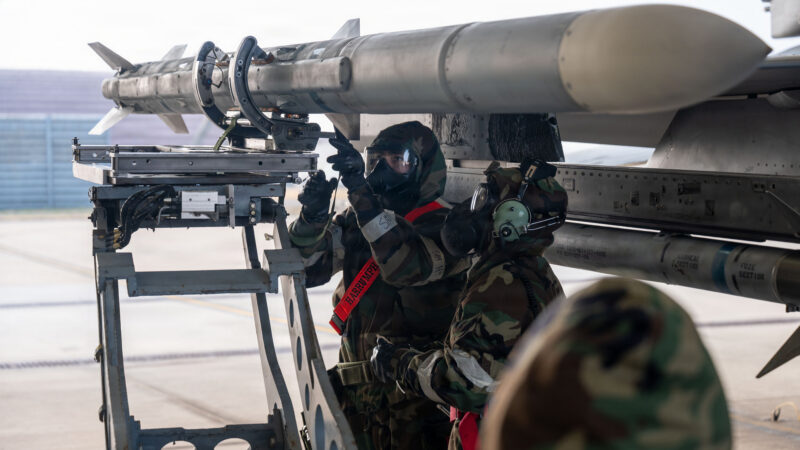
While wartime control of the entire combined U.S.-ROK force is in question, more complex considerations apply to the use of the 7th Air Force, USFK’s air component based at Kunsan and Osan Air Bases in South Korea.
The Air Side
If conflict were to break out today, U.S. and ROK forces would be controlled by a Combined Forces Command that has existed since 1978. The commander of U.S. Forces Korea is dual-hatted as the head of the CFC and has a Korean deputy.
Once the OPCON transfer occurs, that arrangement would flip: a South Korean four-star commander with a U.S. four-star deputy. But even with that combined arrangement, the Pentagon doesn’t cede control of its forces entirely, and it does not give the Korean commander authority over U.S. aircraft in the Pacific.
Retired Lt. Gen. Jeffrey A. Remington, who commanded the 7th Air Force from 2008 to 2012, explained that under the new arrangement, the 7th Air Force commander would still oversee the air component for the Korean general in charge, informing the general on the status of air forces, personnel, and wartime options.
“[The 7th Air Force commander] would continue to be the air component commander, not a Korean, … a U.S. Air Force three-star general,” Remington said.
The commander would then come to the Korean four-star and say, ““Here’s the options, here’s what I can do for you. Here’s the implications of those options,’ and we’ll come to an agreement,” he said.
Even in that arrangement, Remington said Washington likely wouldn’t be involved directly in any major decision involving U.S. forces, especially major airpower assets.
Deptula stressed that in hammering out the details of this arrangement, “the issue is not whether a South Korean general is capable of commanding American airpower. It’s whether the command structure provides the authority, experience, capabilities, and operational flexibility necessary to employ airpower effectively.”
The ROK military is highly professional and capable and a solid U.S. ally in the region, Deptula added. But such a transfer requires more.
“Commanding a modern, integrated air campaign involving hundreds of aircraft, sophisticated intelligence and surveillance capabilities, electronic warfare, space-based systems, and long-range strike assets requires far more than flying airplanes or managing individual missions,” Deptula said.
Day-to-day operations running an Air Operations Center and delivering air tasking orders already happen in a combined way through the AOC at Osan Air Base, Deptula said.
“The real issue is creating a master air attack plan,” he said. “That is the mechanism through which an air campaign translates strategic and operational objectives into coordinated tactical actions. It integrates offensive counterair, defensive counterair, strategic attack, interdiction, close air support, intelligence collection, electronic warfare, air refueling, and other capabilities into a coherent campaign.”
While the U.S. has participated in combined forces operations in World War II and with NATO in Bosnia and Herzegovina and Kosovo, it has never been in a combined force operation without being the ultimate authority for wartime OPCON.
Most U.S. operations during the Global War on Terror and since have been in coalitions. Those typically operate with separate militaries covering different areas, such as the British contribution to the invasion of and early stages of the Iraq War, where their forces were concentrated near Basra and controlled the southeastern section of the war effort near Kuwait.
Combined warfare is different.
“Combined warfare means you’re there together. You’re executing together. You’re mixed and making things happen,” Remington said. “Whereas in a coalition it’s not all that combined, especially from a command-and-control perspective.”
In a very technical sense, for U.S. aviators that might mean being controlled through another nation’s airborne early warning or air battle management systems.
That has been somewhat common with NATO combined forces arrangements in past operations and exercises and with South Korea via their ROKAF Master Control and Reporting Centers. Those two MCRCs serve as nerve centers for all air ops on the peninsula and have operated since the mid-1980s, preceded by a Tactical Air Control Center that ran from the early 1980s until the advent of MCRC.
One MCRC, call sign Watchman, is at Osan. The other, call sign Acacia, is at Daegu Air Base and serves as a reserve aerospace operations center.
Beyond the Peninsula
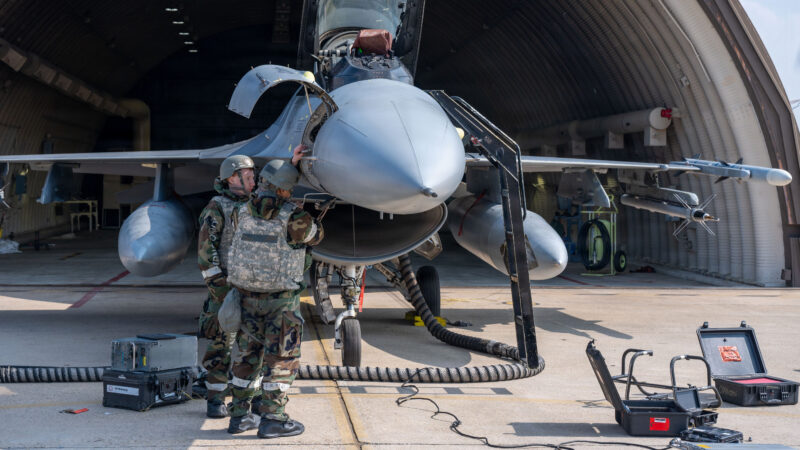
While 7th Air Force is the USFK air component with primary duties to defend South Korea, it also relies on Pacific Air Forces for support and contributes to PACAF’s needs to support U.S. Pacific Command. U.S. Forces Korea are not on a proverbial island, focused solely on local security concerns.
Should a conflict with China or other regional problems erupt, USAF may need to draw upon 7th Air Force.
“The U.S. military is operating with declining force structure and must meet growing global requirements,” Deptula said. “Aircraft, aircrews, munitions, tankers, intelligence platforms, and other assets cannot be committed to two different campaigns simultaneously without accepting significant operational risk.”
That fact means that contingency planning, force allocation, and command relationships take on even more significance when looking to transfer operational control, Deptula said
“Both nations must understand in advance what capabilities are committed, what reinforcements may be available, and under what circumstances U.S. forces might be required elsewhere,” he said.
Any such transfer “must preserve” U.S. commanders’ ability to employ their capabilities where they can achieve the greatest strategic effect, he said.
“Any future defense of South Korea must begin with an appreciation for the fact that air superiority provides the freedom to attack and the freedom from attack,” Deptula said. “It enables all other military operations. The campaign must be designed to achieve the degree of air superiority necessary to permit the joint force to operate effectively, rather than simply contest the airspace.”