


Looking to make a quick start on Defense Secretary Pete Hegseth’s sweeping “FORTRESS America” program to make every military base in the U.S. more self sufficient, the Pentagon is dialing up its efforts in an area the Air Force has been working for several years: energy resilience and independence.
Hegseth unveiled FORTRESS—a long-winded acronym for Federal Operations for Resilience, Troop Resources, Energy, Supply, and Survivability—during his Sept. 30 “State of the Force” speech, and in a subsequent memo outlined five “pillars” of the effort: energy independence; supply chain and defense industrial base resilience; a strategic defense reserve; installation hardening and cyber resilience; and resilience in space and spectrum.
At an Oct. 20 Defense Writers Group roundtable, a senior U.S. defense official said that first pillar is a key early priority.
“That’s absolutely what we’re moving on, is on the energy side of that, comprehensively,” he said, adding: “This is not a wait-and-see kind of a thing. We want to move out pretty quickly to get to that energy [resilience]. Those solutions can include investments in microgrids, battery backup storage.”
Other pillars may take years, the official acknowledged; another of Hegseth’s initiatives, the Next Great American Base project to build a new military base from scratch, will likely act as a “pilot” for ideas to feed into FORTRESS America, he added.
But “first and foremost, it’s doing the assessments of the installations to make sure we understand power generation and where we’re going to go with that, and then getting those deployed,” the official said.
There are already plenty of ideas and projects in the works to address energy resilience—officials have recognized that many bases are reliant on the civilian grid for electricity and water, and adversaries have figured out ways to hack or attack those grids. A ransomware attack shut down the Colonial Pipeline in 2021, causing fuel shortages and panic up and down the East Coast. In 2024, U.S. intelligence agencies warned that Chinese hackers were working to preposition themselves in the cyber networks for critical infrastructure like water and electrical grids. And both the wars in Ukraine and with Iran have featured plenty of attacks on energy infrastructure.
“The attack, as we know it, will not look like an attack,” former Air Force Assistant Secretary for Energy, Installations, and the Environment Ravi Chaudhary told Air & Space Forces Magazine. “It will look like a systematic shutdown of community capabilities. Our adversaries are going to start with making it hard to get on base, and they’ll go for the softest targets they can, which won’t be military. It will be public works.”
Back in 2021, the Department of the Air Force released an Installation Energy Strategic Plan warning of the possibility of extended power disruptions lasting 30 or more days, due to severe weather or cyberattacks. Around that same time, Congress mandated that the Pentagon work to make 99.9 percent of the energy load required for critical missions resilient, and Air Force bases started running Energy Resilience Readiness Exercises—essentially pulling the plug on bases and seeing how units, commanders, and backup systems responded.
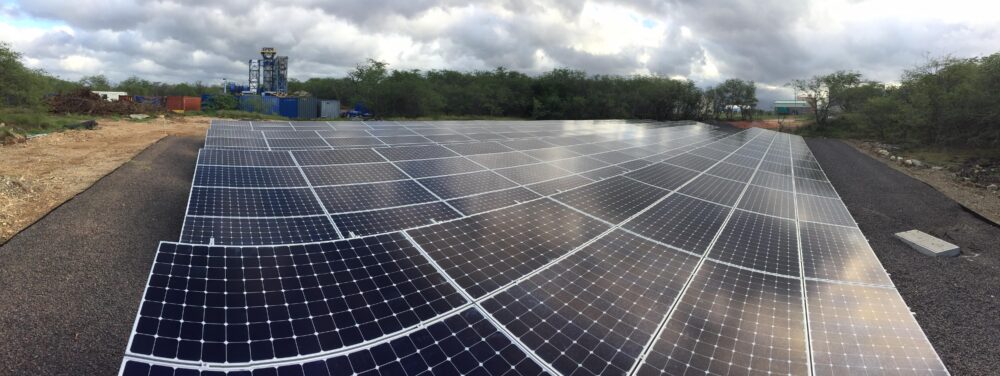
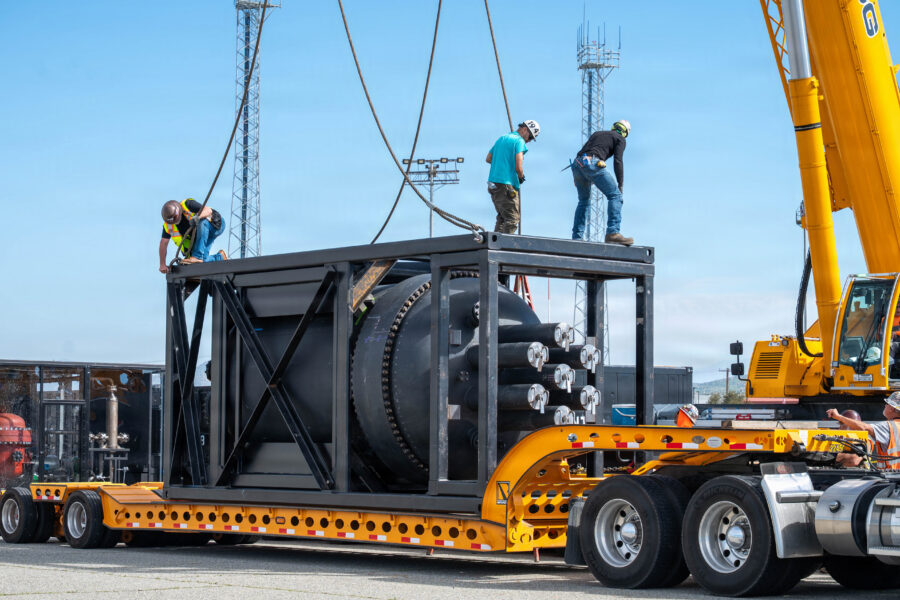
Increasingly, officials started looking at building “microgrids”—power sources outside of the larger civilian energy grid. In 2022, the Air Force started work on a project to build a nuclear microreactor at Eielson Air Force Base, Alaska. Kadena Air Base in Japan deployed a microgrid with generators and solar power in 2023. More nuclear microreactors may be going to Buckley Space Force Base, Colo., and Malmstrom Air Force Base, Mont., under a program with the Defense Innovation Unit.
Chaudhary, who served in the Biden administration, also came aboard in 2023 and helped author the Department of the Air Force’s 2024 Installation Infrastructure Action Plan. Among its action items was a direction to install microgrids at two Space Force bases and 14 Air Force bases by fiscal 2030.
FORTRESS America is wildly more ambitious—Hegseth said in his speech that “every major military installation in America is going to generate its own power, independent of the civilian grid.”
Hegseth did not specify how long that would take or how much money would be devoted to that goal, and the senior U.S. defense official noted Oct. 20 that details are still being worked out as the officials consider the needs of around 500 bases in the continental United States.
“The assessment timeline that we’re in right now is trying to determine what is this going to cost,” the official said.
The assessment isn’t as simple as multiplying the cost of a nuclear microreactor by 500, the official said. Indeed, it could take decades to fully achieve the objective. To move as quickly as possible, the Pentagon aims to used a variety of solutions tailored the the particular needs of each base—including renewable options like geothermal and solar energy, as well as fossil fuels like natural gas, the official said.
Chaudhary agrees with that approach.
“We need to acknowledge this reality that our bases are not a monolith, and they’re vulnerable in different ways, and our adversaries have demonstrated the capability and intent to attack our installations in kinetic and nonkinetic ways,” he said.
While not every base is the same, one that might prove instructive to the entire FORTRESS America effort is Tyndall Air Force Base, Fla. After Hurricane Michael wreaked catastrophic damage on the base in 2018, the Air Force considered walking away completely before deciding to rebuild Tyndall as its “Base of the Future.” That included infrastructure hardened against the worst storms, but also a microgrid, advanced facilities, and more. Chaudhary sees it as a model for many of the elements of FORTRESS America.
“My general thought is that in some way, shape, or form, the Base of the Future of Tyndall is going to be replicated in this new strategy by the Department of War,” he said.
The senior U.S. defense official praised Tyndall’s “very, very thoughtful design work” and seemed to indicate the “Base of the Future” would indeed influence the new program.
“They are incorporating a lot of the things that we ask them: microgrids, smart systems, their ability to to do preventative maintenance by a centralized hub, so they can see across all their facilities and know when things are going to go down,” the official said. “Those are technologies and things that we want to invest into all of our installations, so that we can not only reduce costs, but more importantly, it increases the life of the facility, so that we’re making better investments in the time frame to keep those.”
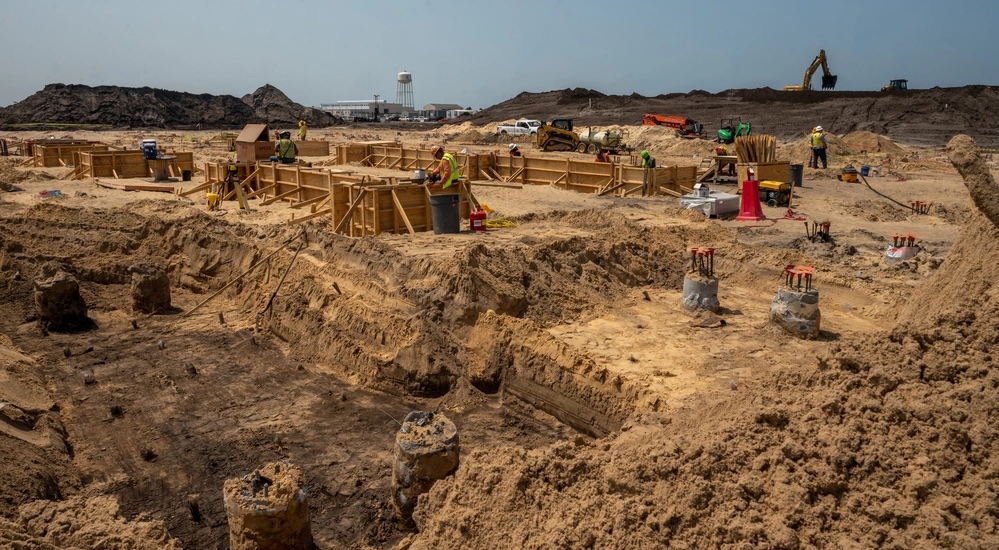
All that work on Tyndall wasn’t cheap though—the Air Force has spent $5 billion or so restoring the base. And while not every base will need to be rebuilt from the wreckage of a hurricane, the cost of FORTRESS America figures to be scores of billions of dollars, if not hundreds of billions.
To bear that cost, both Chaudhary and the senior defense official cited the need for public-private partnerships.
“We’re a capital-intensive country,” Chaudhary said. “How do we leverage that capital to best serve our national security needs? And that really lends itself to public-private partnerships.”
The defense official wondered: “Are there other partnerships, other ways to make these investments that they’re valid and viable … Are there other means by which I can do private investment, other public things? … All of that is what we’re working on right now through the FORTRESS team to get that assessment.”