


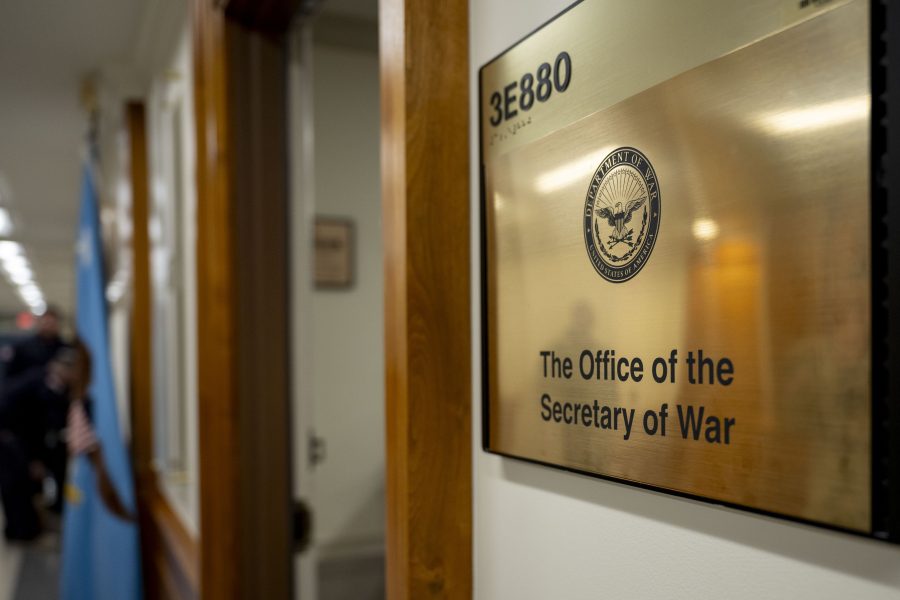
Three of four congressional committees with influence over defense policy have voted to change the official name of the Department of Defense to the Department of War—but final approval of the Pentagon rebrand is months away and not yet assured.
The House Appropriations Committee voted on party lines to amend its version of the 2027 federal spending bill to remove all references to the Department of Defense, the Office of the Secretary of Defense, and other DOD-related entities in U.S. law. The House and Senate Armed Services Committees had previously approved similar measures.
The Pentagon began using the “Department of War” last September, after President Donald Trump issued an executive order allowing it as an authorized alternative name. The order also authorized “Secretary of War” as an acceptable secondary title. But the official name remained the Department of Defense in U.S. law, and only Congress can change that.
Congressional committees have continued to use the official name, as have most news organizations, including Air & Space Forces Magazine.
The Pentagon submitted a legislative proposal asking to Congress to change the name in April, calculating that it would require changing nearly 7,600 references in U.S. law.
While some signage at the Pentagon and on department websites has already changed, the cost of updating buildings and signage on bases around the world remains unclear—but work is underway already. The department projects it will spend $51.5 million on the name change by the end of the current fiscal year, noting that “actual costs are being collected during implementation and will be available after FY 2026 execution is completed.” The Pentagon said the changes are being made in “the most cost effective and noninvasive ways,” and that further costs are not anticipated in fiscal 2027.
The Congressional Budget Office offered a wide cost range in a January estimate, between $10 million and $125 million. That $125 million figure has been cited widely by critics, and the CBO cautioned that its estimate was not for a formal, statutory name change, which it noted would require “updating regulations, directives, doctrine, websites and digital assets, contract templates, and signage.”
“If phased in gradually and limited to OSD, incremental costs could be similar to the range of costs for an unofficial name change,” the CBO report said. “If, however, implementing agencies chose to mandate an immediate change across all materials, costs could reach hundreds of millions of dollars.”
Proponents of the name change argue it better reflects the mission of the department, to fight the nation’s wars, and helps instill the “warrior ethos” championed by Secretary Pete Hegseth. He notes that for much of the history of the nation, the Army was part of the War Department. Critics counter that the change is costly and unnecessary, does not reflect the full scope of the department’s role, and rhetorically deemphasizes the importance of deterring conflict.
The odds of the change being approved are rising. Republicans still control both houses of Congress and with language in both appropriations and authorization bills, there are two chances to get the change across the finish line. Although neither measure is likely to pass before the end of the fiscal year—since 2019, neither measure has made it to the president’s desk before December—history shows that the annual National Defense Authorization bill is the more likely to be completed before this Congress ends.